Online Noorani Qaida classes
Noorani Qaida Online
Live one-on-one Noorani Qaida classes on Zoom, for children from age 4 and adults starting from zero. Every teacher is a Hafiz or Hafiza, and your first three classes are free.
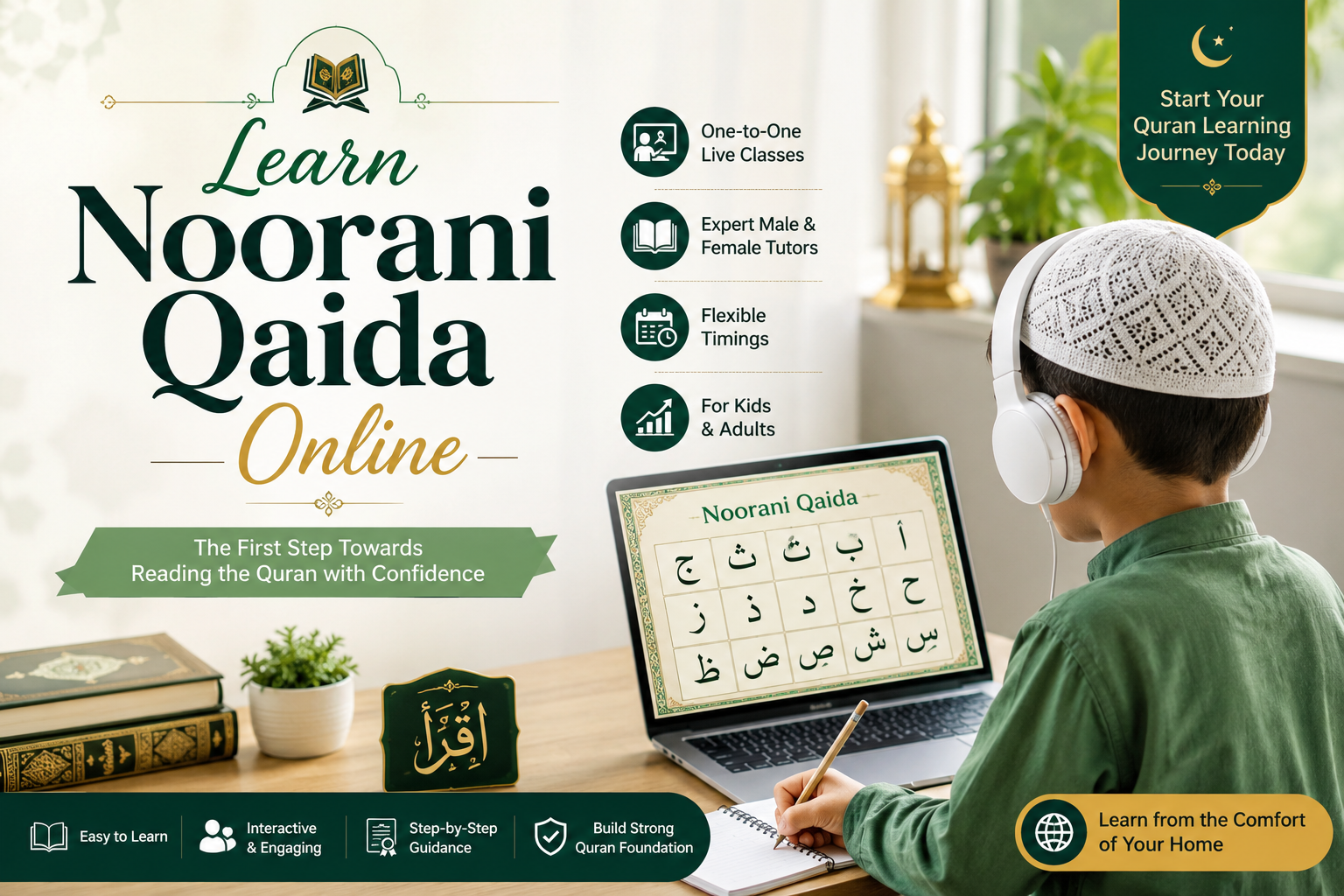
30 minutes a day, Monday to Friday, with the same teacher.
20 classes a month. £30 in the UK, €30 in Europe.
Meet your teacher before you pay anything.
Male and female teachers trained to teach beginners.
Noorani Qaida (Qaida Noorani): What It Is and Why It Comes First
Noorani Qaida is the beginner’s book that teaches you to read Arabic letters correctly before you read the Quran. It covers the shape and sound of each letter, how letters join, the short vowels, and the first rules of correct recitation. Every new reader, child or adult, should finish it before opening the Quran.
Skipping the Qaida is one of the most common mistakes families make. A reader who skips it tends to guess sounds, mixes up letters that look alike, and picks up habits that are hard to undo later. The Qaida trains the eye, the ear and the tongue together. By the time a student finishes it, reading the Quran feels natural instead of forced.
Why Every Beginner Should Start With the Qaida, Kids and Adults
The Qaida matters just as much for a 5-year-old as it does for a 45-year-old reading the Quran for the first time.
For children: young learners pick up sounds faster than adults, but only if they are taught correctly from day one. A child who learns each letter properly keeps that habit for life. A child who is rushed through often mispronounces letters for years because no one corrected them early.
For adults: many adults feel the Qaida is too basic, especially if they already read Urdu. But Quran recitation has its own rules. Tajweed, Makharij and correct vowel sounds do not come from reading Urdu or English. Starting with the Qaida gives adults real confidence instead of worry every time they open the Quran. And Allah has promised that the Quran is made easy to remember (Surah Al-Qamar 54:17).
The Prophet ﷺ said: “The best among you are those who learn the Quran and teach it.” (Sahih al-Bukhari 5027) The Qaida is the first step toward that honor.
Our method
How We Teach Noorani Qaida, Letter by Letter
Our method rests on one rule: a student never moves to the next letter, word or rule until the current one is correct. Not close enough. Correct. Here is what that looks like, stage by stage:
Every Arabic letter by its shape, on its own and in its beginning, middle and end forms.
Where each sound comes from in the mouth or throat, including Ayn ع, Haa ح, Daad ض and Zhaa ظ.
Fatha, Kasra and Damma, and how each one changes a letter's sound.
The doubled and stopped sounds.
The long and soft vowel sounds that beginners are often rushed through.
Putting everything together into real words, then short verses.
Where to pause and how to read the stopping signs printed in the Quran.
Your teacher repeats each stage until the student has it. Progress follows the student, not the page count. Allah tells us to recite the Quran in a measured way (Surah Al-Muzzammil 73:4), and this is where that habit begins.
What a 30-minute class looks like:
- First 5 minutes: the student reads the last lesson back, and the teacher checks it is still correct.
- Next 15 minutes: the new letters, sounds or rule, taught and repeated until they are right.
- Last 10 minutes: the student reads aloud while the teacher corrects each sound, then gets a short practice task for the next day.
One-on-one with a Hafiz or Hafiza, from anywhere in the world. No payment needed to book the trial.
Starting from zero
The Qaida for Students With No Arabic Background
Most of our students, adults especially, start with no Arabic at all. That is normal, and it is exactly who the Qaida is written for. We assume nothing. Every letter, sound and rule is taught from the beginning, in plain words, with as much repetition as the student needs.
Letters beginners mix up most. English and Urdu speakers usually read these pairs as the same sound. We separate them from the first weeks:
A light S and a heavy S.
A light T and a heavy T.
Often all read as Z by Urdu speakers, but each has its own sound.
One from the middle of the throat, one from the deepest part.
Ayn and Hamza, two different throat sounds.
Kaaf from further forward, Qaaf from the back of the tongue.
By the end of the Qaida, a student can:
- Read every Arabic letter in every position of a word
- Say each letter from its correct Makharij
- Read words with short and long vowels, Tanween, Sukoon and Shaddah
- Read short verses slowly, without spelling out each word
- Stop and pause correctly at the common signs
What comes after the Qaida? Once you finish, you move to Quran reading with Tajweed, often called Nazra. The letters are already familiar, the sounds are already trained, and the first Tajweed rules are already in place. Students often tell us this is what surprised them most: how much easier the Quran felt once the Qaida was finished properly.
Qaida Classes for Kids
Our Quran classes for kids are built for short attention spans. Lessons use quick drills, plenty of repetition and steady praise, so a 6- or 8-year-old stays focused for the whole class. Parents are welcome to sit beside their child, and many do in the first few weeks.
Want to help between classes? Our guide on how to teach the Quran to kids at home shows you how. Ten minutes of reading aloud a day works far better than one long session at the weekend.
Qaida Classes for Adults
Our Quran classes for adults move at a different pace. Adults usually want to know why a rule works, not just repeat it, so teachers spend more time on the reasons behind each sound. Classes fit around work and family instead of a school timetable.
The standard is the same for both: a live one-on-one class, mistakes fixed on the spot, and a pace set by the student.
Our Quran Teachers
Every teacher on our team is a Hafiz or Hafiza, trained in Tajweed and in teaching Makharij to beginners. We look for patience, a sharp ear for small mistakes, and the ability to explain one rule three different ways until it clicks.
Before a teacher takes a single class, we check their own recitation and Tajweed, and how they explain a rule to a beginner. Then we watch how they handle the same mistake the third time, because the Qaida is learned through patient repetition.
Female Quran Teachers
Many families ask for a female Quran teacher for their daughters, wives or sisters, and we arrange that from the first class. Our female teachers meet the same standard as our male teachers.
Tell us your preference when you register and we will match you.
Before school, after school or after work. Tell us your time zone and we will match you with a teacher who is free then.
Why Families Choose Our Academy
Islamic Quran Academy is based in Lahore, Pakistan. Since 2020 we have taught Quran reading to students in the USA, UK, Canada, Australia, Europe and the Gulf. Every class is live and one-on-one over Zoom. There are no recorded videos and no group classes where a struggling student can hide.
- Live one-on-one classes: never recorded, never shared with other students.
- Every teacher is a Hafiz or Hafiza: trained to teach beginners.
- 3 free trial classes: see the teaching style before you pay anything.
- Your time zone: choose class times that fit your day.
- Make-up classes: a missed class can be rescheduled.
- Male or female teacher: your choice, from the first class.
- Parents welcome: sit in on any class.
What Parents and Students Say
“I am very happy with Quran Pak Teacher. The teaching method and the resources available on the website are exceptional. My children look forward to every lesson with their teacher and are progressing well Alhamdulillah.” Sara, London, England
“Not having any knowledge of the Arabic language, I was hesitant to try to learn and recite the Quran. I can’t believe the progress I have been making in a few short weeks. The teachers are very encouraging and helped me accomplish so much.” Alhesam, North Carolina, USA
Read more on our reviews page.
Fees
Noorani Qaida Course Fees
The course costs $30 a month in the USA, £30 in the UK and €30 in Europe. Families in other countries can message us for their local price. Each monthly plan includes:
- 20 live one-on-one classes a month
- Monday to Friday, 30 minutes per class
- The same teacher every class
A missed class can be rescheduled. See all monthly plans.
3 easy steps
How to Start
- Message us on WhatsApp or through our contact page. Tell us the learner’s age, your country and the time you prefer.
- Take your three free trial classes with a Hafiz or Hafiza, so you can judge the teacher and the online classroom.
- Choose your plan and start regular classes with the same teacher.
Whether you are a parent looking for the right teacher for your child, or an adult ready to read the Quran correctly for the first time, the Qaida is where it starts.
Contact us on WhatsApp for trial classes in Noorani Qaida
Noorani Qaida Online: Frequently Asked Questions
It is a beginner’s book that teaches Arabic letters, their sounds and how they join. It builds correct pronunciation before you read the Quran.
For beginners, yes. If you already read Arabic letters well, your teacher may move you straight to Quran reading after the trial.
Most children start between ages 4 and 6. We teach children from age 4.
Yes. Many of our students are adults starting from zero, and one-on-one classes let you learn at your own pace.
Most adults finish in 6 to 8 months with five classes a week. Children often take longer.
Arabic letters, Makharij, short and long vowels, Tanween, Sukoon, joined words, and basic stopping rules.
Makharij are the points in the mouth and throat where each letter is made. Saying a letter from the wrong point can change a word’s meaning.
Yes, when they are live and one-on-one. The teacher hears every sound and corrects mistakes straight away.
If You Have Any Questions, Trial Classes & Registration


FEEL FREE TO ASK
We Provide Online Noorani Qaida Classes Worldwide
Our Noorani Qaida classes are fully online, so families join from the USA, the UK, Canada, Australia, Europe and the Gulf. Every class is booked in your own time zone, so a child in London can learn after school and a parent in Toronto can learn after work.
Many children abroad grow up with little Arabic script at home, so we teach them from zero, with the same method we use everywhere. Find your country below.