
Online Quran reading classes
Online Quran Reading with Tajweed
Live one-on-one Zoom classes that take students from Noorani Qaida to reading the whole Quran fluently, with correct Tajweed. Every teacher is a Hafiz or Hafiza, and your first three classes are free.
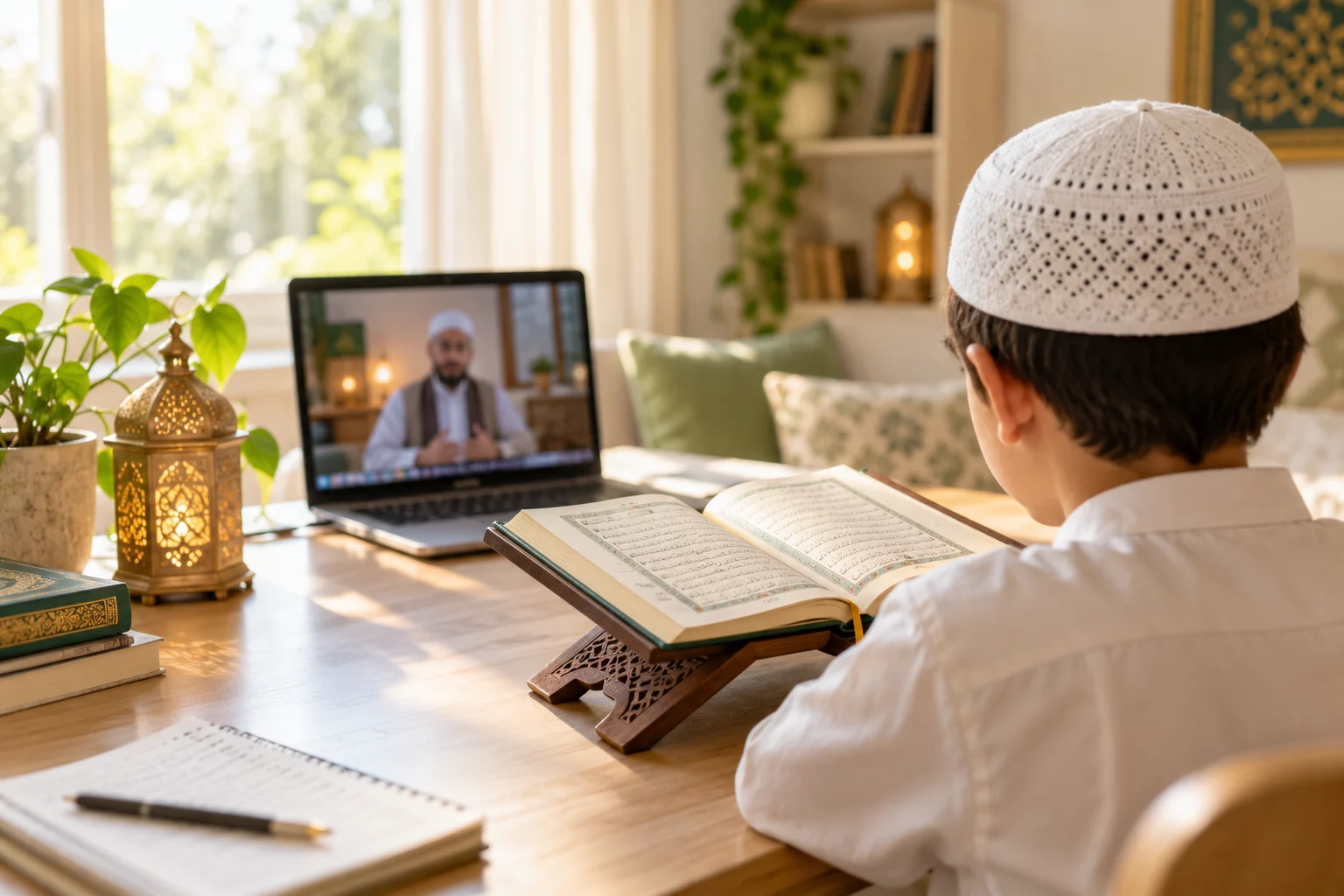
30 minutes a day, Monday to Friday, with the same teacher.
20 classes a month. £30 in the UK, €30 in Europe.
Meet your teacher before you pay anything.
Male and female teachers trained in Tajweed.
What Is Tajweed and Why Does It Matter?
Our online Quran reading course, often called Nazra, teaches students to read the Quran from the page with correct Tajweed. Tajweed is the set of rules for reciting the Quran correctly. The word comes from Arabic and means “to make better.” It teaches you how to pronounce each letter, how long to hold each sound, and where to pause or stop.
The Prophet ﷺ recited the Quran in a specific way, and Tajweed preserves that way. It means a Muslim in London, Lahore or Toronto can recite the Quran the same way it was first recited. Allah tells us to recite the Quran in a measured way (Surah Al-Muzzammil 73:4).
Why Learning Tajweed Is So Important
Tajweed is not only about sounding beautiful. It protects the meaning of Allah’s words.
In Arabic, one changed sound can change a word. Read قَلْب (qalb, heart) with a soft K and it becomes كَلْب (kalb, dog). A small slip in pronunciation can give a verse a meaning it never had.
There is also great reward in learning. The Prophet ﷺ said that the one who is skilled in the Quran will be with the noble, righteous angels, and the one who struggles to recite it gets two rewards (Sahih Muslim 798). So even the beginner who finds it hard is rewarded for every effort.
Already Reading the Quran? Here Is Why You Still Need Tajweed
Many people can read Arabic letters and move through the pages of the Quran. But reading and reciting correctly are not the same thing. You may be shortening a letter that should be long, skipping a pause, or giving a letter the wrong sound without knowing it. These habits are very common for Urdu and English speakers, and they usually go unnoticed until a teacher points them out.
Learning Tajweed when you already read is like polishing something you already own. You do not start from zero. Your teacher listens first, finds your most common mistakes, and fixes them one by one.
Who Our Quran Reading Classes Are For
The course suits two kinds of learners, of any age:
- Students who just finished Noorani Qaida and are ready to read the Quran itself, from Surah Al-Fatiha to the end
- Students who already read but were never taught Tajweed properly
New to Arabic letters? Start with our Noorani Qaida course first. The Qaida teaches the letters and sounds. This course teaches how those letters behave together in the Quran, so the reading becomes correct and fluent.
The Tajweed syllabus
What You Will Learn in Our Quran Reading Lessons
The course moves step by step, so each rule is fully understood before the next one. Every rule is practiced on real verses, so it becomes a habit instead of something you memorize.
Where each letter is made in the mouth and throat, and its qualities, such as heavy or light.
Izhar, Idgham, Iqlab and Ikhfa: four ways to read a silent Noon.
The three Shafawi rules for a silent Meem.
The nasal sound held for about two counts on a doubled Noon or Meem.
The slight bounce on five letters when they are silent.
How long to stretch a vowel, from 2 counts up to 6.
Where to stop, where to pause, and how to read the stopping signs in the Quran.
The four Noon Saakin rules, with examples:
- Izhar (clear): مَنْ آمَنَ, the Noon is said clearly.
- Idgham (merged): مَنْ يَقُولُ, the Noon blends into the next letter.
- Iqlab (changed): مِنْ بَعْدِ, the Noon turns into a Meem sound.
- Ikhfa (hidden): مِنْ قَبْلِ, the Noon is half hidden with a nasal sound.
Mistakes we correct most often:
- Saying Haa ح and Ha ه the same way, or Ayn ع like Hamza ء
- Reading Saad ص like Seen س, or Qaaf ق like Kaaf ك
- Reading Dhaal ذ, Zaay ز and Zhaa ظ all as Z
- Cutting long vowels short, especially in fast reading
- Skipping the Ghunnah on doubled Noon and Meem
- Stopping in the middle of a phrase, or adding a vowel when stopping
Want to know why these rules matter so much? Read why Tajweed is important for every Muslim.
By the end of this course, you will be able to:
- Read any page of the Quran fluently, without spelling words out
- Say each letter from its correct Makharij, including the sounds Urdu and English do not have
- Apply the Noon, Meem, Ghunnah, Qalqalah and Madd rules as you read, without stopping to think
- Stop and start correctly at the signs printed in the Quran
- Recite the Surahs of your daily Salah correctly and with confidence
Your teacher listens to you read, finds your most common mistakes and shows you how classes work. No payment needed to book the trial.
Quran Reading Classes for Kids
Children usually start this course after finishing Noorani Qaida, often around age 5 to 7. Lessons are short, steady and full of encouragement, so a child stays focused for the whole class.
Each child is paired with a teacher who knows how to turn a correction into praise, not frustration. Parents are welcome to sit beside their child and see their progress week by week. See our Quran classes for kids for more.
Quran Reading Classes for Adults
Many adults never learned Tajweed as children, or learned to read without anyone correcting them. It is never too late. Our Quran classes for adults fit around work and family.
Adults often feel shy about making mistakes in front of others. One-on-one classes remove that worry. It is just you and your teacher, at your own pace.
Meet Our Teachers
Every teacher on our team is a Hafiz or Hafiza who has studied Tajweed and Quran pronunciation under qualified teachers before teaching others. A child needs patience and repetition. An adult needs clear reasons and no judgment. Our teachers adjust their style to the student in front of them.
Each teacher is reviewed before joining, and their classes are checked regularly to make sure students are improving, not just attending. In your free trial classes, you meet the actual teacher who will guide you.
Female Teachers for Sisters and Children
Many sisters, and many parents of young girls, prefer a female teacher. We have qualified female teachers who meet the same standard as our male teachers and are especially experienced with children and beginners.
Read more about our female Quran teachers.
How classes work
Our Teaching Process
Every student follows the same six steps, from the first trial class to fluent reading.
Meet your teacher and see how classes work before you pay anything.
Your teacher listens to you read and finds your strengths and most common mistakes.
Lessons are built around what you need to fix first.
Your teacher hears every word and corrects mistakes as they happen.
A missed class can be rescheduled.
Parents and adult students can track how far they have come.
What a 30-minute class looks like:
- First 5 minutes: read back the last lesson, so the teacher can check it is still correct.
- Next 15 minutes: new verses with the day’s Tajweed rule, practiced aloud.
- Last 10 minutes: fluent reading practice, with a short task for the next day.
How Long Does It Take?
Most adults read the whole Quran with Tajweed in about 8 to 12 months, with five classes a week. Children often take longer. Students who read for 10 minutes a day between classes move fastest.
How to practice Tajweed at home:
- Read a little every day. Ten minutes daily works far better than one long session at the weekend.
- Repeat today’s lesson first. Read the verses your teacher corrected before moving to anything new.
- Listen to a good reciter. Follow along in your Mushaf while a well-known Qari recites the same Surah.
- Record yourself. Play it back and listen for long vowels you cut short or a Ghunnah you skipped.
- Ask about the same mistake twice. If a correction keeps coming back, ask your teacher to spend one class on it alone.
After this course, many students go on to Hifz to memorize the Quran, or to Tarjuma and Tafseer to understand it.
Is Learning Tajweed Online as Good as in Person?
For Tajweed, a live one-on-one class is often better than a crowded class. On Zoom your teacher hears every sound clearly and corrects you straight away, instead of waiting for their turn to reach you. You also save travel time, which makes it easier to keep classes going for months.
Before school, after school or after work. Tell us your time zone and we will match you with a teacher who is free then.
Why Families Choose Our Quran Reading Course
- Fair price: $30 a month for 20 classes, which is $1.50 per class.
- Real one-on-one attention: no group classes and no sharing your teacher’s time.
- Your time zone: classes fit around your day.
- 3 free trial classes: you know exactly what you are signing up for.
- Male and female teachers: so every student feels comfortable.
What Our Students Say
“Not having any knowledge of the Arabic language, I was hesitant to try to learn and recite the Quran. I can’t believe the progress I have been making in a few short weeks. The teachers are very encouraging and helped me accomplish so much.” Alhesam, North Carolina, USA
“I wanted to reconnect with the Quran after years away from formal study. The tajweed teacher was patient with every mistake and explained rules clearly. Three months in, my recitation has improved more than I expected.” Aisha M., Cairo, Egypt
Read more on our reviews page.
Fees
Quran Reading Course Fees
The course costs $30 a month in the USA, £30 in the UK and €30 in Europe. Families in other countries can message us for their local price. Each monthly plan includes:
- 20 live one-on-one classes a month
- Monday to Friday, about 30 minutes per class
- The same teacher every class
A missed class can be rescheduled. See all monthly plans.
3 easy steps
How to Start
- Message us on WhatsApp or through our contact page. Tell us the learner’s age, how much they can already read and your country.
- Take your three free trial classes with a Hafiz or Hafiza, so you can judge the teacher and the online classroom.
- Choose your plan and start regular classes with the same teacher.
Reading the Quran correctly is one of the most meaningful things you can do for yourself or your children, and you do not need to leave home to start.
Contact us on WhatsApp for trial classes in Tajweed
Online Quran Reading: Frequently Asked Questions
Nazra means reading the Quran from the page. Tajweed is the set of rules for reading it correctly. This course teaches both together.
Yes, if you are a beginner. If you already read Arabic letters well, your teacher will check your level in the trial and may start you on the Quran directly.
All classes are one-on-one, so the teacher’s full attention is on you.
Yes, qualified female teachers are available for sisters and children.
Classes are held live on Zoom.
Yes. Your teacher finds the mistakes you do not notice and corrects them, without starting you from zero.
Usually around 5 to 7, once Noorani Qaida is complete.
Yes, students from the USA, UK, Canada, Australia, and many other countries join these classes online.


