
Online Islamic studies classes
Online Islamic Studies Classes
Learn Namaz (Salah), Wudu, masnoon duas, the Six Kalimas and Islamic manners in live one-on-one Zoom classes, for kids and adults. Taught alongside your Quran lessons at no extra fee, and your first three classes are free.
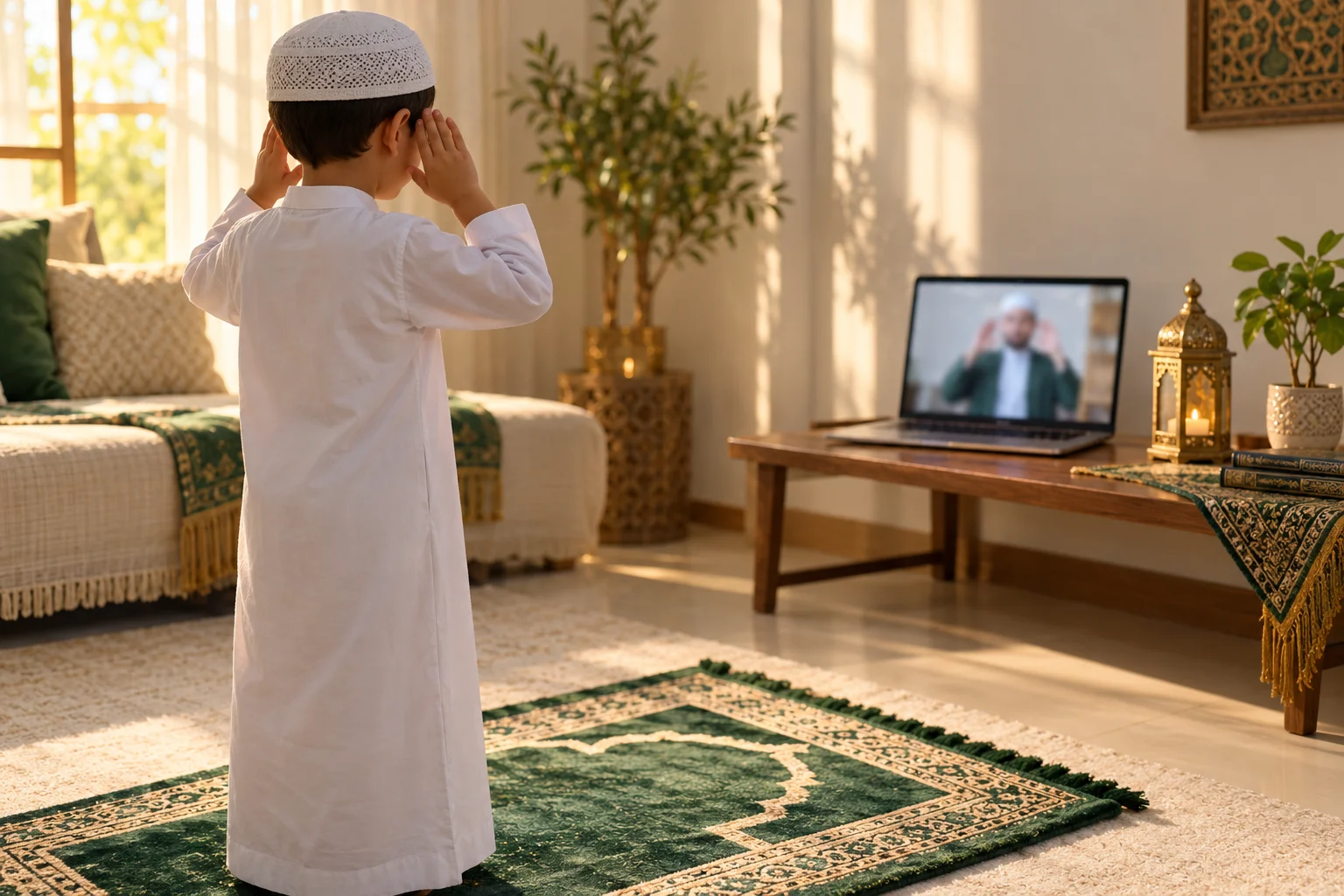
Live lessons on Zoom with the same teacher.
Included with your Quran classes.
Meet your teacher before you pay anything.
Lessons shaped to the learner's age and level.
What Our Online Islamic Studies Classes Cover
Our Islamic studies classes teach the everyday practice of Islam: how to make Wudu, how to pray Namaz (Salah) correctly, the masnoon duas for each part of the day, the Six Kalimas, Islamic manners, and the life of the Prophet ﷺ. Lessons are one-on-one, for children and adults, and are taught alongside your Quran classes at no extra fee.
Reading the Quran is one part of a Muslim’s learning. Praying correctly, knowing what to say when you wake up, eat or travel, and living with good manners are the parts a child uses every single day.
Why Learn Islamic Studies With a Teacher?
Apps and videos can show the steps of Namaz, but they cannot see you pray. A teacher watches each position, listens to each recitation and corrects small mistakes before they become habits. The Prophet ﷺ said: “Pray as you have seen me praying.” (Sahih al-Bukhari 631)
The same is true for duas. Many children learn duas by ear and mispronounce the Arabic for years. In a one-on-one class, the teacher hears every word, explains what it means in Urdu or English, and makes sure the student knows when to say it.
What you learn
Our Islamic Studies Syllabus
Your teacher plans lessons around the learner’s age and level. The syllabus covers six areas:
The steps of Wudu, what breaks it, and basic rules of cleanliness.
Every position and recitation of Salah, with its meaning.
Duas for waking, eating, sleeping, travel and more, with their meanings.
Memorized with correct pronunciation and understood in Urdu or English.
Respect for parents, honesty, greeting with Salam and the Sunnah of daily life.
Stories from the life of the Prophet and the basic rules of daily worship.
Namaz (Salah) is the heart of the course. The Prophet ﷺ told parents to teach their children to pray from the age of seven (Sunan Abi Dawud 495), so younger children start with Wudu, short duas and the Kalimas, and move to the full Namaz step by step. Adults who never learned to pray properly start from the beginning, with no judgment.
Masnoon duas
Daily Duas (Supplications) for Every Part of the Day
The Prophet ﷺ said: “Dua is worship.” (Jami at-Tirmidhi 3372) Our teachers teach the masnoon duas a family uses every day, so they become part of daily life:
- Morning and night: duas on waking up and before sleeping
- Meals: duas before and after eating
- Home: duas for leaving and entering the house
- Masjid and toilet: duas for entering and leaving
- Travel: the dua for riding a vehicle and starting a journey
- After Salah: the short adhkar said after every prayer
For each dua, the student learns the Arabic with correct pronunciation, its meaning in Urdu or English, and when to say it.
Here are six of the first duas our students learn, with the Arabic, an easy pronunciation guide, and the meaning in English and Urdu.
1. Dua Before Sleeping
بِاسْمِكَ اللَّهُمَّ أَمُوتُ وَأَحْيَا
Say: Bismika Allahumma amutu wa ahya
Meaning: In Your name, O Allah, I die and I live.
اے اللہ! تیرے ہی نام کے ساتھ میں مرتا ہوں اور زندہ ہوتا ہوں۔
Source: Sahih al-Bukhari 6324
2. Dua After Waking Up
الْحَمْدُ لِلَّهِ الَّذِي أَحْيَانَا بَعْدَ مَا أَمَاتَنَا وَإِلَيْهِ النُّشُورُ
Say: Alhamdu lillahil-ladhi ahyana ba’da ma amatana wa ilayhin-nushur
Meaning: All praise is for Allah, who gave us life after He had caused us to die, and to Him is the return.
تمام تعریفیں اللہ کے لیے ہیں جس نے ہمیں موت (نیند) کے بعد زندگی دی، اور اسی کی طرف لوٹ کر جانا ہے۔
Source: Sahih al-Bukhari 6324
3. Dua Before Eating
بِسْمِ اللَّهِ
Say: Bismillah. If you forget at the start, say: Bismillahi awwalahu wa akhirahu
Meaning: In the name of Allah. If you forget: In the name of Allah, at its beginning and at its end.
اللہ کے نام سے۔ اگر شروع میں بھول جائیں تو کہیں: اللہ کے نام سے، اس کے شروع میں بھی اور آخر میں بھی۔
Source: Sunan Abi Dawud 3767
4. Dua After Eating
الْحَمْدُ لِلَّهِ الَّذِي أَطْعَمَنِي هَذَا وَرَزَقَنِيهِ مِنْ غَيْرِ حَوْلٍ مِنِّي وَلَا قُوَّةٍ
Say: Alhamdu lillahil-ladhi at’amani hadha wa razaqanihi min ghayri hawlin minni wa la quwwah
Meaning: All praise is for Allah, who fed me this and provided it for me without any power or strength on my part.
تمام تعریفیں اللہ کے لیے ہیں جس نے مجھے یہ کھلایا اور میری کسی طاقت اور قوت کے بغیر مجھے یہ عطا کیا۔
Source: Jami at-Tirmidhi 3458
5. Dua for Leaving the House
بِسْمِ اللَّهِ تَوَكَّلْتُ عَلَى اللَّهِ لَا حَوْلَ وَلَا قُوَّةَ إِلَّا بِاللَّهِ
Say: Bismillahi, tawakkaltu ‘alallah, la hawla wa la quwwata illa billah
Meaning: In the name of Allah, I put my trust in Allah. There is no power and no strength except with Allah.
اللہ کے نام سے، میں نے اللہ پر بھروسہ کیا۔ اللہ کی مدد کے بغیر نہ کوئی طاقت ہے نہ کوئی قوت۔
Source: Sunan Abi Dawud 5095
6. Dua Before Entering the Toilet
اللَّهُمَّ إِنِّي أَعُوذُ بِكَ مِنَ الْخُبُثِ وَالْخَبَائِثِ
Say: Allahumma inni a’udhu bika minal-khubuthi wal-khaba’ith
Meaning: O Allah, I seek refuge with You from the evil ones, male and female.
اے اللہ! میں خبیث جنوں اور خبیث جنیوں سے تیری پناہ میں آتا ہوں۔
Source: Sahih al-Bukhari 142
In class, the teacher listens to every word and corrects the pronunciation, so the dua is learned right the first time.
Your teacher checks what the learner already knows and plans Quran and Islamic studies lessons together. No payment needed to book the trial.
Islamic Studies for Kids: Salah, Duas and Kalimas
Children learn best in short, friendly steps. Our teachers use simple stories, repetition and praise, so a 5-year-old can learn the Kalimas and daily duas, and an older child can pray the full Namaz with confidence.
Want to practise at home between classes? Our guide on how to teach your child to pray Salah shows what to teach at each age, from 3 to 12.
Parents are welcome to sit in on any class and see what their child is learning. Many families also join our Quran classes for kids and Noorani Qaida at the same time.
Islamic Studies for Adults: Learn to Pray Properly
Many adults were never taught to pray properly, or learned the duas by ear without knowing what they mean. It is never too late. One-on-one classes let you ask any question in private and learn at your own pace.
New Muslims are especially welcome. Your teacher starts from Wudu and the first steps of Salah, alongside our Quran classes for adults.
How It Fits With Your Quran Classes
Islamic studies is taught alongside your Quran lessons, at no extra fee. Your teacher plans both together, based on the learner’s age and goals. A child in Noorani Qaida might learn a new dua each week, while an adult in Quran reading might work through the full Namaz with its meaning.
Male and Female Teachers
Both male and female teachers are available. Many families prefer a female teacher for girls and women, especially for lessons on Namaz and Taharah. Read more about our female Quran teachers.
Before school, after school or after work. Tell us your time zone and we will match you with a teacher who is free then.
Why Families Choose Our Islamic Studies Classes
- No extra fee: Islamic studies is included with your Quran classes.
- One-on-one: the teacher watches every step of Namaz and hears every word of each dua.
- Meaning, not just memorizing: every dua and Kalima explained in Urdu or English.
- For every age: from young children to adults and new Muslims.
- Male or female teacher: your choice, from the first class.
- 3 free trial classes: see the teaching style before you pay.
What Parents Say
“Alhamdulillah, my kids have memorized so many daily duas since joining QuranPakTeacher.com. As a mother, I used to struggle to make them sit and learn even simple duas at home, but the teachers here made it so easy and fun for them. Now my children recite duas before eating, sleeping, and even leaving the house, all on their own, without me reminding them.” Mahnoor Saeed, United States
Read more on our reviews page.
Fees
Fees: Included With Your Quran Classes
There is no extra fee for Islamic studies. It is taught alongside your Quran classes, which cost $30 a month in the USA, £30 in the UK and €30 in Europe. Each monthly plan includes:
- 20 live one-on-one classes a month
- Monday to Friday, 30 minutes per class
- The same teacher every class
Families in other countries can message us for their local price. See all monthly plans.
3 easy steps
How to Start
- Message us on WhatsApp or through our contact page. Tell us the learner’s age, what they already know and your country.
- Take your three free trial classes and meet your teacher.
- Choose your plan and start Quran and Islamic studies lessons with the same teacher.
Teaching a child to pray and to remember Allah through the day is a gift that stays with them for life.
Contact us on WhatsApp for trial classes in Islamic Studies
Online Islamic Studies: Frequently Asked Questions
No. Islamic studies is taught alongside your Quran classes at no extra fee.
Children can start from around age 4 with short duas and the Kalimas, and learn the full Namaz as they grow.
Yes. Every dua and Kalima is explained in Urdu or English, along with when to say it.
Yes. Your teacher starts from Wudu and the first steps of Salah, at your own pace and in private.
Yes. Female teachers are available for girls and women, including lessons on Namaz and Taharah.
It depends on age and practice at home. Many students learn the full Namaz within a few months of regular classes.
Yes. Parents are welcome to sit in on any class.
A phone, tablet or laptop with Zoom and a stable internet connection.


