
Online Urdu classes
Learn Urdu Online
Live one-on-one Zoom classes that teach children and adults to speak, read and write Urdu, with native teachers from Pakistan. Built for Pakistani families abroad, and your first three classes are free.
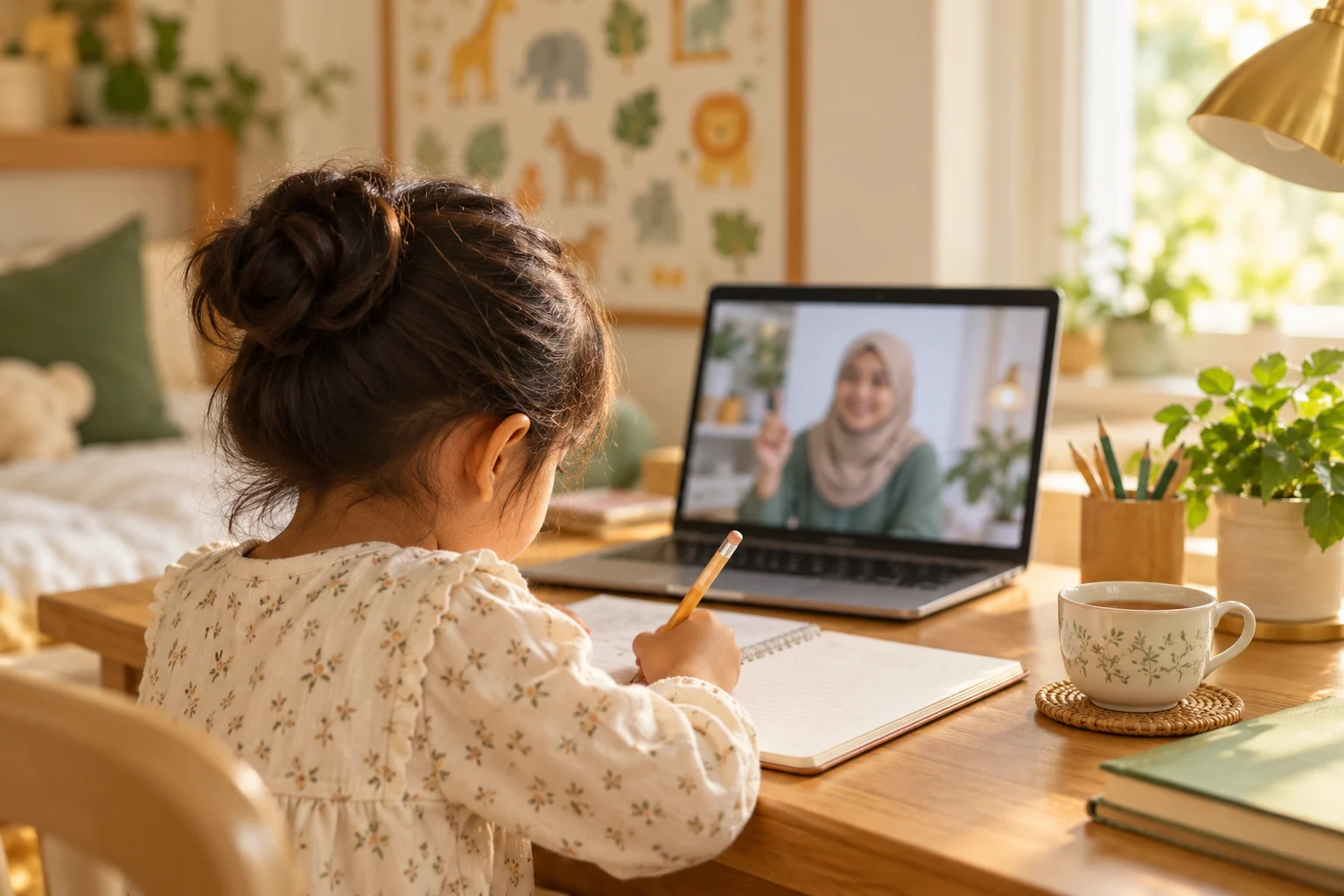
30 minutes a day, Monday to Friday, with the same teacher.
20 classes a month. £50 in the UK, €50 in Europe.
Meet your teacher before you pay anything.
Male and female teachers from Pakistan, with clear English.
Urdu: The Language of Home
Islamic Quran Academy teaches children and adults to speak, read and write Urdu in live one-on-one Zoom classes. The course is built mainly for Pakistani families abroad who want their children to keep the language of home.
Urdu is spoken by about 245 million people as a first or second language, which puts it among the 10 most widely spoken languages in the world. It grew in and around Delhi under the Delhi Sultanate and the Mughal Empire, where Persian was the court language. Over centuries, Persian and Arabic words blended with local speech to form a language written in the flowing Nastaliq script.
By the 18th and 19th centuries, Urdu had become a language of great poetry. Poets such as Mir Taqi Mir, Mirza Ghalib and later Allama Iqbal used it to write about love, faith and philosophy, and their verses are still quoted at weddings and family gatherings today.
Why Pakistani Families Abroad Choose Us
In the UK, USA, Canada, Australia or the Gulf, daily life runs in English or the local language. Children grow up with a new school, new friends and a new first language. Slowly, the Urdu of their parents and grandparents fades.
Many parents know the signs. The child understands some Urdu but answers in English. They cannot read a note from their grandmother, follow the jokes at a family wedding, or talk easily with cousins on a visit home.
Teaching Urdu to a child raised abroad needs more than a textbook. Our teachers use everyday topics children already know, such as school, food, cricket and family, so Urdu feels like part of their life rather than homework.
What you learn
Structured Urdu Lessons for Every Age
The course suits complete beginners and learners who want to polish what they already know. Children, adults and older learners all follow the same steps, at their own pace.
Recognizing and writing each letter, including the sounds English does not have.
Saying Urdu sounds clearly, including the aspirated sounds.
Words and phrases for family, food, greetings and daily life.
Short conversations from the first weeks, so learners use the language.
Correct word order and grammar in simple, useful sentences.
From joined letters to short stories, letters and news.
Neat Urdu script, letter by letter.
Learners practice the letters English does not have, such as Rre ڑ, Tte ٹ and Ddal ڈ, and the aspirated sounds, such as Kh کھ and Ph پھ. Every class is live and one-on-one over Zoom, five days a week, at a time set by your own time zone.
Already reading the Quran? Urdu and Arabic share most letter shapes, so students who have finished Noorani Qaida usually learn the Urdu alphabet faster. Urdu also opens the door to our Quran Tarjuma course, where the meaning of the Quran is taught in Urdu.
Children raised abroad
Where Children Raised Abroad Get Stuck, and How We Help
- They understand but will not speak. Speaking feels risky, so they answer in English. Every class starts with a short, easy chat in Urdu, so speaking becomes a habit before it becomes a test.
- Letters that differ only by dots. Bay ب, Pay پ, Tay ت, Ttay ٹ and Say ث share one shape and change only by their dots. We teach these letters a few at a time and test them side by side.
- Letters change shape when they join. A letter can look very different at the start, middle or end of a word. We practice joined forms early, so reading real words does not feel like a new alphabet.
- Reading right to left. Children used to English read in the wrong direction at first. Short daily reading fixes this within a few weeks.
- Writing feels slow. We start with large, simple letters and move to joined handwriting step by step.
Families come to us for different reasons:
- So children can talk with grandparents in Urdu
- To prepare for a family trip to Pakistan
- So adults can read Urdu books, poetry or the news
- To keep the language alive for the next generation
Your teacher checks how much Urdu the learner already knows and shows you how lessons work. No payment needed to book the trial.
Meet Our Urdu Teachers
Our Urdu teachers are native speakers from Pakistan. Each teacher brings:
- Native Urdu with clear English, so lessons work even for a learner who knows no Urdu yet
- Experience with heritage learners: children and adults abroad who understand some Urdu but cannot read or speak it with confidence
- A patient, step-by-step style for learners from age 4 to retirees
- Conversation-first teaching, with speaking practice in every class
Male and Female Teachers
Both male and female teachers are available. Tell us if you prefer one, and we will arrange it from the first class.
We match each student with a teacher by age, goals and personality, whether that is a shy 6-year-old or a busy professional.
How classes work
Our Teaching Process
Our process is simple and gets students speaking and reading Urdu with confidence.
Meet a teacher and see how lessons work before you pay anything.
The teacher finds out how much Urdu the student already knows, if any.
Speaking only, or full reading and writing, built around age and pace.
30 minutes, five days a week, on Zoom.
The teacher reviews progress and adjusts the plan as needed.
If a class is missed, it can be rescheduled.
What a 30-minute class looks like:
- First 5 minutes: a short chat in Urdu about the student’s day, to warm up speaking.
- Next 15 minutes: new letters, words or a grammar point, practiced aloud.
- Last 10 minutes: reading or writing practice, with a small task to do before the next class.
Before school, after school or after work. Tell us your time zone and we will match you with a teacher who is free then.
How Long Does It Take to Learn Urdu?
Most adults can hold simple conversations and read basic Urdu in about 6 to 8 months with five classes a week. Children’s progress depends on their age and practice at home. Speaking Urdu with them for even 10 minutes a day makes a real difference.
Why Families Choose Our Urdu Classes
- Native teachers from Pakistan: who also speak clear English.
- Built for heritage learners: children abroad who understand some Urdu but cannot read or speak it.
- Speaking from day one: every class starts with a short chat in Urdu.
- Male or female teacher: your choice, from the first class.
- Your time zone: classes fit around school and work.
- 3 free trial classes: see the teaching style before you pay.
Read what other families say on our reviews page.
Fees
Urdu Course Fees
The Urdu course costs $50 a month in the USA, £50 in the UK and €50 in Europe. Families in other countries can message us for their local price. Each monthly plan includes:
- 20 live one-on-one classes a month
- Monday to Friday, 30 minutes per class
- The same teacher every class
A missed class can be rescheduled. See all monthly plans.
3 easy steps
How to Start
- Message us on WhatsApp or through our contact page. Tell us the learner’s age, your country and your goal.
- Take your three free trial classes with a native Urdu teacher.
- Choose your plan and start regular classes with the same teacher.
Whether you want your children to speak with their grandparents, or you want to read Urdu yourself for the first time, the first step is simple.
Contact us on WhatsApp for trial Online Urdu Course
Learn Urdu Online: Frequently Asked Questions
Yes. Every Urdu class is one-on-one, so the lesson moves at the student’s own pace and the teacher’s full attention is on them.
Each 1-on-1 class is 30 minutes long. In some cases, this can be extended up to 40 minutes depending on the student’s needs and lesson plan.
Yes, you can choose a schedule that suits your convenience. We do our best to match you with a teacher who is available during your preferred time, no matter your time zone.
This depends on how many classes you take per week and your consistency. On average, adults reach a conversational and reading level in about 6 to 8 months. For children, progress depends on their age, competency level, and the support they receive from parents at home.
No problem if you miss a lesson, you can request a make-up class to be rescheduled at a time that works for you.
We conduct all live 1-on-1 sessions via Zoom
Just a laptop, PC, tablet, or smartphone with a stable internet connection. We use Zoom for the audio/video sessions.
Yes. Our course is carefully structured to be followed by learners of all ages from a 4-year-old child to an elderly adult and is adapted to each student’s pace and comprehension level.


