
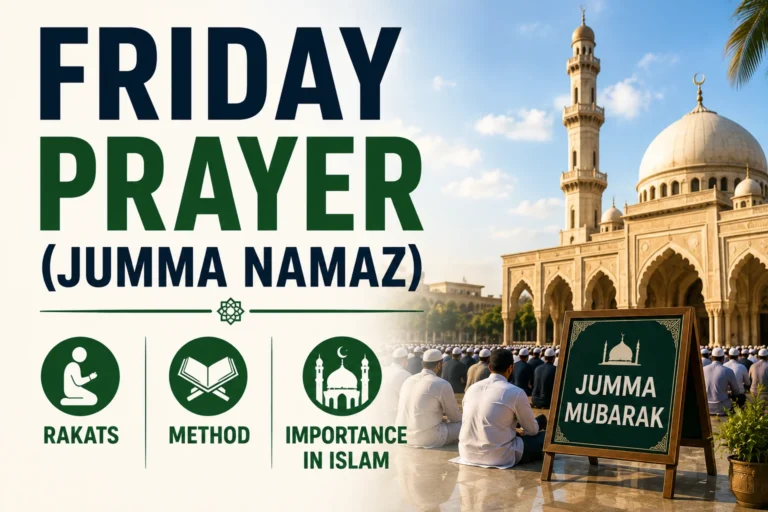
Quick answer: Jummah has 2 Fard rakats, prayed in congregation behind the Imam after the Khutbah. In the Hanafi order followed by most Muslims in Pakistan and India, the full Friday prayer comes to 14 rakats: 4 Sunnah, 2 Fard, 4 Sunnah, 2 Sunnah and 2 Nafl. Only the 2 Fard rakats are obligatory.
Jummah (Jumu’ah) is the congregational prayer held every Friday at Dhuhr time. For adult Muslim men it replaces the 4 rakats of Dhuhr, and it is the only prayer of the week that comes with a sermon. This guide explains every rakat, how the count differs between schools of thought, what to pray at home or if you arrive late, and the Sunnahs of Friday.
Jummah Rakats Chart (Hanafi)
| Order | Prayer | Rakats | Status |
|---|---|---|---|
| 1. Before the Khutbah | Sunnah | 4 | Sunnah Muakkadah |
| 2. After the Khutbah, behind the Imam | Fard | 2 | Obligatory |
| 3. After the Fard | Sunnah | 4 | Sunnah Muakkadah |
| 4. After the 4 Sunnah | Sunnah | 2 | Sunnah (preferred by many Hanafi scholars) |
| 5. Last | Nafl | 2 | Voluntary |
| Total | 14 | Only 2 are Fard |
The 14-rakat count you see on charts in Pakistani masjids includes the Sunnah and Nafl. If someone tells you “Jummah is 2 rakats”, they mean the Fard; if they say “14 rakats”, they mean the full set.
Why Is Jummah Only 2 Rakats?
Umar ibn al-Khattab (RA) said that the Friday prayer is two rakats, complete and not shortened, as taught by the Prophet ﷺ (Sunan an-Nasa’i 1420). Scholars explain that the Khutbah takes the place of the other two rakats of Dhuhr. That is one reason listening to the Khutbah carries so much weight: it is part of the Jummah itself, not an extra.
Sunnah Before and After Jummah: Hanafi vs Other Schools
The 2 Fard rakats are agreed upon by all. The voluntary rakats around them differ:
- Hanafi: 4 Sunnah Muakkadah before the Khutbah. After the Fard, 4 Sunnah followed by 2 Sunnah, then 2 Nafl if you wish.
- Ahl-e-Hadith, Hanbali and many other scholars: no fixed Sunnah before Jummah. You pray as many voluntary rakats as you can until the Imam arrives, based on the hadith that a man “prays what was written for him” and then listens silently to the Imam (Sahih al-Bukhari 883). After the Fard, pray 2 or 4 rakats.
Both views come from authentic hadith. The Prophet ﷺ said: “Whoever of you prays after Jumu’ah, let him pray four” (Sahih Muslim 881), and he himself would pray two rakats in his house after Jummah (Sahih al-Bukhari 937). Many scholars combine these: 4 if you pray in the masjid, 2 if you pray at home. Follow the practice of your own school or local masjid, and respect those who follow another.
How to Pray Jummah Step by Step
- Prepare: take a ghusl, make wudu, wear clean clothes and, for men, use perfume.
- Go early: the earlier you arrive, the greater the reward.
- Pray the Sunnah before the Khutbah: 4 rakats in the Hanafi school, or voluntary rakats in other schools.
- Listen to the Khutbah in silence: the Imam gives two short sermons and sits briefly between them. Do not talk, even to tell someone else to be quiet (Sahih al-Bukhari 934).
- Pray 2 Fard behind the Imam: make the intention in your heart, for example: “I intend to pray the 2 Fard rakats of Jummah behind this Imam for Allah.” The Imam recites aloud in both rakats.
- Pray the Sunnah after the Fard: 4 and then 2 in the Hanafi school, or 2 or 4 in other schools.
- Pray 2 Nafl if you wish, then make dua.
If you enter while the Khutbah has started, Hanafi scholars say to sit and listen without praying. Shafi’i and Hanbali scholars say to pray two short rakats of greeting the masjid and then sit, based on Sahih Muslim 875.
How Many Rakats in Jummah Prayer at Home?
Jummah cannot be prayed alone at home, because it needs a congregation and a Khutbah. If you stay home for a valid reason, such as illness, travel or heavy rain, you pray Dhuhr instead: 4 Fard rakats, with its normal Sunnah (in the Hanafi school, 4 before and 2 after). You can read the full method in our Dhuhr prayer guide.
If you pray Jummah at the masjid and go home afterwards, you may pray the Sunnah after Jummah at home. The Prophet ﷺ prayed 2 rakats at home after Jummah, which is why many scholars say 2 rakats at home or 4 in the masjid.
Jummah Rakats for Ladies
Jummah is not obligatory for women. A woman can choose either way:
- At home: she prays Dhuhr as usual, 4 Fard rakats with its Sunnah.
- At the masjid: if she prays Jummah behind the Imam, the 2 Fard rakats are enough and she does not pray Dhuhr.
What If You Arrive Late for Jummah?
- Hanafi: if you join the Imam at any point before the final salam, even in the last sitting, you complete 2 rakats as Jummah.
- Maliki, Shafi’i and Hanbali: you must catch at least the ruku of the second rakat. If you join after that, you complete 4 rakats as Dhuhr. This is based on the hadith: “Whoever catches one rakat of Jumu’ah has caught the prayer,” (Sunan an-Nasa’i 1425).
What If You Miss Jummah?
If you miss Jummah, pray 4 rakats of Dhuhr. Missing it for a valid excuse carries no sin. Missing it without a reason is serious: the Prophet ﷺ said that whoever leaves three Jumu’ahs out of negligence, Allah places a seal on his heart (Sunan Abi Dawud 1052). The way back is sincere repentance and not making it a habit.
Who Must Attend Jummah?
Jummah is obligatory for every adult, sane Muslim man who is a resident and healthy. The Prophet ﷺ excluded women, children, the sick and those who are not free (Sunan Abi Dawud 1067), and travellers are also excused. Anyone who is excused may still attend, and their Jummah counts in place of Dhuhr.
When Is Jummah Prayed?
Jummah is prayed in Dhuhr time, after the sun passes its highest point. The exact time of the Khutbah changes with the seasons and from masjid to masjid, so check your local masjid’s timetable.
Sunnahs and Virtues of Friday
- Ghusl: “When any of you comes to Jumu’ah, let him take a bath” (Sahih al-Bukhari 877).
- Going early: the first to arrive earns a reward like sacrificing a camel, and the reward reduces for those who come later (Sahih al-Bukhari 881).
- Surah Al-Kahf: reciting it on Friday brings light between the two Fridays (reported by al-Hakim and graded sahih by al-Albani).
- Durood: send abundant blessings on the Prophet ﷺ, as Friday is one of the best days for it (Sunan Abi Dawud 1047).
- Dua in the last hour: there is an hour on Friday in which dua is accepted, and many scholars place it in the last hour before Maghrib (Sunan Abi Dawud 1048).
- Surahs in the prayer: the Prophet ﷺ often recited Al-Jumu’ah and Al-Munafiqun, or Al-A’la and Al-Ghashiyah, in the Jummah prayer (Sahih Muslim 877 and 878).
Teaching Children About Jummah
Children learn Jummah best by going with their parents and copying what they see. Before that, they need to know wudu, the basic steps of Salah and the short surahs. Our tips on how to teach a child to pray Salah can help you start at home, and our online Islamic studies classes cover prayer, duas and the Sunnahs of Friday with a teacher one to one.
Frequently Asked Questions
Is Jummah 2 or 4 rakats?
Jummah is 2 Fard rakats prayed behind the Imam. You pray 4 rakats only when you pray Dhuhr instead, for example at home.
How many Sunnah rakats are there in Jummah?
In the Hanafi school, 4 before and 6 after (4 then 2). Other schools have no fixed Sunnah before and 2 or 4 after.
Is Jummah prayer 14 rakats?
In the Hanafi order the full set is 14 rakats, but only 2 of them are Fard. The rest are Sunnah and Nafl.
How many rakats in Jummah prayer for ladies at home?
A woman at home prays Dhuhr: 4 Fard rakats with its Sunnah.
Can I pray Jummah alone?
No. Jummah needs a congregation and a Khutbah. If you pray alone, you pray 4 rakats of Dhuhr.
Is the Sunnah before Jummah Muakkadah?
In the Hanafi school, yes, the 4 rakats before Jummah are Sunnah Muakkadah. Other schools treat prayer before Jummah as voluntary without a fixed number.
Want to read about the other daily prayers? See our guides to Fajr, Dhuhr, Asr, Maghrib and Isha.