Quran Teacher Syria
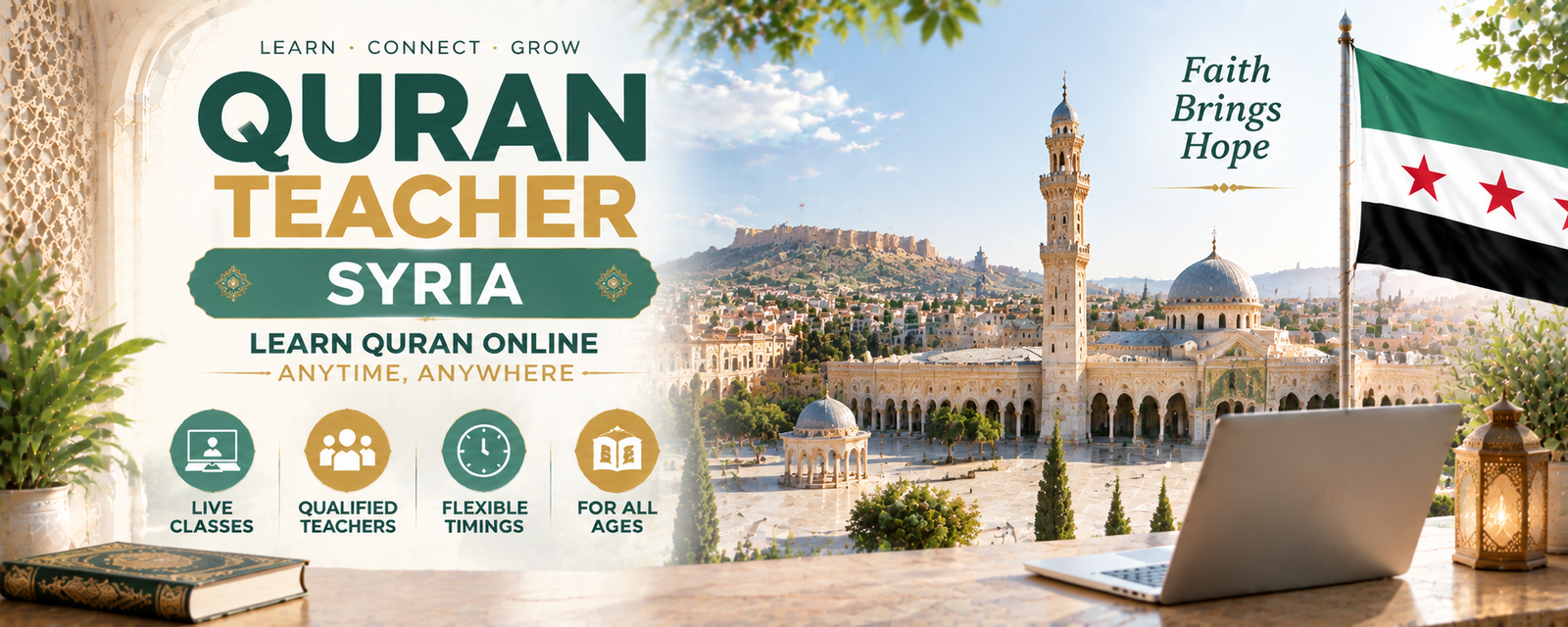
A child back in Aleppo after years in Gaziantep, a mother in Homs who never finished her Qaida, a father in Damascus who wants his daughter taught by a woman: these are the people who write to Quran Pak Teacher from Syria. Each one is given a Quran Teacher Syria families can check by name, a Hafiz who teaches live on video. Twenty lessons of 30 minutes cost $30 a month.
Hanafi Teachers for Most Syrian Homes
Most Sunni Syrians follow the Hanafi school, and so do our teachers in Lahore. When your child learns wudu, salah or the duas after prayer, nothing clashes with what is done at home or in the local masjid. Kurdish families in the northeast are more often Shafi’i, and for them the teacher follows the family’s way instead.
We teach the Hafs an Asim riwaya, the same one printed in the mushafs sold in Damascus and Aleppo.
Your Teacher and the Language of Each Lesson
Hafiz Ali Ahmad and Hafiz Umair Akram each bring ten years of teaching. All staff at our online Quran academy are huffaz, and a female Quran teacher takes every girl or woman who asks.
Lessons are in English and Urdu, not Arabic. A child who understands only Arabic can still learn the letters, though a local sheikh will explain faster.
Help for Children Returning from Jordan and Turkey
This is where one to one lessons help most. The UNHCR reports that about 220,000 Syrian refugees came back from Jordan alone between December 2024 and August 2026. Many of these children grew up in camps or foreign schools and missed years of Quran study.
A ten year old who cannot yet read starts the Qaida with a teacher of their own, not beside five year olds. Children from age four can join.
Learn Quran Online Syria With Five Hours of Power
In July 2026, Al Jazeera reported that parts of Damascus had five or six hours of electricity at a stretch before a cut. A 30 minute lesson fits inside one block. Tell us your usual power hours when you book, and if the supply drops mid lesson, we arrange a make up.
Teachers work in shifts around the clock, Monday to Friday. Syrian families most often choose 08:00 to 10:00, 15:00 to 18:00, or 19:00 to 22:00 Damascus time, which is two hours behind Lahore.
In each lesson your child reads back yesterday’s portion, learns the next lines with every wrong vowel stopped and repeated, and leaves with a short passage to practise. A parent may watch from the same room.
Four Stages from Qaida to Meaning
Stage one: the Qaida
The Noorani Qaida course starts with how each letter sounds alone, then how it changes when joined, then how fatha, kasra and damma shape a word.
Stage two: reading the mushaf
In the reading course, students learn Quran online with tajweed straight from the mushaf. The teacher marks where to pause (waqf), where a noon is hidden or merged, and where the voice bounces on qalqalah letters. This is Quran reading with tajweed as daily practice.
Stage three: memorising
Our Quran memorization course gives each student a daily new portion, a check of the past week, and a steady rotation of older juz so nothing fades.
Stage four: meaning
Tarjuma explains each word in English or Urdu. Tafseer covers why a surah was revealed and what it asks of the reader.
For Pakistani families
The Urdu course helps children of Pakistanis working in Syria keep their home language.
Lessons for Mothers, Fathers and Returning Adults
Our online Quran classes for adults suit parents, returnees and new Muslims who want to start again without an audience. Online Quran classes for kids and adults share one timetable, so a mother and son can book back to back.
Choose a Local Halaqa If One Is Near
Damascus has trained Quran reciters for over a thousand years. Circles still meet in the Umayyad Mosque, in Midan and the Old City, and at the Khalid ibn al Walid Mosque in Homs. If your child follows Arabic well and a trusted sheikh teaches nearby, start there.
Monthly Fee and Paying from Syria
The fee is $30 for the month, fixed in US dollars, so swings in the Syrian pound do not change it. Terms are on our fee plan page. We take payment by Western Union. The US repealed the Caesar Act in December 2025, but transfers into Syria are still uneven, so message us to confirm a route before you book.
Three Free Trial Classes to Start
Send the learner’s age, city and usual power hours through our contact page. You get three free trial classes with the teacher who will stay with you.
Contact us on WhatsApp for trial classes in Syria
F.A.Q. GUIDE RELATED TO OUR ONLINE COURSES & CLASSES
No. We teach in English and Urdu only.
Yes. We teach Monday to Friday, so Friday works, though it is a Syrian weekend day. Saturday and Sunday are off.
No. The teacher teaches Quran and tajweed and follows your family’s practice for salah.
A phone, tablet or laptop with a camera and a working connection.
Yes, any time, and she can be taught only by a woman.
Most students read with tajweed within six to twelve months of regular lessons.
We use Western Union. Message us first to confirm it works from your city.
No. After reading, students can move to Hifz, Tarjuma or Tafseer.
If You Have Any Questions, Trial Classes & Registration


FEEL FREE TO ASK
Where We Provide Online Quran Classes
Home to some of the oldest cities in the Islamic world, Syria carries a heritage of learning and scholarship that stretches back centuries, and today its families, wherever they now call home, are keeping that heritage alive through one-to-one online Quran classes built around their children’s schedule and pace.