Quran Teacher Paraguay
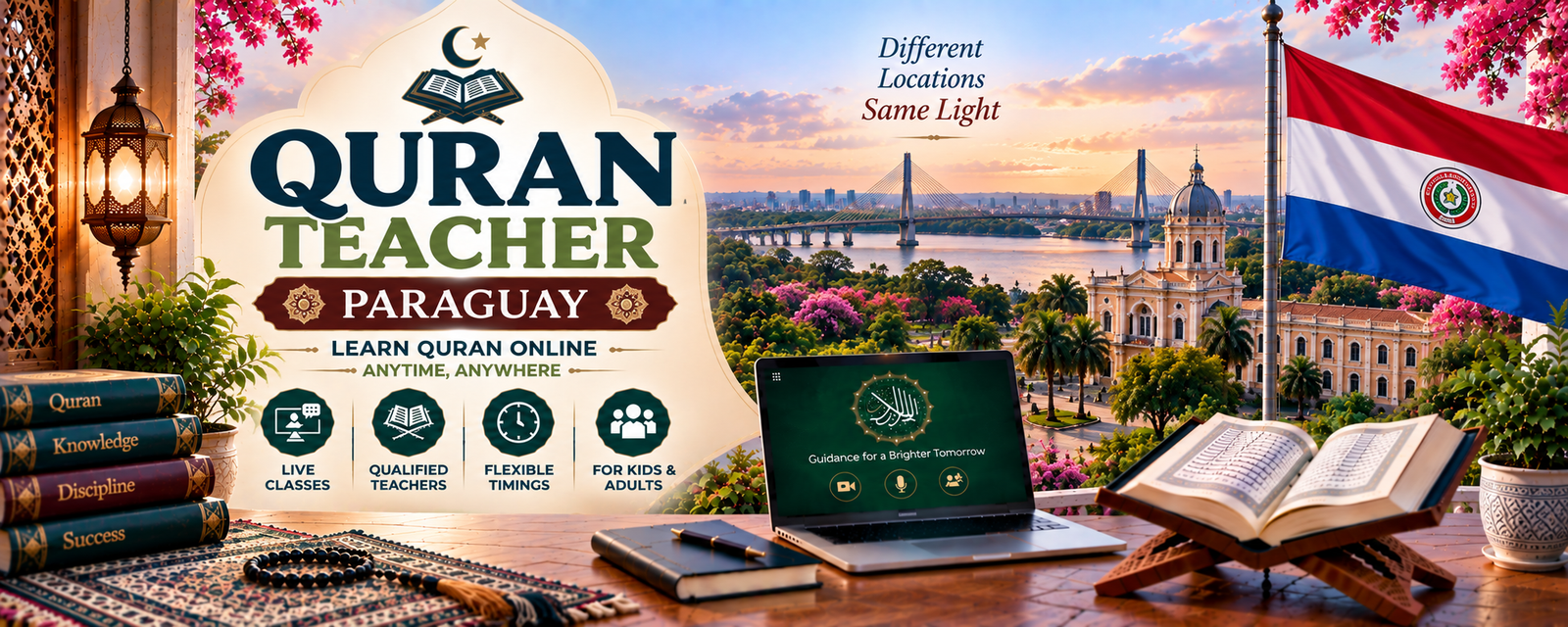
Almost every Islamic institution in this country sits in two cities. If you live in either of them, you have real options. If you do not, you have almost none. Quran Pak Teacher exists for the second group, and for families in the first who need something the mosque timetable cannot give them. Finding a Quran teacher Paraguay families can actually use comes down to where you live and what hour you are free.
The community is real, and it is concentrated
Figures for Paraguay’s Muslim population disagree sharply, and it is worth knowing that before anyone quotes you one.
Some sources put the total below 1,000, around 0.02% of the country. Others estimate 15,000. The United States Department of State records Muslim leaders placing it near 10,000, with the majority in Ciudad del Este. The Mezquita del Este puts roughly 7,000 members in Ciudad del Este and about 20,000 across the Triple Frontier.
What all of them agree on is the concentration. Islam arrived in Paraguay with Lebanese, Syrian and Palestinian migration from the 1970s onward, settling around Ciudad del Este, close to the Friendship Bridge and the trade that crosses it.
What already exists in Ciudad del Este and Asunción
Ciudad del Este has the Mezquita del Este, formally Masjid al-Khulafā al-Rāshidīn. Ground was broken in April 2011 and the building was finished in November 2015, designed by engineer Héctor Duré and paid for entirely by the local Arab-Islamic community at a cost near one million dollars.
It holds around 650 people. The dome stands 20 metres, the two minarets 35 metres, on a site of 3,500 square metres. It runs as a cultural centre alongside the prayer hall and is administered by the Comunidad Árabe Islámica del Paraguay. Other mosques operate in the same city, and Asunción has the Centro Benéfico Cultural Islámico, led by Faozi Mohamed Omairi.
This matters because it changes what we can honestly claim. Ciudad del Este is not short of Islamic provision. It has better facilities than most cities its size anywhere in Latin America.
If you live near that mosque and its classes suit your family, go there. A teacher who knows your household and sees your child every week is worth more than a screen.
Who we teach in Paraguay
Three groups, and it is worth being specific about them.
Families outside the two cities. Encarnación, San Lorenzo, Coronel Oviedo, Villarrica and Pedro Juan Caballero have nothing comparable. Ciudad del Este is a long drive down Ruta PY02, not a weekly errand.
Paraguayan converts. The mosque communities here grew out of Arab migration, and their social life runs partly in Arabic. A Spanish-speaking Paraguayan who accepted Islam last year faces a real barrier walking into that, separate from anything religious.
Third-generation children. Lebanese-descended Paraguayans number around 200,000 in total, and household language has shifted across the generations from Lebanese Arabic toward Paraguayan Spanish. Grandparents often read Arabic. Grandchildren often do not.
Online Quran teacher in Paraguay: working with an eight hour gap
Paraguay stopped changing its clocks in 2024. President Santiago Peña signed the law on 11 October and it was published on 14 October, putting the country permanently on UTC-3. The gap to Lahore is now a fixed eight hours all year.
Our teachers cover every hour of the day in shifts, Monday through Friday. Weekends are not staffed.
So a 6:00 pm slot in Ciudad del Este starts at 2:00 am for your teacher. A 7:00 pm slot is 3:00 am. Morning study at 8:00 am in Asunción lands at 4:00 pm in Lahore, which is a comfortable hour on both ends.
Tell us the window that fits your week and we will find a teacher already on that shift.
Spanish, Guaraní, and the language your teacher speaks
Paraguay has two official languages and most of the country speaks both. We teach in neither.
Our teachers work in English and Urdu. Recitation is in Arabic, and explanation happens in English.
For a Lebanese-Paraguayan family where English is already a school language, that works. For a Guaraní and Spanish speaking household with little English, it will be hard, and you should know that before you book rather than discover it in the third week. Our about page covers who teaches and how.
Which recitation you will learn
We teach Hafs, the reading of the Quran used by most of the Muslim world, in the Hanafi tradition our teachers were trained in at Lahore.
If a child has already started reading with a teacher here, bring a recording or a page to the trial class. Matching what someone has already learned is easier than correcting it later.
Female teachers
The Mezquita del Este set aside a mezzanine for roughly 150 women when it was built. Provision for women here is taken seriously, and our classes follow the same expectation.
We employ female teachers alongside male ones. Request a woman when you book and the match is made before your first lesson, not adjusted afterwards.
She can teach any of our six subjects. Nothing is reserved for male teachers, and the fee does not change. If your daughter does not settle with the teacher we choose, tell us inside the trial period and we will find another.
Children’s classes and what you can watch
Lessons run on Zoom, Microsoft Teams or Google Meet, through a link sent to you rather than to your child.
Every session is one student with one teacher. No group calls, and the same teacher returns each week.
Parents are welcome in any lesson without arranging it in advance. Sit in whenever you want to hear how your child is being taught.
Courses
Six subjects, each taught one to one. Every student starts wherever their reading actually is, not where their age suggests it should be.
Noorani Qaida
The starting point for anyone who cannot yet read Arabic script, whether that is a five year old or a forty year old.
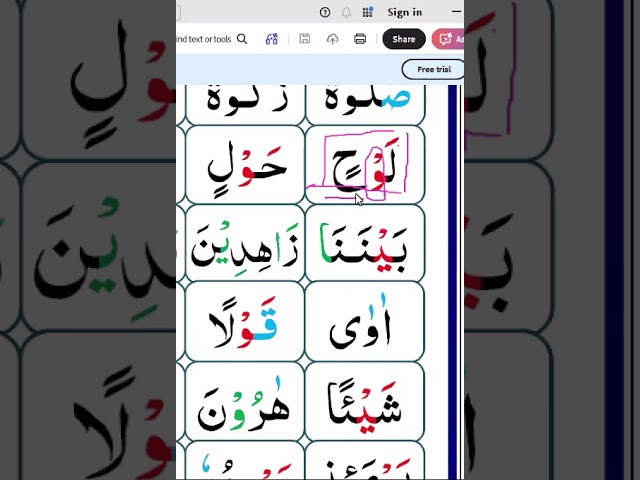
The Qaida works through the Arabic letters one at a time, first in isolation and then joined, so a student learns how each letter changes shape depending on where it sits in a word. After the letters come the short vowels, then sukoon, then the doubled letters. Most students reach the end in four to six months at five lessons a week.
It is slow at the beginning and then it moves quickly. Skipping it is the most common reason adults read the Quran with errors they cannot later hear. Full course detail here.
Quran reading with Tajweed
Once the letters are secure, the student moves to the Quran itself and to Tajweed, the rules governing how each letter is sounded.
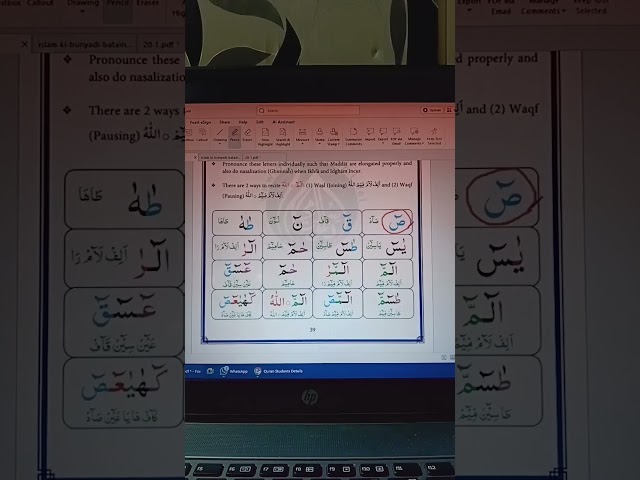
Tajweed covers where in the mouth or throat a letter is produced, how long a vowel is held, and what happens when certain letters meet. Noon sakinah, meem sakinah and the rules of madd come in stages rather than all at once.
The teacher listens, corrects, and has the student repeat. That is why it works one to one and does not work well in a group of thirty. Read more on the Quran reading course.
Hifz, memorisation
For students committing the Quran to memory, in whole or in part.
Work is split between new memorisation each day and revision of what is already held. The revision half matters more than the new half, and it is where most self-taught attempts fail. The teacher sets a daily portion, hears it back, and keeps a running revision cycle so earlier surahs do not slip away.
Some families start with the shorter surahs of the thirtieth juz and go no further. Others aim at the full Quran over several years. Both are normal. See the Hifz course.
Tarjuma, word by word meaning
Tarjuma is translation. The student learns what the words themselves say.
The teacher moves through the text giving the meaning of each word in order, so the student builds a vocabulary of the Quran’s own language rather than reading a paraphrase in English. Recurring words come up again and again, and after some months a reader starts recognising them without being told.
This is the course for someone who recites fluently but does not know what they are reciting, which describes a great many Muslims. It stops at meaning and does not go further. Course page here.
Tafseer, explanation and context
Tafseer is a different subject from Tarjuma, and the two are often confused.
Where Tarjuma tells you what a verse says, Tafseer explains what it means and why it was revealed. That includes the occasion of revelation, how a verse relates to others on the same subject, what the classical scholars understood from it, and what rulings or lessons follow.
Tafseer assumes you already have the translation. We usually recommend a student completes a stretch of Tarjuma first. Taken together the two courses change how someone reads, more than any amount of added recitation speed. Tafseer course detail.
Learn Urdu
Urdu lessons for reading, writing and speaking.
This suits South Asian households keeping the language alive with children who were born elsewhere. For most families in Paraguay it will not be relevant, and we would rather say so than pad the list. Urdu course here.
The full course list covers all six with fees and timings.
Fees
Twenty classes a month cost $30.
That is five lessons a week, Monday to Friday, thirty minutes each, one student to one teacher. Billing is in US dollars, so the guaraní exchange rate on the day does not change what you owe.
Every subject costs the same. So does a male or female teacher. Nothing is added for enrolment, for study materials, or for switching teachers partway through.
Ask about rates for a second or third child when you enrol. Our fee page sets out the full plan.
Free trial classes
Three lessons, free, before money is discussed.
We do not collect payment details beforehand. You attend all three, then decide.
Use them to test the real thing. Book the hour you would actually use during a working week in Paraguay, not a convenient Saturday. Check whether your child follows the teacher’s English. If you want a female teacher, ask for one now so you are trying the arrangement you would keep.
Message us on the contact page to arrange them.
Wherever you are between Asunción and the Friendship Bridge, a qualified Quran teacher Paraguay families can rely on comes down to matching an hour, not closing a distance. Book your three trial lessons through our contact page.
Contact us on WhatsApp for trial classes in Paraguay
F.A.Q. GUIDE RELATED TO OUR ONLINE COURSES & CLASSES
No. Classes are taught in English, with recitation in Arabic.
No. Distance makes no difference to an online lesson.
Tarjuma gives the meaning of each word. Tafseer explains context, reasons for revelation, and what scholars drew from the verse.
Yes, at the same fee. Request her at booking.
Late evening in Paraguay is early morning in Lahore, and those shifts are covered.
No. Three lessons, no card details, no obligation afterwards.
Let us know and the lesson is rescheduled.
Hafs, in the Hanafi tradition.
If You Have Any Questions, Trial Classes & Registration


FEEL FREE TO ASK
Where We Provide Online Quran Classes
Home to a thriving Arab-Muslim trading community in Ciudad del Este, Paraguay’s families are keeping Quran learning close to home, through flexible one-to-one online classes built around their week.