
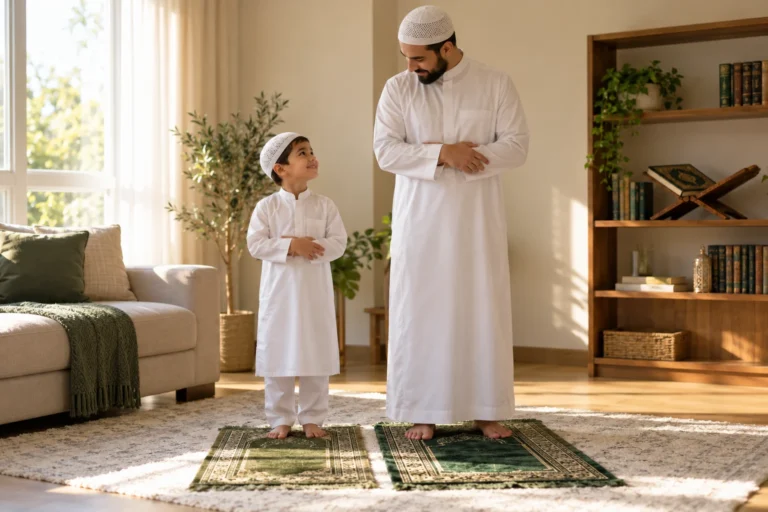
You teach a child to pray Salah in stages. From about age 3 to 6, let them stand beside you and copy. From 7, teach Wudu and the full prayer step by step, one daily prayer at a time. From 10, build the habit of all five prayers on time and teach the meaning of what they recite. Patience, your own example and a little praise matter more than any app or chart.
That is the short answer. The rest of this guide shows you exactly what to do at each age, the mistakes to avoid, and how to keep Salah a source of love rather than a daily argument.
Why Start Early?
The Prophet ﷺ told parents to teach their children to pray from the age of seven, and to be firmer about it by the age of ten (Sunan Abi Dawud 495). The years before seven are not wasted. They are when a child watches, copies and starts to love the sight of their parents on the prayer mat.
A child who has stood beside you for years does not need to be convinced at seven. They already know the movements. All that is left is to learn the words, the steps and the habit.
And Allah reminds parents that this takes patience: “And enjoin prayer upon your family and be steadfast therein” (Surah Ta-Ha 20:132). Teaching Salah is not one lesson. It is a few years of gentle, daily effort.
Before You Begin: Two Things That Matter Most
1. Your own prayer: Children copy what they see far more than what they hear. If they see you stop what you are doing when the Adhan time comes, make Wudu and pray calmly, they learn that Salah is important without a single lecture. The Prophet ﷺ taught his Companions the same way: “Pray as you have seen me praying” (Sahih al-Bukhari 631).
2. A calm, positive tone: The way you talk about Salah in the early years shapes how your child feels about it for life. Speak about it as a meeting with Allah, a time to say thank you and ask for help, not as a chore that must be ticked off. Praise effort more than perfection.
If your family follows a particular school of thought, keep your child’s teaching consistent with it. Small details, such as where the hands are placed, can differ between schools. What matters for a child is learning one way correctly and calmly.
Ages 3 to 6: Watching, Copying and Loving It
At this age, the goal is not a correct prayer. The goal is a child who wants to stand on the prayer mat.
- Give them their own prayer mat: A small mat of their own makes Salah feel special. Let them choose the colour if you can.
- Let them stand beside you: Invite them to pray next to you, even if they wander off after the first Ruku. Never scold a young child for leaving the mat.
- Copy the movements together: Practice Takbeer (raising the hands), Ruku (bowing) and Sajdah (prostration) as a gentle game at a calm time of day, not during your own prayer.
- Teach the first words: Start with “Allahu Akbar”, “Subhana Rabbiyal Azeem” for Ruku and “Subhana Rabbiyal A’la” for Sajdah. Short, repeated words are easy to remember.
- Begin Surah Al-Fatiha slowly: One verse a week is enough. Recite it together before bed.
- Make Wudu fun: Show them the steps at the sink and let them copy. Do not worry about perfection yet.
- Praise, praise, praise: “I loved praying next to you today” does more than any reward chart at this age.
What success looks like by age 6: your child knows the main movements, joins you happily for at least one prayer a day, and is learning Al-Fatiha.
Ages 7 to 9: Learning the Full Prayer, Step by Step
This is the age the Prophet ﷺ named for teaching Salah. Now your child learns Wudu properly and the full prayer, and starts praying regularly.
Step 1: Teach Wudu properly
Walk through Wudu slowly at the sink: intention in the heart and Bismillah, washing the hands, rinsing the mouth, rinsing the nose, washing the face, washing the arms up to the elbows, wiping the head, wiping the ears, and washing the feet up to the ankles. Let your child do it while you watch for a week or two.
Step 2: Teach the prayer in order
Teach one step at a time and practice it until it feels easy:
- Face the Qiblah and make the intention in your heart.
- Takbeer: raise the hands and say “Allahu Akbar”.
- Standing (Qiyam): recite Surah Al-Fatiha, then a short Surah such as Al-Ikhlas.
- Ruku: bow and say “Subhana Rabbiyal Azeem” three times.
- Stand up again, saying “Sami Allahu liman hamidah”, then “Rabbana lakal hamd”.
- Sajdah: prostrate and say “Subhana Rabbiyal A’la” three times, sit briefly, then make a second Sajdah.
- That is one Rak’ah. The second Rak’ah follows the same steps.
- Sit for Tashahhud (At-Tahiyyat) after two Rak’ahs. In the final sitting, add the Durood (Salawat) on the Prophet ﷺ and a short dua.
- End with Salam, turning the head to the right and then to the left.
Step 3: Learn the number of Rak’ahs
The five daily Fard prayers are Fajr 2, Dhuhr 4, Asr 4, Maghrib 3 and Isha 4 Rak’ahs. Many families start with the Fard Rak’ahs only, and add the Sunnah prayers once the habit is strong.
Step 4: Add one daily prayer at a time
Do not expect all five prayers from day one. A gentle order that works for many families:
- Weeks 1 to 4: Maghrib, when the whole family is usually home
- Then add Isha, before bed
- Then Dhuhr and Asr on weekends and holidays, and on school days when possible
- Fajr last, with a gentle wake-up and lots of praise
What success looks like by age 9: your child can make Wudu alone, knows the full prayer with Al-Fatiha, a few short Surahs and Tashahhud, and prays at least two or three prayers a day.
Ages 10 and Up: Building a Lifelong Habit
By ten, the goal moves from learning how to pray to praying because they want to. The hadith asks parents to be firmer at this age, and scholars explain that firmness as serious, consistent encouragement. Gentle methods always come first, and harshness tends to push children away from Salah, not toward it.
- All five prayers, on time: Help your child connect each prayer to their day: Fajr before school, Dhuhr at lunch, Asr after school, Maghrib at dinner, Isha before bed.
- Teach the meaning: A child who knows that Al-Fatiha is a conversation with Allah prays very differently from one who only knows the sounds. Go through the meaning of Al-Fatiha and the short Surahs they recite.
- Give them responsibility: Let them lead a family prayer at home sometimes, give the Adhan, or remind younger siblings. Responsibility builds ownership.
- Pray at the masjid together: when you can, especially Jumu’ah for boys. Seeing other children and adults pray builds belonging.
- Plan for school days: Talk with your child about how to pray Dhuhr at school, whether a quiet room is available, and how to make Wudu discreetly.
- Keep talking, not nagging: If they miss a prayer, a calm “let’s make it up together” works far better than a lecture.
What success looks like by age 12: your child prays all five prayers most days without being reminded, and understands what they are saying.
Common Mistakes Parents Make
Starting with fear: Talking mostly about punishment for missing Salah makes a child see prayer as a threat. Start with love, gratitude and the reward of prayer.
Expecting all five prayers at once: Asking a seven-year-old to pray five times a day from the first week often ends in tears and a quiet return to zero. Add one prayer at a time.
Comparing siblings or cousins: “Your cousin already prays all five” rarely motivates. It usually makes a child resent both the cousin and the prayer.
Correcting during the prayer: Interrupting a child mid-prayer to fix a mistake is discouraging. Make a mental note and practice the step together later.
Praying in a rush yourself: If your own Salah is fast and distracted, your child learns that it is something to get through. Let them see you pray slowly and calmly.
Try a Simple Weekly Salah Chart
A chart works well for children aged 7 to 10. Draw five columns for the five prayers and seven rows for the days of the week. Your child ticks each prayer they pray. At the end of the week, sit together, look at the chart and praise the effort, not just the number of ticks.
Keep rewards small and meaningful: choosing the Friday dinner, a trip to the park, or a new prayer mat after a month of steady effort. The aim is to build the habit until the chart is no longer needed.
When a Teacher Can Help
Most of this journey happens at home, and it should. But many parents reach a point where help makes a real difference:
- You are not sure your own recitation of Al-Fatiha or the Tashahhud is correct enough to teach.
- Your child has learned the prayer by ear and is mispronouncing the Arabic.
- Your child listens to a teacher more readily than to a parent, which is very common.
- You live somewhere with no masjid or weekend madrassa nearby.
In our online Islamic studies classes, a teacher watches every position of your child’s Salah, listens to every word, and corrects small mistakes before they become habits. Lessons are one-on-one, cover Wudu, Salah, daily duas and the Kalimas, and are taught alongside your child’s Quran lessons at no extra fee. If your child is still learning to read Arabic letters, they can start with Noorani Qaida at the same time. Many families also ask for a female Quran teacher for their daughters, and parents are welcome to sit in on every class.
Start Small, Start Today
You do not need a perfect plan to begin. Tonight at Maghrib, invite your child to stand beside you. Tomorrow, practice one step together. Praise every small effort.
The child who copies your Sajdah at four, learns Al-Fatiha at six and joins you for Maghrib at eight is the young adult who prays on their own at sixteen. Every prayer you teach them is a gift that stays with them, and with you, for life.
Want help along the way? Book three free trial classes and let a teacher check where your child is today.
Frequently Asked Questions
At what age should a child start praying Salah?
The Prophet ﷺ told parents to teach Salah from age seven. Children can start copying the movements from about three.
Is Salah compulsory for children?
Salah becomes obligatory at puberty. Before that, parents teach it so the habit is strong by then.
How do I teach my child Salah if they do not know Arabic?
Start with short phrases like “Allahu Akbar”, then Al-Fatiha one verse at a time. Learning the meaning in English or Urdu helps.
My child keeps forgetting the number of Rak’ahs. What should I do?
Pray beside them and let them follow you. Counting becomes natural with practice.
Should I reward my child for praying?
Small rewards can help at first. Praise and your own example matter more in the long run.
Can girls learn Salah from a female teacher online?
Yes. Many families choose a female teacher for girls, and lessons can be one-on-one from home.