
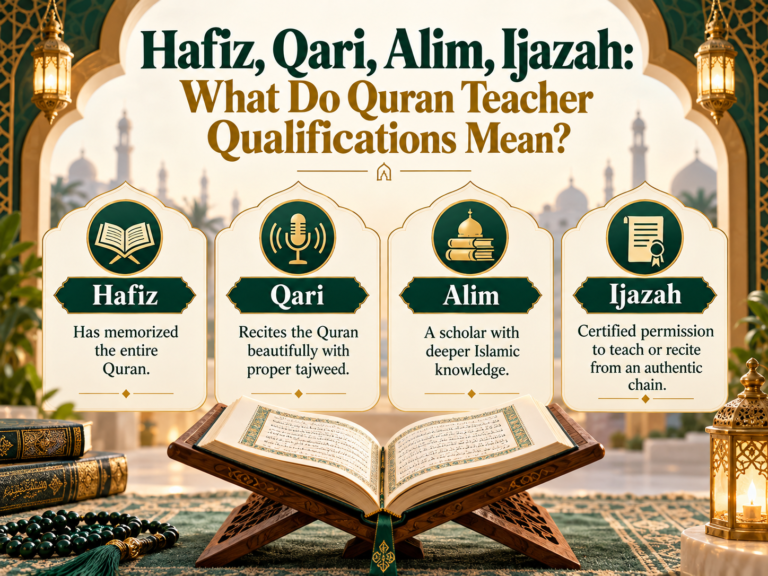
Quran teacher titles describe different skills. Each one tells you what a teacher has studied, but not whether they can teach your child well. Here is what each title means:
- Hafiz (female: Hafiza): has memorized the entire Quran.
- Qari (female: Qaria): is trained to recite the Quran with correct Tajweed.
- Alim (female: Alimah): has completed years of formal study in Arabic, Tafseer, Hadith and Islamic law, usually through the Dars-e-Nizami course.
- Mufti: an Alim who has done further training to give rulings on Islamic law.
- Mualim (female: Mualima): simply means teacher. It is a role, not a qualification.
- Ijazah: a certificate from a qualified teacher confirming that you recite correctly, with permission to teach.
- Sanad: the chain of teachers behind an Ijazah, going back to the Prophet ﷺ.
One person can hold several of these at once. A teacher can be a Hafiz, a Qari and an Alim all together. The right title for your child depends on what they are learning, and that is what this guide explains.
What Is a Hafiz or Hafiza?
A Hafiz is someone who has memorized the whole Quran, all 114 Surahs, and can recite it from memory. A woman who has done the same is called a Hafiza. The word comes from the Arabic hifz, meaning to protect or preserve.
Becoming a Hafiz usually takes several years of daily lessons and constant revision. Many Hafiz finish as children or teenagers.
What a Hafiz is good at teaching:
- Hifz itself, because they know the method from the inside: the daily new lesson, the revision of recent lessons, and the revision of everything memorized so far
- Quran reading, since they have read the full Quran many times
- Short Surahs for Salah
What “Hafiz” alone does not tell you: memorizing is not the same as reciting with perfect Tajweed, and it is not the same as being able to teach. A Hafiz who learned in a hurry can carry pronunciation mistakes too. Ask how they learned Tajweed, and watch them teach in a trial.
Want to know what Hifz involves for your child? See our online Hifz classes.
What Is a Qari or Qaria?
A Qari is someone trained to recite the Quran correctly and beautifully, following the rules of Tajweed. A woman with the same training is called a Qaria. The word comes from the Arabic qira’ah, meaning recitation.
In Pakistan and India, the title usually means the teacher has completed a formal Tajweed or Qirat course at a madrassa. Some Qaris go further and learn the different recognized ways of reciting the Quran, called the Qira’at.
What a Qari is good at teaching:
- Tajweed and correct pronunciation, letter by letter
- Fixing old reading mistakes in students who already read
- Noorani Qaida, where correct sounds matter most
Hafiz vs Qari, in one line: a Hafiz has memorized the Quran, while a Qari specializes in how it is recited. Many teachers are both, often called a Hafiz-Qari.
For reading with correct Tajweed, a Qari or a Hafiz with strong Tajweed is the right choice. See our Quran reading with Tajweed course.
What Is an Alim, Alimah or Mufti?
An Alim (plural: Ulama) is a scholar who has completed years of formal Islamic study. A woman with the same training is called an Alimah.
In Pakistan and India, this usually means finishing the Dars-e-Nizami course at a madrassa, which takes around eight years. It covers Arabic grammar, Tafseer, Hadith, Fiqh (Islamic law) and more. In Pakistan, the final certificate, Shahadat-ul-Aalamiya, is recognized by the Higher Education Commission as equal to an MA in Arabic or Islamic Studies for teaching purposes.
A Mufti is an Alim who has done further specialist training in Islamic law and is qualified to give formal rulings (fatwas).
What an Alim or Alimah is good at teaching:
- Tafseer, the full explanation of the Quran
- Tarjuma, the meaning of the Quran word by word
- Islamic studies, Hadith and the reasons behind rulings
Does your child need an Alim for Qaida or reading? Not necessarily. Scholarship and teaching a 5-year-old to read are different skills. For Tafseer, though, an Alim or Alimah is the right teacher. See our online Quran Tafseer course.
What Is a Mualim or Mualima?
Mualim simply means teacher, and Mualima means female teacher. In many Pakistani homes, the woman who teaches Qaida and Quran reading to the neighborhood girls is called the Mualima, or “Mualima Baji.”
The word describes a role, not a qualification. A Mualima might also be a Hafiza, a Qaria or an Alimah, or she might have none of these titles but years of experience. If a teacher is introduced only as a Mualim or Mualima, ask what they studied and where.
What Is an Ijazah and a Sanad?
An Ijazah is written permission from a qualified teacher. It confirms that a student recites the Quran correctly and may now teach it to others. A Sanad is the chain of names attached to that Ijazah: the student’s teacher, that teacher’s teacher, and so on, going back to the Prophet ﷺ.
The idea of learning the Quran from a trusted person goes back to the Prophet’s time. He said: “Learn the Quran from four: Abdullah bin Mas’ud, Salim, Mu’adh and Ubayy bin Ka’b.” (Sahih al-Bukhari 4999) The Quran has always been passed on from teacher to student, not only from book to reader.
Common types of Ijazah:
- Ijazah in recitation: the student read the whole Quran to the teacher, by looking, with correct Tajweed.
- Ijazah in Hifz: the student recited the whole Quran from memory.
- Ijazah in a specific Qira’ah, such as Hafs ‘an ‘Asim, the recitation most people in Pakistan, India and the Gulf use.
Does every Quran teacher need an Ijazah? No. It is a strong sign of quality, especially for advanced Tajweed and Hifz. But many excellent teachers of Qaida and beginner reading do not hold one. A teacher with strong Tajweed who teaches patiently can serve a beginner very well.
How to check an Ijazah: ask whose Ijazah it is, in which recitation, and see the certificate. A real Ijazah names the teacher who gave it and usually lists the Sanad. Be careful when an academy says “all our teachers are Ijazah certified” but cannot show you a single certificate.
Which Qualification Does Your Child Actually Need?
Match the teacher to the course. A higher title is not always a better fit.
- Noorani Qaida (ages 4 and up): a Qari, Qaria, Hafiz or Hafiza with strong Tajweed and real patience with young children. Correct sounds from day one matter more than any title. See our Noorani Qaida course.
- Quran reading with Tajweed: a Qari or Qaria, or a Hafiz or Hafiza trained in Tajweed. An Ijazah in recitation is a strong plus.
- Hifz (memorization): a Hafiz or Hafiza, ideally one who has taught Hifz before and holds an Ijazah in Hifz.
- Tarjuma (meaning): an Alim or Alimah, or a teacher with formal Arabic and Tafseer training.
- Tafseer: an Alim or Alimah. This is the one course where scholarly training is essential.
For girls and women: many families prefer a Hafiza, Qaria or Alimah. The same standards apply. Read more about learning with a female Quran teacher.
The quality no title shows: patience. A brilliant Qari who loses patience with a 6-year-old will teach worse than a less famous teacher who keeps a child smiling. Only a trial class shows you this.
Questions to Ask at a Trial Class
A free trial is the best time to check a teacher. Ask these questions, and watch how they teach.
- Are you a Hafiz or a Qari, or both? Where did you study?
- Do you hold an Ijazah? From whom, and in which recitation?
- How long have you taught children (or adults) at this level?
- How do you correct a mistake the child keeps repeating?
- How will I know my child is progressing?
- Can I sit in on the classes?
Then watch the lesson itself. Does the teacher correct mistakes calmly? Does your child read for most of the class? Does the teacher explain why, not only what?
Red flags:
- Titles claimed with no detail, such as “certified” with no certifier named
- A teacher who cannot tell you where they studied
- Mistakes left uncorrected during the trial
- Shouting, mocking or impatience with a child
- An academy that will not let parents watch a class
Who Teaches at Islamic Quran Academy
Every teacher at Islamic Quran Academy is a Hafiz or Hafiza. We have both male and female teachers, and lessons are explained in Urdu or English. We match each student with a teacher suited to their course, age and goals.
The best way to judge a teacher is to watch one teach. Book a free trial class, ask the questions above, and sit beside your child for the whole lesson. Read what families say on our reviews page, see our monthly plans, or contact us to book.