Quran Teacher Lebanon
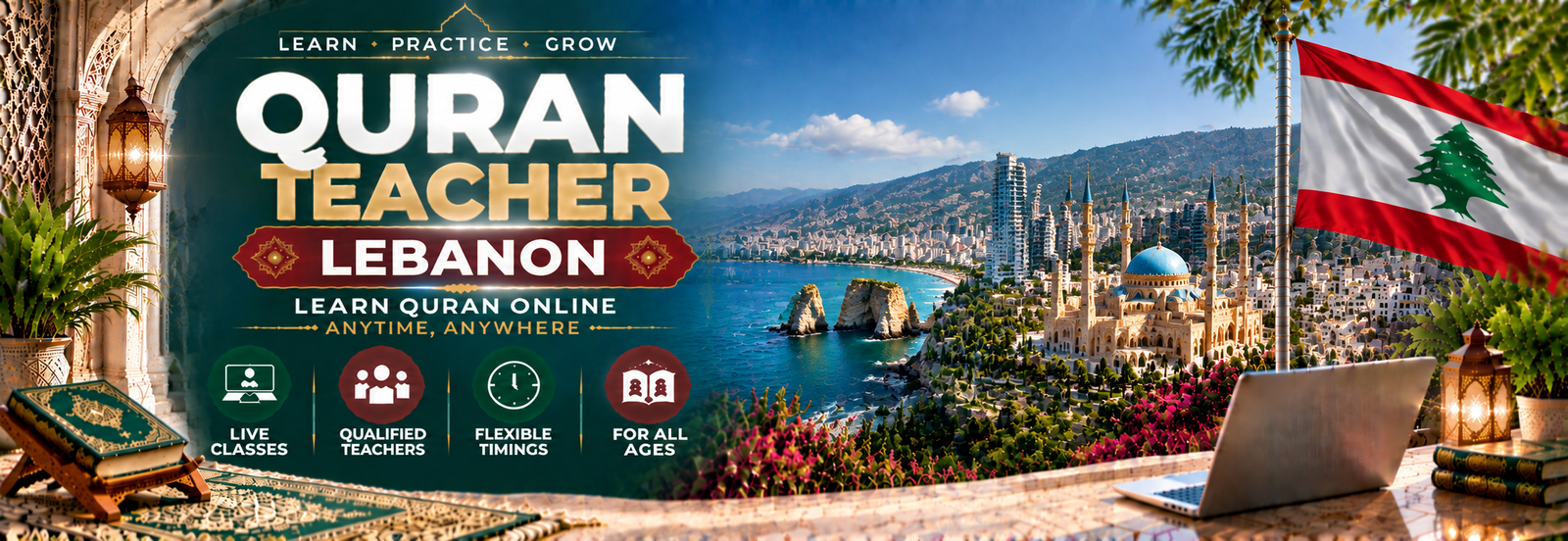
Learn the Quran Online From Anywhere in Lebanon With Your Own Hafiz
Parents who look for a Quran Teacher Lebanon option often start at the neighbourhood masjid, and many find a good class there. Others hit a wall. The evening circle is full, the time clashes with homework, or their child studies in English and struggles when every rule is explained in Arabic. Quran Pak Teacher connects your child with a Hafiz or Hafiza in Lahore for live one to one classes, explained in clear English, or Urdu if you prefer.
Where Our Classes Fit and Where a Local Ustaz Is Better
Lebanon has old Quran roots, from Dar al Fatwa in Aisha Bakkar to the historic mosques of Tripoli and Saida. The CIA World Factbook puts Muslims at about 68% of Lebanese citizens, and many local mosques run Quran circles. If your family wants lessons explained in Arabic, or your child learns best sitting with neighbours, a local teacher may suit you better, and we will say so when you contact us.
Our classes suit a different family. Lebanon’s Center for Educational Research and Development reports that 34% of schools use English as their foreign language and another 23% use English and French together. Many children in Hamra, Verdun or Tariq el Jdideh read Arabic script slowly and think in English. A teacher who explains a Tajweed rule in their stronger language can save months of confusion.
We teach the Hafs recitation used across Lebanon. Our teachers come from a Sunni Hanafi background. Reading and Tajweed lessons work for every family, but if you want Tafseer from your own tradition, raise it during the trial and you will get a straight answer.
Online Quran Classes Lebanon Families Can Plan Around School
Lahore is 2 hours ahead of Beirut in summer and 3 hours ahead in winter. Our teachers work in shifts around the clock, Monday to Friday, so a 4:30pm lesson after school in Tripoli or a late one in Nabatieh once dinner is cleared is simple to arrange. Lessons run 30 minutes, five days a week. There are no weekend classes, which leaves Saturday free for Brevet revision or family visits to the Chouf.
Each student keeps one teacher and one slot.
Six Courses From First Letter to Tafseer
All six courses are live and one to one.
Noorani Qaida is the starting point for children from age 4 and for adults who never learned. Students learn each letter, its sound and how letters join into short words.
Quran Reading moves the student into the mushaf. They read aloud while the teacher corrects makharij, madd and ghunnah as they go. Most students read fluently with Tajweed within 6 to 12 months.
Hifz is our Quran memorization course, paced to the student, with each day split between fresh ayat and revision of what is already memorized.
Tarjuma gives the meaning of every word of an ayah in English or Urdu, so students understand what they recite in salah.
Tafseer explains the background and lessons of each surah for teens and adults.
Learn Urdu helps South Asian households in Lebanon keep their home language alive in the next generation.
Fees and Paying From Lebanon
The fee is $30 a month for 20 classes, about $1.50 per class. Other currencies are on our fee plan. Families pay by Western Union. In Lebanon, OMT has been Western Union’s accredited agent since 1998 and lists more than 1,400 branches, so most parents can send the monthly fee in US dollars from a shop near home with no bank card.
Before you pay anything, your child gets three free trial classes.
A Hafiza for Women and Girls in Lebanon
Many Lebanese mothers want to learn alongside their children, and many girls feel more at ease reading aloud to a woman. Any female student can ask for a Hafiza, a woman who has memorised the whole Quran, and keep her every week. Our online Quran classes for ladies are set around your hours, with a Hafiza who teaches in the slot you choose.
Every lesson is one to one, with no other student on the screen. For young children, keep the laptop in a shared room and sit beside them for the first lessons.
Book Your Free Classes
A good Quran Teacher Lebanon match is one your child keeps asking for long after the first month. Write to us on our contact page and the three free classes will be arranged around your week.
Contact us on WhatsApp for trial classes in Lebanon
F.A.Q. GUIDE RELATED TO OUR ONLINE COURSES & CLASSES
Yes. Children begin with Noorani Qaida from age 4. The teacher starts with single letters, so no reading skill is needed on day one.
No. Our teachers recite Quranic Arabic with Tajweed but explain in English and Urdu. If your child needs explanation in Lebanese Arabic, a local ustaz is the better choice.
We teach Hafs from Asim, the recitation printed in the mushaf used in Lebanese homes and mosques.
Yes. Any female student can ask for a Hafiza when booking, and she keeps the same teacher every week.
Any hour, Monday to Friday. Lebanon is 2 to 3 hours behind Lahore, so after school and evening slots are open.
Pay $30 at any OMT branch as a Western Union transfer, then send us the MTCN on WhatsApp. No bank card is needed.
Go local if a circle near you fits your time. Online Tafseer suits adults who want a fixed weekly slot and room to ask their own questions in English.
The teacher checks your level, suggests a course and shows how lessons run. You decide afterwards, and nothing is paid before then.
If You Have Any Questions, Trial Classes & Registration


FEEL FREE TO ASK
Where We Provide Online Quran Classes
A small Mediterranean country where Islam and Christianity have shaped daily life side by side for generations, Lebanon’s Muslim families continue to pass the Quran down through their children, now increasingly through one-to-one online classes built around school, work, and Beirut’s fast-paced rhythm.