
Quran Teacher Ireland

We at Quran pak teacher teaches families across Ireland by live video. Every tutor has memorised the whole Quran. Lessons last 30 minutes, run Monday to Friday, and cost €30 a month for 20 lessons. Your first lesson is free. You do not need to give card details to book it.
Why families here look beyond their own town
The 2022 Census recorded 81,930 people in Ireland whose religion was Islam. That is up from 49,204 in 2011, according to the Central Statistics Office. Most live in Dublin and its suburbs, in places like Clondalkin, Blanchardstown and Lucan.
There are only two Muslim national schools in the State. One is on Roebuck Road in Clonskeagh, Dublin 14, open since 1990. The other is on Ratoath Road in north Dublin, open since 2001. Both run buses, but only from Dublin areas such as Lucan, Tallaght, Coolock and Blanchardstown. A family in Cork, Galway, Ennis, Tralee or Ballyhaunis has no school option at all.
Mosques do run weekend classes. There is the Dublin Mosque on South Circular Road, the Cork Islamic Cultural Centre, the Islamic Centre on Old Dooradoyle Road in Limerick, and the mosque on Clare Road in Ballyhaunis, County Mayo. These are good places, and for many children they are the right choice. The problem for a lot of parents is simply the drive, and the fact that a weekend class is one group session a week.
Lesson times that fit the Irish school day
The primary school day here is set at five hours and forty minutes, as Citizens Information explains. Junior and senior infants usually finish near 1:30pm. First to sixth class finish closer to 2:45pm. Secondary students finish between 3:30pm and 4pm.
Our tutors work Irish hours. We keep slots open from 3:30pm onwards for children, and later evening slots for adults once the house is quiet. Weekend mornings are also open. Lahore is four or five hours ahead of Ireland depending on the time of year, so a 5pm lesson in Dublin falls in the evening for your tutor. Nobody is teaching your child half asleep.
Tell us the time you want when you book and we will hold it. Lessons stay at the same time each week so they fit around homework, training and family life.
Keeping lessons safe for your child
You can sit in on any lesson, at any time, without telling us first. You do not need a reason.
Your child has the same tutor every session, so they are not meeting a new adult each week. If you would like a lesson recorded so you can watch it later, ask and we will record it. If your child does not settle with a tutor, message us and we will move them to someone else. There is no charge and no awkward conversation.
Noorani Qaida
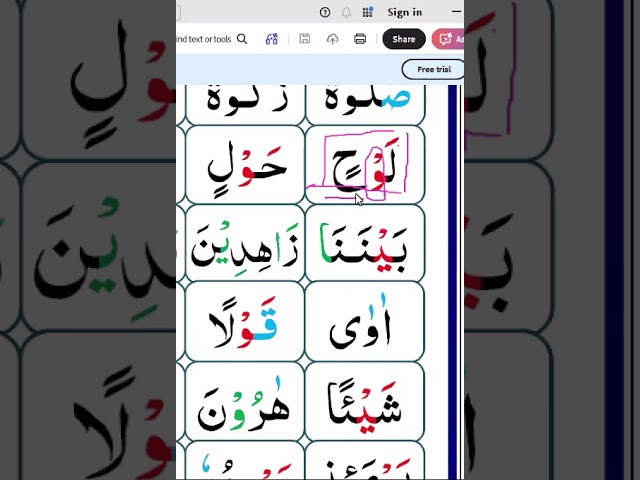
Noorani Qaida is the starting point for anyone who cannot yet read Arabic script, whether a young child or an adult beginner.
It teaches the shapes and sounds of the Arabic letters, and the correct point in the mouth or throat from which each letter is pronounced.
Students learn the short vowel signs that change how a letter sounds.
They also learn how letters join together and change shape depending on where they sit in a word, along with basic marks like tanween, sukoon and shadd.
The teaching here is slow and repetitive on purpose, since a student is not moved ahead until a sound is secure.
Every later stage depends on this foundation being solid, so rushing through it tends to cause pronunciation problems that are hard to correct years later.
Quran Reading with Tajweed
Quran reading with tajweed begins once a student can read the script with reasonable confidence.
Tajweed refers to the set of rules that govern correct pronunciation while reading the Quran itself, building on what was learned in Noorani Qaida but going into much more depth.
Students refine their articulation of each letter.
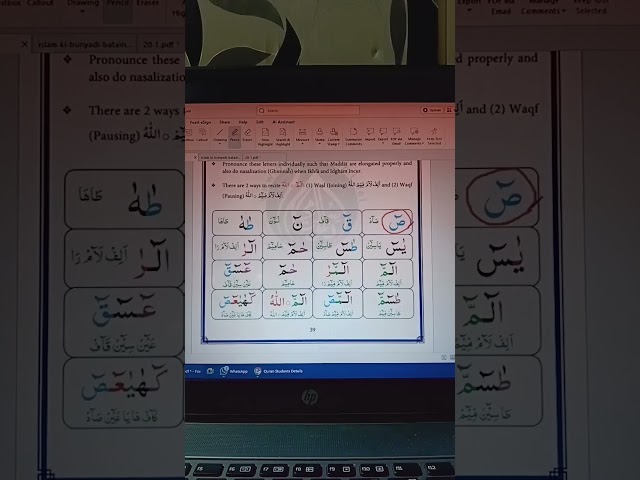
They learn ghunnah, the nasal sound applied in certain situations, and qalqalah, the slight bounce given to a handful of letters when they carry sukoon.
They also learn idgham, where one letter’s sound merges into the next.
They learn ikhfa and iqlab, which involve hiding or changing the sound of noon sakinah and tanween before certain letters.
They learn the rules of madd, which govern how long particular vowels are stretched.
Alongside this, students learn where and how to pause correctly during recitation so the meaning of a verse is not broken.
Throughout, the focus stays on reading clearly and correctly rather than quickly.
This stage often continues for years, running alongside memorisation and translation classes.
Hifz (Quran Memorisation)
Hifz is the memorisation of the Quran, whether in full or in part.
It depends on a student already having solid tajweed, since mistakes learned during memorisation are very difficult to undo later.
Teaching usually follows a daily new portion that is kept small enough to be properly retained.
Alongside this, there is regular revision of recently learned material, and rotating revision of older, previously completed portions so that nothing is allowed to fade.
A teacher listens to each portion individually and corrects both memory slips and pronunciation errors as they arise.
Some families follow an intensive pattern of five days a week, aiming to complete the Quran within a set number of years.
Others follow a lighter weekend pattern that fits around school or work, with smaller portions and a longer overall timeline.
Either way, hifz is treated as a long, steady commitment rather than something to rush, since consistent revision matters more than how quickly new material is added.
Tarjuma
Tarjuma is the word by word and verse by verse translation of the Quran.
It aims to help a student understand what they are reading, not only pronounce it correctly.
It usually starts with matching individual Arabic words to their meanings, so that students begin recognising vocabulary that repeats throughout the text.
From there, students move on to putting those words together into full, coherent verses in Urdu or English.
Over time, as the same root words and sentence patterns keep appearing, students start to follow simpler verses on their own without leaning entirely on a translation.
This is generally introduced once a student has a reasonable grip on reading.
It often runs alongside tajweed classes, since understanding what a verse means tends to make correct pausing and pacing during recitation feel more natural.
Tafseer
Tafseer goes further than translation into explanation and context.
It covers why a verse was revealed, what it means in depth, and how it connects to other parts of the Quran and to hadith.
This includes looking at the historical circumstances behind a verse’s revelation.
It involves unpacking word choices that carry meaning a simple translation cannot capture.
It also means cross referencing a verse with related verses elsewhere in the Quran, or with relevant hadith, to build a fuller picture.
Tafseer draws on established scholarly interpretation, including cases where different scholars have understood the same verse in more than one valid way.
It considers what a verse means practically for daily life, ethics and worship.
Tafseer is usually introduced for older students or adults who already have a solid grounding in tarjuma, since it assumes the student already understands the literal meaning and is ready to explore what lies beneath it.
Female tutors for sisters and girls
Ask for a female tutor when you book and we will arrange one. Lessons are one to one, so nobody else is in the class. For many women and older girls this removes the two real barriers at once, which are getting to a centre and being seen while learning as a beginner.
Adults starting from nothing
A good number of our students are adults who never learned to read Arabic script. Some are new to Islam and have no family member who can teach them. Nobody watches you struggle in a private lesson, and you set the pace yourself. You can spend three weeks on the letters if you need three weeks.
Fees
€30 a month covers 20 lessons, which is five lessons a week of 30 minutes each. There is no joining fee and no charge for the trial. Lessons are always one student with one tutor, never a group. View Monthly Fees Plan
How this compares with a weekend class
A weekend class at your local mosque gives a child something online cannot, which is other Muslim children in the room and a link to the community near you. That matters, and for some families it is the better answer on its own.
What it gives in teaching time is roughly 90 minutes a week in a group. Twenty private lessons a month works out at ten hours of one to one attention. Plenty of families in Ireland do both, using the mosque for the community and daily lessons for reading and memorisation.
Contact us on WhatsApp for trial classes click here
F.A.Q. GUIDE RELATED TO OUR ONLINE COURSES & CLASSES
Yes, most children as young as four or five can start with Noorani Qaida online, as long as sessions are kept short and interactive.
A laptop, tablet or smartphone with a stable internet connection and a video calling app is usually enough.
Yes, we have many families across Ireland, including Dublin, Cork, Galway and Limerick, learning with us online.
Yes, and parents can request a teacher of a specific gender for their child or for themselves.
Yes, a change can be requested at any point if the student or parent feels another teacher would suit better.
Yes, classes are arranged to suit Ireland time (GMT/IST), including evenings and weekends, so they fit around local school and work schedules.
Missed classes can usually be rescheduled, depending on the notice given and the teacher’s availability.
Both are available, and classes can be conducted in whichever language the student is most comfortable with, which suits many Irish-based families who prefer English.
If You Have Any Questions, Trial Classes & Registration


FEEL FREE TO ASK
Where We Provide Online Quran Classes in Ireland
Students in Ireland can join our online Quran lessons from home, with flexible schedules and personalised one-to-one teaching designed around their learning.