
Quran Teacher Jamaica
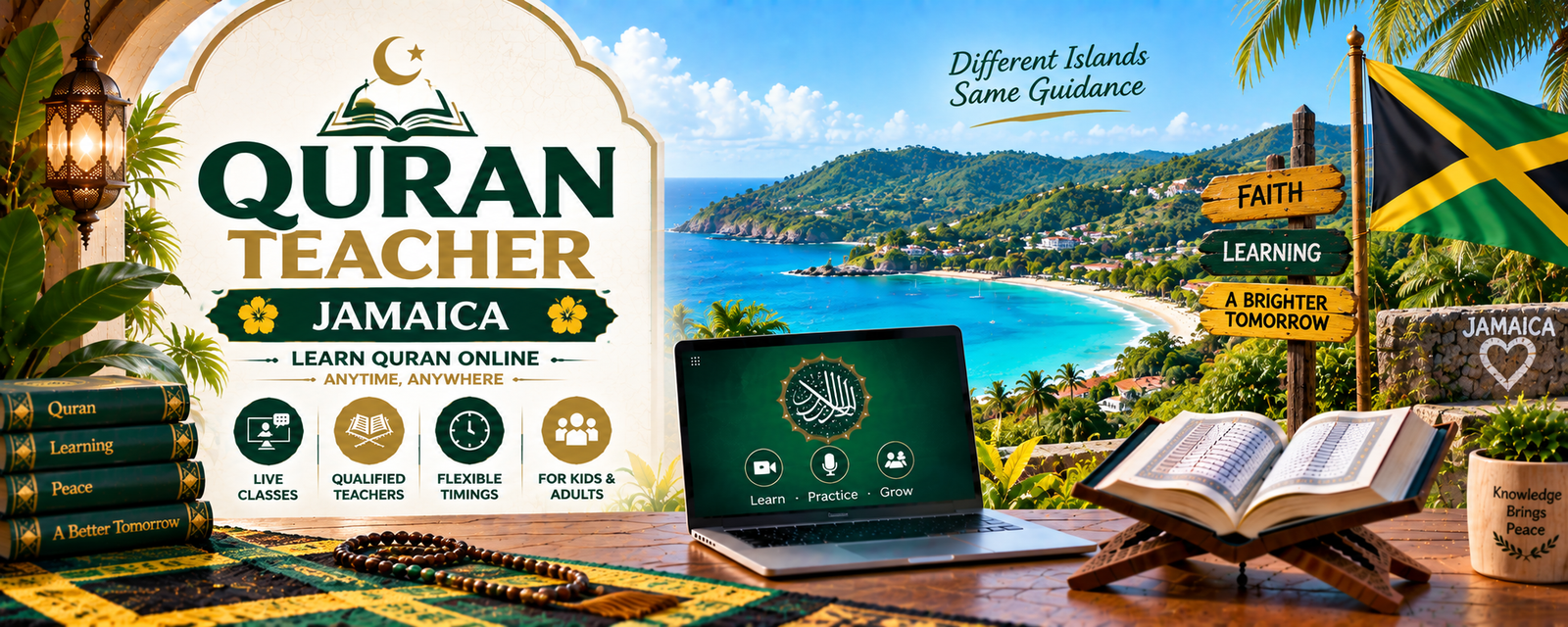
A Quran teacher Jamaica families can reach every weekday costs thirty US dollars a month here, runs one to one over video, and starts with three free trial classes. Lessons are thirty minutes, Monday to Friday, in English and Urdu, taught in Hafs an Asim. That is the short answer.
The longer one starts with a concession. If you live a short drive from Central Masjid on Camp Road in Kingston, or near Masjid Ar-Rahman in Spanish Town, sitting with a local teacher face to face is still better. Take it. Quran Pak Teacher is built for the families who cannot.
Distance Is the Real Problem, Not Interest
The community here is small and spread thin. The Jamaica Foundation for Islamic Charity puts the Muslim population near 5,000, served by roughly fifteen masajid. Most sit in Kingston, Spanish Town, Portmore and Old Harbour. The Islamic Council of Jamaica, formed in 1981, runs classes from Kingston.
Outside those towns the nearest masjid can be a two or three hour drive. Jamaican relief groups report that many masajid stay shut on weekdays because the imams hold full time jobs to support their families. A child in Newell, St Elizabeth or at Three Miles River in Westmoreland may hear Quran taught once a week, on Jumu’ah, and not again until the next one.
Several masajid took hurricane damage and are still under repair. Weekly classes have not restarted everywhere.
What an Online Quran Teacher in Jamaica Can Actually Offer
A screen does not replace a masjid and we will not pretend it does. What it gives you is a fixed half hour with the same tutor every weekday, which most Jamaican districts cannot supply at any price.
Compare the two honestly. A weekend masjid class gives your child a room full of other Muslim children, an imam who knows the family, and a sense of belonging that no video call produces. It also gives one session a week, shared between fifteen students, often cancelled when the imam is at work. A daily one to one class gives five sessions a week, undivided attention, and correction at the exact moment a letter comes out wrong. Most families who have both use the masjid for community and us for progress.
Our Courses
Six courses, taught in order, all listed on our courses page. Your tutor sets the starting point during the free trial, so nobody repeats work already done.
Noorani Qaida teaches the Arabic letters from nothing. Students learn each letter alone, then joined at the start, middle and end of a word, then the vowel marks that change the sound. Children from age four start here. So do adults who never learned, and there is no shame in that. Most finish in three to five months of daily half hour classes, and finishing means you can sound out any word in the mushaf even before you know what it means.
Quran reading picks up where Qaida ends. This is nazra, reading straight from the mushaf, with Tajweed rules taught as they arise rather than as separate theory. The tutor corrects pronunciation in the moment, which is the part an app or a recording cannot do. Our students usually read fluently with correct Tajweed inside six to twelve months, depending on practice between classes.
Hifz is memorisation. New students begin with the short surahs of Juz Amma, the ones needed in salah every day. Each class splits three ways: new lines, yesterday’s lines, and older revision, because memorisation without revision does not hold. Some students finish a juz in a few months and others take longer. Both are fine.
Tarjuma covers word by word meaning. Students stop guessing at what they recite and start recognising the vocabulary that repeats across the text. It suits anyone who has finished nazra and wants the words to carry sense.
Tafseer adds context: when an ayah was revealed, what was happening around it, how scholars have understood it since. For families who want Islamic studies covered alongside Quran, this is the course that does it.
Urdu teaches reading, writing and speaking. Indo-Jamaican households descended from the indentured migrants who arrived from 1845 often want the language kept alive at home, and grandparents are usually the reason parents ask.
Online Quran classes for kids stay short and repetitive. Adult classes move faster and skip the drills.
Will Your Internet Handle It
Almost certainly, yes. Jamaica’s median download speed sat near 90 Mbps with 12 ms latency in May 2026, which is well beyond what a video lesson needs. Flow launched the island’s first commercial 5G network on 11 June 2026, covering more than seventy percent of the population across Kingston, Portmore, Spanish Town, May Pen and the north coast. Digicel runs LTE and fixed wireless alongside its own fibre.
Coverage in Jamaica is decided street by street, and rural districts often depend on fixed wireless or satellite. If your signal drops mid lesson, the tutor switches video off and carries on by audio. Reciting does not need a picture.
Class Times Built Around Jamaican Hours
Jamaica holds UTC minus five all year and never shifts for daylight saving. Lahore sits ten hours ahead. Our teachers work shifts covering all twenty four hours, Monday to Friday. Seven in the morning before school in Kingston, or six in the evening after work in Ocho Rios, both fall inside a staffed shift. Your time never bends to ours.
Hurricane season runs June to November and outages happen. Classes missed to a storm or a power cut are made up, not charged for.
Teachers and Recitation
Our tutors are Hafiz and Hafiza. They teach Hafs an Asim, the reading used across Caribbean masajid, in English and Urdu. Hafiz Ali Ahmad and Hafiz Umair Akram each carry ten years of teaching.
We publish no stock photographs and no invented profiles. Ask for your tutor by name before you pay and you will get one. Academy background sits on our about page.
Safeguarding and Parent Access
Every class is one to one with a parent free to sit in. No private messaging between tutor and student outside class. Sessions recorded on request. Notes from current families are on our testimonials page.
Parishes We Teach In
Kingston, Spanish Town, Portmore, Old Harbour, Montego Bay, Ocho Rios, Mandeville, Negril, May Pen, Port Maria, Albany, Santa Cruz, Morant Bay and Newell, plus the rural districts between them.
Fees and Free Trials
Thirty US dollars a month covers twenty classes of thirty minutes, one to one, Monday to Friday. Classes stretch to forty minutes on request. Full pricing sits on the fee plan. Payment reaches us through Western Union, which has agent locations across Kingston, Montego Bay, Mandeville and most parish capitals.
The first three classes are free and nothing is taken upfront. You meet the tutor, watch how your child responds, and hear the corrections being made before any money moves. If the fit is wrong, say so after the third class and that is the end of it. Message us through the contact page to book, and tell us the parish and the hour that suits you so we can put you with a tutor whose shift matches.
A dependable Quran teacher Jamaica parents can count on should be steady, named and answerable to you. Book the free trials, sit in on the first lesson, then decide.
Contact us on WhatsApp for trial classes in Jamaica
F.A.Q. GUIDE RELATED TO OUR ONLINE COURSES & CLASSES
We bill in US dollars, thirty for twenty classes. Your bank converts at the day rate, so the JMD figure moves with the exchange rate.
Yes. Female tutors teach girls and women, and you can request one before the trial starts.
Yes. A standard mobile data connection carries a lesson. If the signal weakens, video switches off and audio continues.
Yes. Adults start on Noorani Qaida in a private class, with no group and no audience.
Hafs an Asim. If your masjid follows a different reading, tell us at the trial so we can be honest about fit.
Yes. Reverts begin with the Arabic letters and the short surahs needed for salah, at whatever pace suits.
Yes, and many families do exactly that. Tell the tutor what your child covers at the masjid so the two do not collide.
Send a message through the contact page and we will book three free trial classes with a named tutor.
If You Have Any Questions, Trial Classes & Registration


FEEL FREE TO ASK
Where We Provide Online Quran Classes
Reggae, mountains, and a laid-back island rhythm define life in Jamaica, but tucked within that rhythm is a small, committed Muslim community that’s finding its own way to keep the Quran close, through one-to-one online classes that fit around work, school, and everyday island life.