
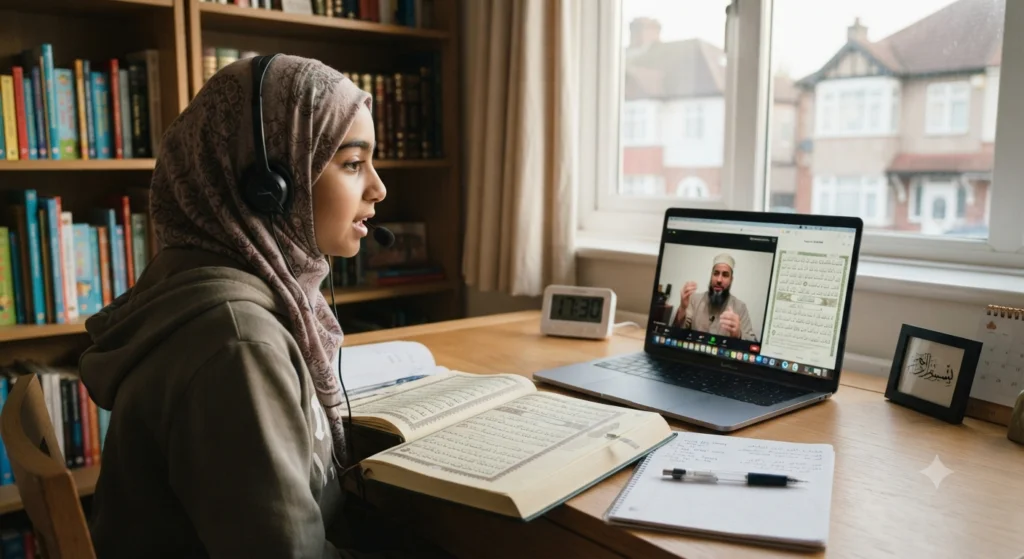
Virtual Learning of the Quran in Non-Islamic Countries
Millions of Muslim families now live in countries where mosques are few, madrasahs don’t exist nearby, and finding a qualified Quran teacher used to feel almost impossible. If you live in the USA, UK, Canada, Australia, or anywhere without a strong local Islamic community, you already know this problem well.
Virtual learning has changed that completely. Today, a Muslim family in a small town in Texas or a quiet suburb outside Toronto can connect with a certified Quran teacher the same way a family in Cairo or Karachi does. The only real difference is a screen.
This article looks at how online Quran classes work for Muslims living abroad, why this shift matters, and what to look for when choosing a teacher for your family.
Why Learning Quran Abroad Used to Be So Hard
Before reliable internet and video calls, Muslim families living in non-Islamic countries had limited choices. Most relied on:
- Weekend classes at a local mosque, if one existed nearby
- Community volunteers with varying levels of Quran knowledge
- Sending kids “back home” during school holidays for intensive study
- Self-teaching from books, without correction or feedback
None of these options were reliable for every family. Some cities had no mosque within driving distance. Others had a mosque, but no teacher trained in proper Tajweed. Parents often ended up teaching their kids themselves, even when they weren’t fully confident in their own recitation.
How Online Quran Classes Solve This Problem
Online learning removes the geography problem entirely. A qualified online Quran teacher in Pakistan, Egypt, or Saudi Arabia can teach a student in London, Sydney, or Vancouver through a simple video call, using apps like Zoom, Google Meet, or Microsoft Teams.
This matters for a few clear reasons:
1. Access to Qualified Teachers, Not Just Available Ones
Instead of settling for whoever happens to live nearby, families can choose a teacher based on qualifications, teaching style, and experience with children or adults. A parent in Chicago can pick a teacher with a proper Ijazah in Tajweed, even if no such teacher lives within a thousand miles.
2. Flexible Timing Across Time Zones
Good online academies work with students across many time zones. A family in Australia can book an evening class that lines up with morning hours for a teacher elsewhere. This flexibility barely existed with local, in-person options.
3. One-on-One Attention
Many mosque classes, when available, involve group settings with ten or more children per teacher. Online quran classes online are often structured as one-on-one sessions, giving each student direct correction and full attention, something that’s hard to get in a crowded weekend class.
4. Consistency Even When Life Gets Busy
Families abroad often juggle school schedules, work, and other commitments that don’t leave room for driving to a mosque twice a week. Online classes fit into a home schedule, which makes it far easier to stay consistent over months and years.
What Muslim Families Abroad Should Look for in a Quran Teacher
Not every online option is equally reliable. Before enrolling your family, check for these things.
Proper Credentials
Ask if the teacher holds an Ijazah, a formal certification showing they studied Quran recitation under a qualified scholar. This matters more than a friendly personality alone.
Experience Teaching Students Abroad
Teaching a child who grew up surrounded by Arabic is different from teaching a child raised in an English-speaking or non-Arabic environment. A teacher experienced with students abroad understands common pronunciation challenges specific to that background.
Male and Female Teacher Options
Many families prefer a female teacher for daughters or young children. Reliable academies offer both male and female teachers so families can choose what feels right for them.
A Free Trial Class
Never commit to a long-term package before testing a session. A trial class shows you the teacher’s patience, communication style, and whether the video call quality works well for your household.
Quran Learning for Kids Raised Abroad
Children raised outside Muslim-majority countries face a specific challenge: they may speak fluent English at school but have little daily exposure to Arabic or Islamic environment. This makes early, structured Quran learning even more important.
A good program for these children usually starts with:
- Learning Arabic letters and sounds through something like a Noorani Qaida course
- Moving into Quran reading with correct Tajweed, once letters and basic reading are solid
- Adding simple meaning and Tafsir as the child grows older, so recitation isn’t just mechanical
Consistency matters more than speed here. A child who studies twice a week for two years will usually retain far more than one rushed into memorization without solid reading skills first.
Adults Learning Quran Later in Life
It’s common for adults living abroad, especially converts or those who moved away from religious environments years ago, to start learning Quran as adults. This comes with its own considerations.
Adult learners often benefit from combining Quran reading with an online Quran Tarjuma course, so they understand the meaning of what they’re reciting, not just the pronunciation. Many adults find this deepens their connection to prayer in a way that reading alone doesn’t.
Country-Specific Considerations
Every country has its own mix of challenges and available community resources. Families in the United Kingdom, Canada, and Australia often search separately for local guidance, since school schedules, time zones, and community size vary a lot between these places. Working with a teacher who has specific experience teaching Muslim families in your country can make communication and scheduling much smoother.
Practical Tips for Getting Started
- Start with a level assessment. A good teacher checks where your child or you currently stand before creating a study plan.
- Choose consistent timing. Two or three fixed sessions a week work better than irregular, whenever-possible scheduling.
- Keep a notebook at home. Simple review between classes speeds up progress significantly.
- Involve the whole family when possible. Parents reviewing lessons alongside kids reinforces what’s being learned.
- Be patient with pronunciation. Tajweed takes time to master, especially for students not surrounded by Arabic daily. Consistent correction matters more than fast progress.
Final Thoughts
Living far from a mosque or Islamic school no longer means your family has to go without proper Quran education. A qualified Quran teacher is now only a video call away, no matter which country you live in. What matters most is choosing a teacher with real credentials, patience, and experience working with students raised outside the Arabic-speaking world.
If your family has been searching for a reliable way to learn Quran online, start with a free trial class and see how a dedicated teacher can bring that learning experience straight into your home, wherever in the world you are.