
Quran Teacher Uruguay

Finding a Quran Teacher Uruguay families can actually reach is hard, and that is not your imagination. The United States Commission on International Religious Freedom put the country’s Muslim population at roughly 700 to 1,500 people in its 2022 report, close to 0.1 percent of Uruguay. Most live in Chuy, Rivera, Artigas and Montevideo. Quran Pak Teacher runs live one to one classes from Lahore for these households, scheduled around Uruguayan evenings instead of Pakistani ones.
Start with what already exists near you
If you live in Montevideo, visit the Centro Egipcio de la Cultura Islámica at Baltasar Vargas 1178 first. The centre has operated since 1982 under the Egyptian Embassy and, as recorded in 2022, is overseen by Sheikh Samir Selim. It holds daily prayers, Friday jummah, Arabic lessons and Quran teaching sessions. Canelones has an Islamic centre as well. Sitting with a teacher in person beats any screen, and we would rather say that than pretend otherwise.
This page is for everyone else. Chuy sits 340 kilometres northeast of the capital in Rocha Department, separated from Chuí in Brazil by one shared avenue. Uruguay’s national statistics institute recorded 9,675 residents there at the 2011 census, including much of the country’s Palestinian community, estimated at around 5,000 people nationally. Rivera faces Santana do Livramento across the Parque Internacional. Artigas looks over the Cuareim at Quaraí. In those towns the nearest masjid is a full day of driving.
Who studies with us from Uruguay
A trading family in Chuy whose children speak Spanish at home and have never seen Arabic script. An adult in Rivera who reads slowly, learned by copying others, and wants pronunciation fixed without a room full of people listening. A parent in Montevideo who needs a fixed weekday slot that a mosque timetable cannot offer.
Classes built around the Uruguayan clock
Uruguay runs on UTC minus three. Lahore runs on UTC plus five. The gap is eight hours, and most academies quietly ignore it.
Our teachers work in shifts across all 24 hours, Monday to Friday. A 5:00 pm class in Montevideo is 1:00 am in Lahore. A 6:00 pm class is 2:00 am. A 7:00 pm class is 3:00 am. Those shifts are staffed. Your child studies after school, before dinner, at the same hour every weekday, with the same teacher. We do not run weekend classes, so plan around Monday to Friday.
Booking an online Quran teacher in Uruguay from any department
Each class runs 30 minutes, one student with one teacher, over a live video link, 20 classes a month. Two named teachers lead our Quran instruction: Hafiz Ali Ahmad and Hafiz Umair Akram, each with ten years of teaching behind them. We publish no invented profiles and no photographs of people who do not teach here.
We teach Hafs an Asim. That matters in Uruguay. The Palestinian, Lebanese and Egyptian origin families who make up most of the community already recite this way, so there is nothing to unlearn. Your child reads as their grandparents read.
Female Quran teacher for women and girls
Women and girls can request a female teacher, and the request is honoured without questions. This is arranged before the first trial class, not afterwards, so no student ever sits through a session she is uncomfortable in.
Our female teachers cover the same six courses as the rest of the staff, from the first letters of Noorani Qaida through Tajweed, memorisation and Tafseer. Many mothers in Chuy and Rivera study alongside their daughters in separate slots, often because they were never taught properly themselves and would rather not say so in front of a group. There is no beginner level we consider too basic. Tell us when you book that you want a female teacher and give the two evening times that suit you.
Our courses
Six courses, all taught live, one student with one teacher. Any of them can be started during your free trial classes so you can see the method before paying.
Noorani Qaida
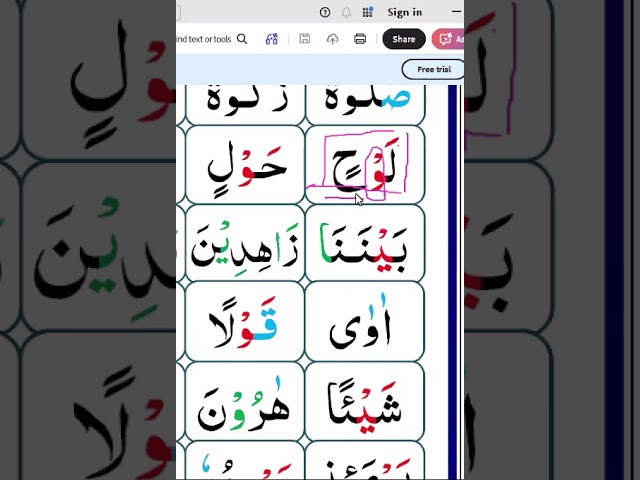
Noorani Qaida is where a complete beginner starts. It teaches the Arabic letters one at a time, then how those letters change shape when joined, then short vowel sounds, then full words. For a child in Chuy or Rivera who speaks Spanish at home and has never seen Arabic script, this is the right first step, and there is no shame in an adult starting here too. Most students spend three to six months on Qaida before moving to the Quran itself.
Quran Reading with Tajweed
Quran Reading takes a student who knows the letters and builds fluent recitation. The teacher listens to you read aloud every session and corrects pronunciation as you go, which is the part a recorded video or an app cannot do. Tajweed rules are introduced gradually while you read rather than taught as separate theory, so you apply each rule the same day you learn it.
Hifz
Hifz is structured memorisation. The teacher sets a daily portion based on what the student can hold, then revises earlier portions in every class so nothing slips away. Pace is set by the student, not by a fixed syllabus, and a child memorising alongside school in Uruguay will move slower than one in a full time madrasa. That is expected. Progress notes are kept so a student never loses ground after a break.
Tarjuma
Tarjuma teaches word by word meaning. Many people recite fluently for years without knowing what they are saying, which is common in families several generations away from an Arabic speaking country. This course closes that gap, starting with the short surahs a student already knows by heart so the first lessons feel familiar rather than daunting.
Tafseer
Tafseer explains background and commentary: when a passage was revealed, what it was responding to, and how scholars have understood it. It suits older students and adults who already read with reasonable fluency. Teenagers in Uruguay who face questions about Islam at school often take this course specifically, because it gives them answers that come from the text rather than from arguments online.
Learn Urdu
Learn Urdu is offered for families who want to keep the language alive across generations. It covers reading, writing and everyday conversation. It is separate from the Quran courses and is usually taken by children of Pakistani origin families whose grandparents speak Urdu but whose parents are losing it.
Every course is listed with full details on our courses page.
What happens if a teacher leaves or you miss a week
The common complaint about online classes is not teaching quality. It is teachers who vanish and get swapped without warning. If your teacher becomes unavailable we tell you before the next class, not after it, and we hand over the student’s progress notes so the new teacher does not restart from the beginning. Miss a class and you can ask for a make up session. Let us know in advance where you can, though we will not charge you for an emergency you could not plan for.
Fees, trial and payment from Uruguay
Fees are 30 USD, 30 GBP or 30 EUR a month for 20 classes. Full details sit on the fee plan page. Payment goes through Western Union. We do not bill in Uruguayan pesos, and saying so here is better than letting you find out at checkout.
Three trial classes come free, with no card details taken. Message us through the contact page with the student’s age, your city and two evening times.
Keeping classes safe
A parent or guardian may sit in on any class. Ask before recording a session and we will ask before recording one. If a student is uncomfortable with a teacher, tell us and we change the teacher without asking you to explain. Families have written about their experience on our testimonials page.
Book a trial
Send us the city, the student’s age, two times that work in your evening and whether you want a male or female teacher. We confirm the teacher and a fixed weekday slot before the first lesson. Reach us on the contact page or read the full FAQ. Choosing a Quran Teacher Uruguay families stay with for years comes down to two things: a teacher who appears at the same hour every week, and straight answers about what is not on offer.
Contact us on WhatsApp for trial classes in Uruguay
F.A.Q. GUIDE RELATED TO OUR ONLINE COURSES & CLASSES
Yes, in Montevideo. The Centro Egipcio de la Cultura Islámica on Baltasar Vargas runs Quran sessions and Canelones has an Islamic centre. Outside the capital there is almost nothing, which is why families in Chuy, Rivera and Artigas study online.
Any hour Monday to Friday. Uruguay is eight hours behind Lahore, so your 6:00 pm is the teacher’s 2:00 am. That shift is staffed.
Yes. Ask when booking and a female teacher is assigned before the trial class, not after.
Hafs an Asim, already used by most Arab origin families in Uruguay.
Yes. Teaching is in English and Urdu, and Noorani Qaida starts at the alphabet, so no Arabic is assumed. Mention your child’s comfort in English when you book the clase de prueba.
30 USD, 30 GBP or 30 EUR monthly for 20 classes, paid by Western Union.
Most students reach fluent reading in six to twelve months of steady weekday classes. Younger beginners take longer.
Request a make up session and we schedule one.
If You Have Any Questions, Trial Classes & Registration



FEEL FREE TO ASK
Where We Provide Online Quran Classes
Along the shores of the Río de la Plata, Uruguay’s Muslim families are keeping Quran learning close to home, through flexible one-to-one online classes built around their week.