Quran Teacher Senegal
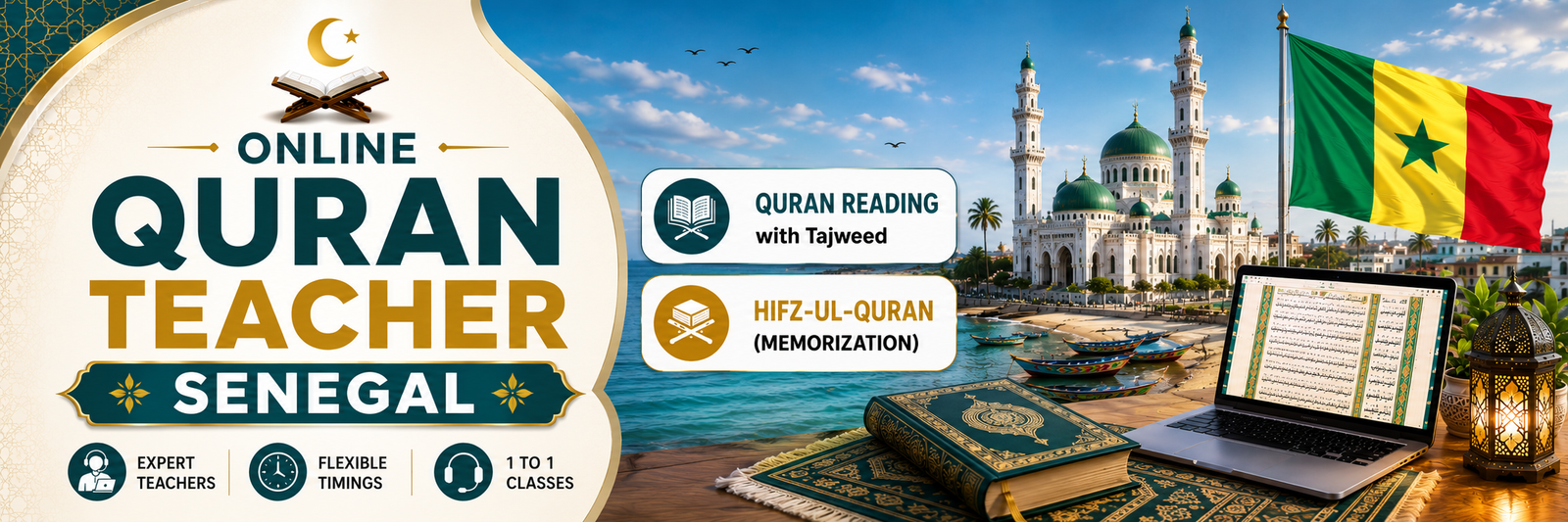
Quran Pak Teacher gives families across Senegal private online Quran lessons with trained male and female teachers. Each class lasts 30 minutes, runs Monday to Friday, and puts one teacher with one student. Twenty classes cost $30 a month. New students get three free classes before they pay anything.
Your child learns at home, at your own table, at a time that suits your family.
WhatsApp us for your free classes
Learning at home instead of sending your child away
Quran study here has long meant the daara. Families still send a child to learn with a Serigne, sometimes far from home, sometimes for years. That road has produced huffaz, people who know the whole Quran by heart, in Touba, Tivaouane and Medina Baye. It carries deep weight in a country where about 95 percent of people are Muslim, according to Georgetown University’s Berkley Center, and where most families follow the Tijaniyya, Mouride, Qadiriyya or Layene orders.
It is not the only road.
Whether your home is in Plateau, Médina, Ouakam, Sacré Coeur, Point E, Parcelles Assainies, Grand Yoff or Guédiawaye, your child can study without leaving the house. You sit beside them. You hear how the teacher corrects them. At five in the evening you know where your child is, because they are with you.
Some families choose both. A talibé at the daara, and a younger child starting at home first.
How online Quran classes work in Senegal
Senegal keeps GMT all year and never moves its clocks, so a fixed weekly slot stays fixed. Children usually study straight after school. Adults often pick early morning before work, or the evening after Isha.
You need a phone, tablet, laptop or computer and a working connection. Senegal has more than 19 million mobile subscriptions, and about 65 percent of people can reach the internet, according to the national regulator ARTP. If your data carries a video call, it carries a lesson. We teach on Zoom and Google Meet.
Families join us from Dakar, Thiès, Touba, Kaolack, Saint Louis, Mbour, Rufisque, Diourbel, Ziguinchor and Louga. Senegalese households in France, Italy, Spain, the United Kingdom and the United States study with us too.
If your family travels for the Magal, the Gamou or Ramadan, tell us and we will move those lessons. Any class you miss is made up when you ask.
Which way of reciting does your family follow?
Most of West Africa recites in Warsh ‘an Nafi’. Much of the wider Muslim world uses Hafs ‘an ‘Asim. Both were passed down from the Prophet, peace be upon him. The difference is in how certain letters and vowels are said, not in what the words mean.
Almost no online academy raises this. So a child finishes a year of lessons and recites in a way that sounds unfamiliar at home.
Tell us which reading your family follows when you book. We will confirm before your first paid class which of our teachers can work in it, and we will say so plainly if none can.
Who will teach your child
Our teachers are qualified huffaz and hafizat, meaning each one has memorised the entire Quran. We have taught from the Islamic Quran Academy in Lahore since 2020. Our students live in the United Kingdom, the United States, Canada, Australia, Europe, the Gulf and West Africa.
You keep the same teacher every week, at the same hour. A teacher who turns up every week is worth more than a famous name who does not.
Lessons are given in English and Urdu, with recitation in Arabic. We do not teach in French or Wolof at this time. If your child studies in French at school, tell us when you book so the teacher slows the pace and explains carefully.
You meet your teacher during the free classes, before you commit to anything. If the match is wrong for your child, say so and we will find another teacher. Families have written about their experience on our students feedback page.
Quran classes for kids in Senegal
Children usually start between four and seven with Noorani Qaida. It teaches the Arabic letters, the sound each one makes, and how they join together. From there your child moves to Quran reading classes with Tajweed, then to memorisation if that is what your family wants.
Thirty minutes is short on purpose. A child who still enjoys the lesson when it ends comes back the next day.
A female Quran teacher for women and girls
Qualified women teach women and girls. This is a normal option, not a favour you have to ask for twice.
Many of our women students are mothers learning next to their own children. Others are reading the Quran properly for the first time. Ask for a female teacher when you book and that is who you meet.
Adults who are starting from nothing
If you cannot read Arabic yet, you are not late. We teach adults in their forties, fifties and sixties, and people who came to Islam later in life.
Nobody else sits in the room, so no group watches you sound out letters. Most adults read fluently with correct Tajweed in six to eight months, depending on how often they study.
Courses in our Quran academy
Noorani Qaida for beginners of any age. Quran reading with Tajweed, which can also be taken as online Tajweed classes on their own if you already read Arabic and want your pronunciation corrected. Hifz with daily targets and revision. Tarjuma for word by word meaning. Tafseer for context and explanation. Urdu for those who want translation in Urdu.
Every course is one to one. See all six on our courses page.
Fee, payment and free classes
Twenty classes a month cost $30, which is about $1.50 a lesson. There is no joining fee and nothing to buy. Details sit on our monthly fee page, and our refund policy is published openly.
Your first three classes are free. You pay only after you have watched a lesson.
Message us and we will confirm which payment method works best from Senegal.
Knowing that it is working
You get a short written note each week saying what your child covered, what improved, and what still needs work.
You may join any lesson without telling us first. Every teacher is named to you before the first class, so you know exactly who is teaching your child. Lessons happen at a set time on a link we send, and teachers do not message students privately outside class hours.
Book your free classes
Message us on WhatsApp and tell us three things. Who the classes are for, roughly what level they are at, and which times of day suit you. We match a teacher and book your free classes, usually within a day or two.
If it works, you carry on. If it does not, you owe nothing.
WhatsApp: +92 313 858 1672 or use our contact page.
Contact us on WhatsApp for trial classes click here
F.A.Q. GUIDE RELATED TO OUR ONLINE COURSES & CLASSES
Yes, our tutors teach step-by-step, starting with Arabic letter recognition, so children with no prior Arabic knowledge can follow along easily.
One-to-one classes are 30 minutes per student. In some cases, this can be increased up to 40 minutes.
Yes, tutors regularly update parents or students on progress, covering recitation accuracy, memorization, and Tajweed improvement.
All classes are strictly one-on-one — no group sessions — ensuring full, personalized attention from the tutor.
Yes, subscriptions are flexible with no long-term lock-in — you can pause or cancel as per your plan’s terms.
Payments can be made securely online via international payment methods; full details are provided during signup.
A laptop, PC, tablet, or smartphone, plus an internet connection. Zoom is used for audio/video calls.
Yes. The courses follow a detailed plan suitable for all ages, from a 4-year-old child to an elderly adult, regardless of prior experience or qualifications whether you’re in or anywhere else.
If You Have Any Questions, Trial Classes & Registration



FEEL FREE TO ASK
Where We Provide Online Quran Classes
Known for its deep Islamic scholarship, Senegal’s families are now bringing that same tradition home, through flexible one-to-one online Quran classes built around their schedule.