Quran Teacher Namibia
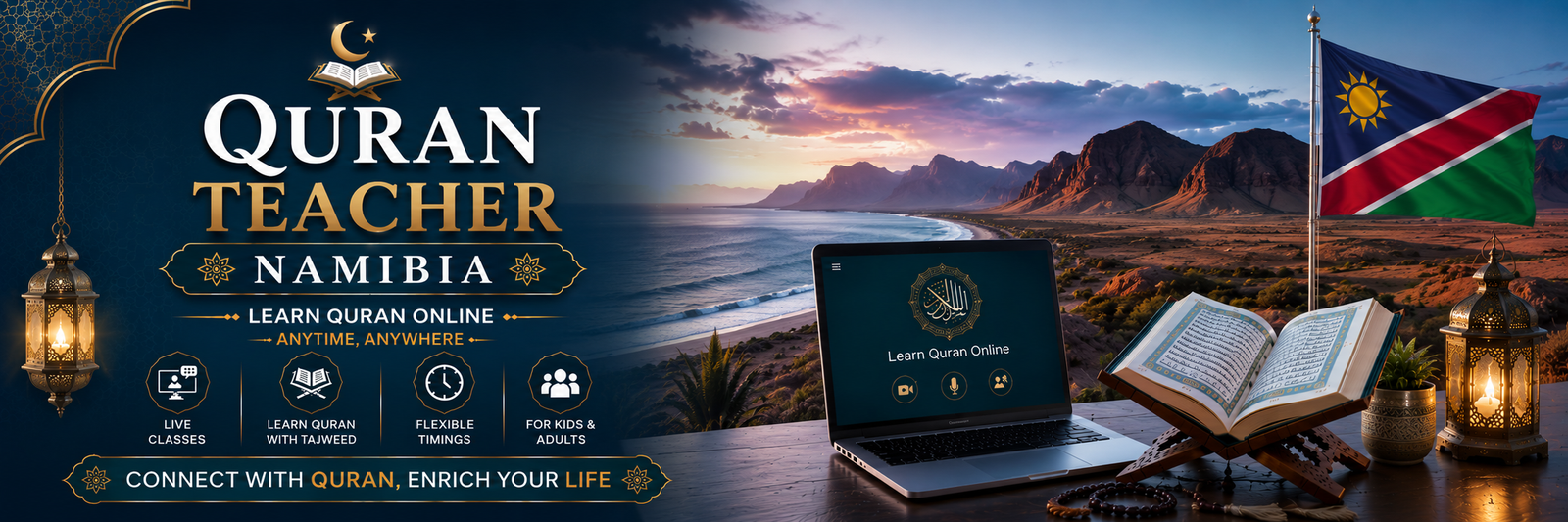
Finding a Quran teacher in Namibia is hard outside three or four towns. The 2023 census counted 3,022,401 people, and Muslims are a small share. Away from Windhoek, Walvis Bay, Katima Mulilo and the far north, most families have no madrasa within driving distance. Live one to one lessons over video are the answer. We teach from Lahore, in English and Urdu, using Hafs recitation, at any hour that suits your household.
Where families can find local classes, and where they cannot
Estimates of the Muslim population differ widely: community figures near 20,000, some national ones reaching 70,000, and the US State Department grouping Muslims with Baha’is, Jews and Buddhists at roughly 3%. Nobody counts it precisely. What is clear is where the mosques are.
In Windhoek, Sunni families usually pray at the Windhoek Islamic Centre or the Namibia Islamic Association masjid on Hippocrates Street. The Quba Mosque on Nelson Mandela Avenue is a Shia masjid, so it will not suit every household. In Walvis Bay there is Masjid Ul Ashrafi in Narraville and Bait Ur Rahmaan on Hage Geingob Avenue. Mosques also serve Katima Mulilo and the north around Oshikango.
If you can reach one of these, go. A teacher your child sits beside beats one on a screen. But if you are in Rundu, Gobabis, Otjiwarongo, Swakopmund, Keetmanshoop or on a farm in Omaheke, there is nothing nearby. That is the gap we fill.
What lessons cost, in Namibian dollars
Private tutoring here runs around N$182 an hour on published Namibian marketplace rates, so near N$91 for a half hour.
Our monthly fee is US$30, roughly N$500, for 20 classes a month. Five days a week, 30 minutes each, one to one. That is about N$25 a class, with no registration fee and no charge for books. You get three free trial classes first.
Paying from Namibia
Visa and Mastercard from Bank Windhoek, FNB and Standard Bank work fine, and we send a bank link if a card fails. Two things worth knowing: eWallet and PayToday move money only inside the country, so they cannot reach us, and Stripe and Square do not support Namibia as a merchant country as of 2026, which is why some services cannot take a Namibian card at all.
Will the connection hold?
Testing for the year to June 2026 put MTC’s average fixed download at 23.5 Mbps and mobile at 50.4 Mbps, with Paratus at 57 milliseconds ping. Windhoek and the coast are steady. The north is not, which is why funding has gone to Ohangwena, Oshikoto, Kavango West and Kunene.
Quran lessons are talk, not streaming, so the bandwidth demand is small. We run on Zoom or Google Meet, and drop the video when the line will not carry it. Families in Ondangwa and Oshikango run whole terms this way on mobile data.
Hanafi homes, Hafs recitation, and the language at the table
Most Namibian Muslims are Sunni and follow the Hanafi school, and local students of Islamic knowledge have long trained at Darul Uloom institutions in Durban. Our teachers are Hanafi trained and teach Hafs an Asim, the recitation used across southern Africa.
On language we will be straight. Our teachers work in English and Urdu, not Oshiwambo, Khoekhoegowab, Afrikaans or Silozi. Children schooled in English do well. If your child thinks mainly in Oshiwambo, a local teacher may suit them better, and we will say so on the trial.
Who will be teaching
Degrees and certificates are checked before any teacher is allowed near a student, and background checks are part of that. Male and female teachers are both on the roster.
For Namibia, three things decide the match: whether your child is comfortable in English, whether you need a sister to teach a daughter, and which hour of the day you want the lesson to sit in.
All three get sorted on the trial call, where you meet the actual teacher rather than a sales person. Wrong fit, say so, we change at no cost.
More about us, and what families have said.
Keeping your child safe online
Police here report that most fraud cases now come through digital channels, and CRAN keeps warning the public about scams. That caution is sensible, so here is how we work.
Lessons are recorded and the file is yours to keep. Drop into any session unannounced, no permission needed. Contact between teacher and student is limited to class hours, with everything else going through the parent account. One named person handles concerns, and you may cancel at the end of any month under our refund policy.
Our courses
Six courses. Every one is a single teacher with a single student, and all use Hafs.
Noorani Qaida
Where a child with no Arabic starts. The shapes, the sound each one carries, the marks above and below them, then putting them together. Four to six months is normal, though a five-year-old will take longer than a ten-year-old and that is fine.
Quran Reading with Tajweed
Begins once the letters are secure. Children learn where in the mouth and throat each sound is properly made, which is what makharij means, and then the rules that govern length, pauses and nasal tone.
Hifz: Quran Memorization
Memorization, starting at Juz 30 because those are the surahs a child already hears in prayer. Little and often works better than long sittings, so new work stays light and revision does the heavy lifting.
Tarjuma: Word by Word Translation
Urdu translation, one word at a time. For homes where Urdu is spoken and parents want the child to grasp meaning, not just produce sound.
Tafseer: Meaning and Context
The background behind a passage, why it came down and how scholars have read it since. Adults and older teenagers mostly.
Urdu Lessons
A course of its own, for families raising children far from home who want the language to survive the generation.
A certificate follows each course, once the Tajweed assessment is cleared.
If you have been looking for a Quran teacher in Namibia and coming up short, book a free trial and let your child meet the teacher before you pay anything.
Contact us on WhatsApp for trial classes in Namibia
F.A.Q. GUIDE RELATED TO OUR ONLINE COURSES & CLASSES
Yes. The Windhoek Islamic Centre runs Quran and Arabic classes for children, women and new Muslims. If you can get there, use it. Video lessons suit families where distance or timing rules that out.
The Windhoek Islamic Centre and the Namibia Islamic Association masjid on Hippocrates Street. Quba Mosque on Nelson Mandela Avenue is Shia, which matters if your household is Sunni.
Yes. Visa and Mastercard from Namibian banks work. Local wallets such as eWallet and PayToday cannot reach us, as they work only inside the country.
Yes, for girls and for adult women. Request one when you book. Lessons stay one to one.
Usually. Audio uses very little data. If video drops in Ondangwa or Katima Mulilo, we run audio only and share the page on screen.
Hafs an Asim, the recitation used here and across southern Africa. We do not teach Warsh.
Namibia is UTC+2, three hours behind Pakistan. A 5pm class in Windhoek is 8pm in Lahore, so after school and after work slots are open.
Tell us and we change teacher, at no cost and no questions.
If You Have Any Questions, Trial Classes & Registration



FEEL FREE TO ASK
Where We Provide Online Quran Classes
Amid the vast dunes of the Namib Desert, Namibia’s Muslim families are keeping Quran learning close to home, through flexible one-to-one online classes built around their week.