
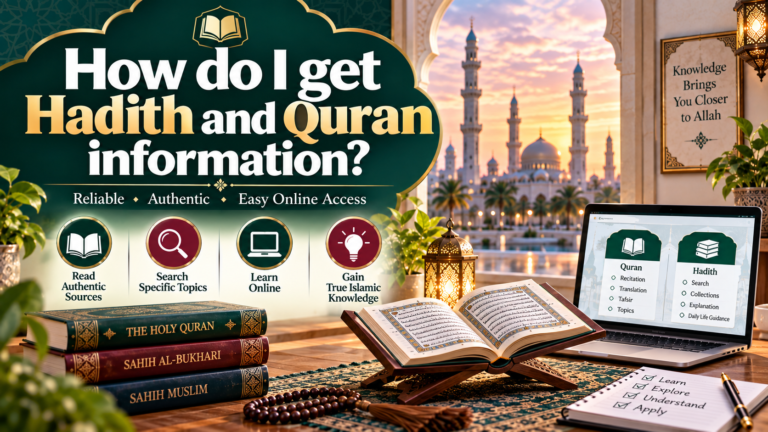
Most people now receive their Quran and Hadith information as a screenshot in a family group chat. Some of those quotes are real. A measurable share are not. Researchers building the MAHADDAT dataset collected roughly 2,400 fabricated hadiths circulating on Islamic websites, which shows the problem is not limited to careless individuals. This guide from Quran Pak Teacher shows where the trustworthy sources sit and how to check any narration yourself in about a minute.
The Arabic text does not vary
This part is settled. There is one Arabic text of the Quran, carried in unbroken memorised chains since the seventh century, and it does not differ between publishers. Quran.com and Tanzil.net both serve it free, with the Arabic alongside translations. The Mushaf printed by the King Fahd Complex for the Printing of the Holy Quran in Madinah is the edition most printed copies follow worldwide.
Everything wrapped around that text is where real differences begin.
A translation is one scholar’s reading
When you read a verse in English you are reading someone’s attempt to carry meaning between two languages that do not line up cleanly. Two translators can produce quite different sentences from the same Arabic, and both can be sound work.
Saheeh International is plain and widely quoted. Abdel Haleem reads more naturally on a first pass. Yusuf Ali and Pickthall are older and more formal. For Urdu speakers, Ma’ariful Quran by Mufti Muhammad Shafi remains the standard in most Pakistani households, and it explains rather than only translates.
Read a verse in two versions before building an argument on it. Where they diverge, the Arabic is carrying something English cannot hold, and that is the point to ask a person who reads Arabic.
Where to find authentic hadith sources online
Unlike the Quran, there is no single hadith text. There are collections, compiled by different scholars, to different standards.
Sunni scholarship treats six as primary: Sahih al-Bukhari, Sahih Muslim, Sunan Abi Dawud, Jami at-Tirmidhi, Sunan an-Nasa’i and Sunan Ibn Majah. Alongside them sit Muwatta Malik, Musnad Ahmad, and collections assembled for everyday readers such as Riyad as-Salihin and Mishkat al-Masabih.
Sunnah.com is the most usable free English database. Published extracts of its contents count roughly 39,000 narrations across eleven collections, each entry showing the Arabic, an English translation, the reference number, and in most cases a grading with the name of the scholar who gave it.
Two things to understand before trusting what you see. Bukhari and Muslim hold their position because their compilers judged every entry sound by strict criteria before including it, and Sahih al-Bukhari carries 7,563 narrations on that basis. The four Sunan collections were built differently and deliberately include weaker material, so the grading note matters far more there than in the first two.
How to check a narration in one minute
Copy a distinctive phrase from the message, not the whole quote. Search it on Sunnah.com. Note which collection it appears in, its number, and the grading. If it is in Bukhari or Muslim, it is authentic. If it is in one of the four Sunan, read the grading and see who issued it. If it appears nowhere and nobody can name the book, treat it as unverified and leave it alone.
What the grading words actually mean
Every narration has two parts. The chain is the sequence of people who transmitted it. The text is the wording itself. Scholars examined both.
Sahih means the chain is unbroken, every narrator was known for honesty and accurate memory, there is no hidden defect, and the wording does not contradict more firmly established reports. Hasan meets the same conditions except that one narrator’s memory was slightly less precise. Both are accepted for practice.
Daif means weak. Something in the chain failed, such as a narrator with a poor memory or a gap where one link never met the next. Most scholars permit weak narrations only well away from matters of belief and law.
Mawdu means fabricated. It is not a hadith. Someone invented it and attached it to the Prophet ﷺ.
Why two scholars grade the same narration differently
Sooner or later you will find one source calling a hadith sahih and another calling it weak. This is normal scholarship, not a scandal.
Grading is a judgement, not a lookup. It depends on how strictly a given narrator is assessed and how much weight supporting chains are given. Shaykh Nasir al-Din al-Albani graded enormous numbers of narrations and his verdicts circulate widely online, but they reflect his method, and scholars in other traditions have differed with him on specific cases. Hanafi and Deobandi scholarship, which most families of Pakistani and Indian background follow, sometimes reaches a different conclusion on the same material.
The habit worth building is noticing who gave the grade, not only what the grade says.
The forwarded message test
Learn this pattern and teach it to your children. A quote arrives with no collection named, no number, no narrator, and often an instruction to share it with ten people or something bad will follow.
That last part settles it. Nothing in the established collections works like a chain letter. Saying nothing costs you nothing. Attributing words to the Prophet ﷺ that he did not say is treated very seriously, and children understand that quickly when it is framed as honesty rather than as a rule.
A chatbot is not a source
This is catching sincere people out. Language models generate text by predicting what comes next. They do not look anything up. A systematic study across 42 topics found 55 percent of GPT-3.5 citations and 18 percent of GPT-4 citations were entirely fabricated, and among the references that did exist, a further 43 percent and 24 percent contained substantive errors. OpenAI states plainly that its own model can produce fabricated quotations and citations that do not exist.
In practice this appears as hadith numbers that do not exist and narrations attributed to Bukhari that are not in Bukhari. Researchers studying families in Muslim-majority countries have recorded parents and teachers specifically discouraging children from asking these tools religious questions, after users found verses distorted and rulings invented.
Use one to understand a concept you are already studying, or to prepare a question for a scholar. Never accept a reference without checking it in a real database. Never take a ruling from one, because a ruling depends on your circumstances and a qualified person has to weigh those.
Where a search box stops and a teacher starts
A database proves a narration exists. It cannot tell you what it means, how scholars have understood it for fourteen centuries, or how it sits beside narrations that appear to point the other way. That work is a trained discipline, and doing it from search results alone is how careful people end up confidently wrong.
The same limit applies to recitation. An app can show a child the letters. Only a teacher hears that the makhraj is wrong and corrects it in the moment. Free resources handle lookup well. For everything past lookup, a qualified person remains the safest route to reliable Quran and Hadith information, and you can start with a free trial class.