Quran Teacher Mongolia
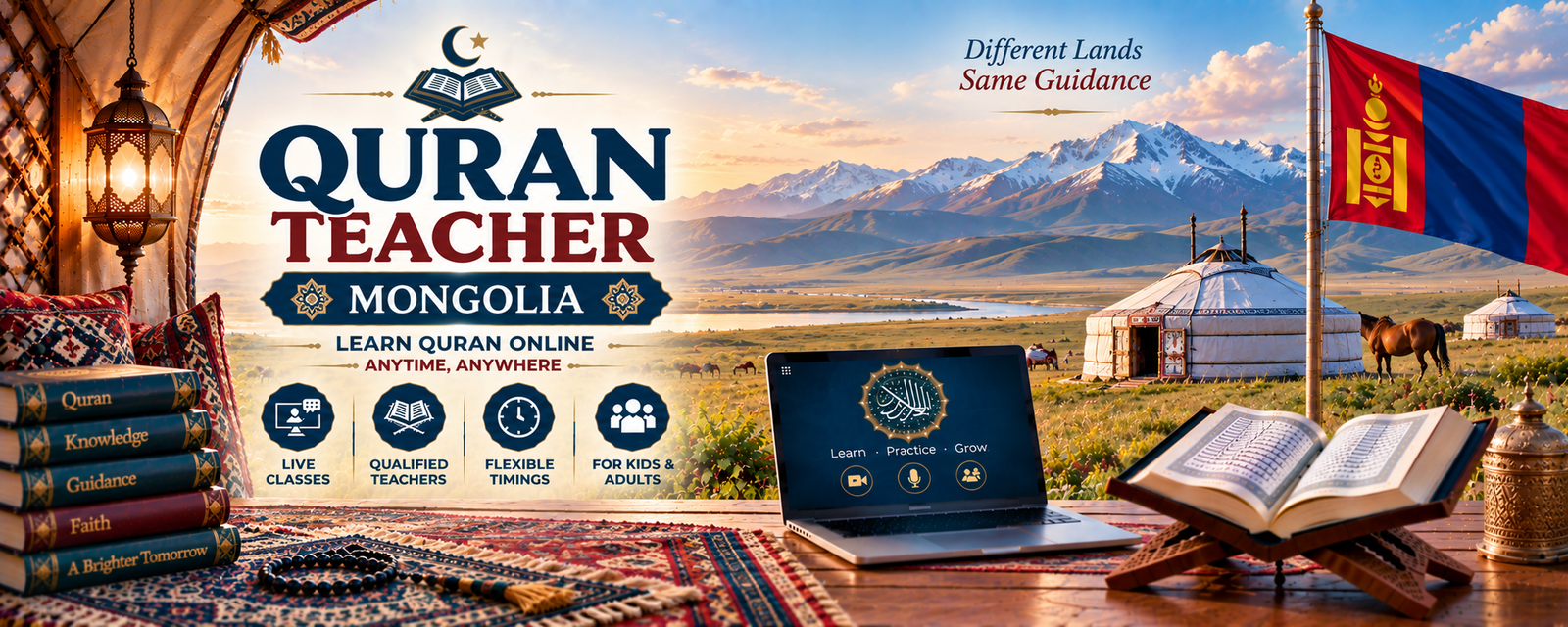
For most of the last century, teaching the Quran here was not allowed. The mosque in Ölgii was pulled down during the purges of the 1930s and its imam was executed. Only after 1990 could families teach their children openly again. That history is why the search for a Quran teacher Mongolia families can work with looks different from anywhere else, and it is where Quran Pak Teacher starts.
What the census actually says
The 2020 national census recorded 105,500 Muslims in Mongolia, 3.2% of the population. That is up from 82,641 in 2010, and it makes Islam the country’s second largest religion after Buddhism.
Nearly all of them are ethnic Kazakhs, with smaller Khoton and Uyghur communities. Bayan-Ölgii province is 88.7% Muslim, with a provincial population near 110,000. Khovd province is 11.5% Muslim, mainly in Khovd city, Khovd sum and Buyant.
Between 1991 and 1993 roughly 80,000 Kazakhs left for Kazakhstan, and Bayan-Ölgii’s population fell from 102,817 to 75,043 before recovering. Most families in Ölgii still have relatives on the other side of that move.
The madhhab question, which nobody else answers
Mongolia’s Kazakh Muslims are Sunni and follow the Hanafi school.
So do we. Our teachers were trained in the Hanafi tradition in Lahore, and they teach Hafs, the recitation your community already uses.
This is worth saying plainly because almost every online academy serving this search is staffed from Egypt, and none of them state a madhhab anywhere on their sites. If a child in Ölgii learns from a teacher working in a different school of fiqh, the recitation will be fine but the rulings around it may not match what the imam at home teaches. Ours will.
What already exists in Ölgii, Khovd and the capital
Ölgii has the Abu-Bakr Siddiq Central Mosque, built in 1992 with funding from the United Arab Emirates and led by Chief Imam Bakhyt Lenbay. It also houses the Islamic Center of Mongolia. Four more mosques operate in the same town, among them Sherkhan Mosque from 2002.
Ulaanbaatar has several Hanafi mosques, including Nalaikh Mosque from 2013, the Tolgoit Mosque in Songino Khairkhan, and the Ali ibn Abi Talib Mosque in Bayanzurkh from 2017. Darkhan-Uul has the Khongor Mosque from 2007. Around seventeen mosques operate nationwide.
Kazakh communities also run their own Islamic schools, sometimes with support from Kazakhstan and Turkey.
If your child can walk to one of these and the classes suit you, send them there. Learning beside other children from your own town is worth more than any video call, and this page is not an argument against it.
Online Quran teacher in Mongolia: two time zones, one short gap
Mongolia runs two clocks. Bayan-Ölgii, Khovd and Uvs sit on UTC+7. The rest of the country, including Ulaanbaatar, is on UTC+8. Daylight saving was abolished in 2017, so neither moves.
Lahore is UTC+5. Ölgii is two hours ahead of your teacher. Ulaanbaatar is three.
A 7pm lesson in Ölgii means a 5pm start in Lahore. A 6pm lesson in Ulaanbaatar is 3pm there. Both are ordinary working hours on both ends, which matters more than it sounds. It means your family is not limited to whoever happens to be awake at four in the morning.
Our teachers work Monday to Friday. Weekends are not covered.
Winter, distance, and why a screen helps here
Bayan-Ölgii’s sums are spread across the Altai. Ulaankhus, Tsengel, Deluun, Nogoonnuur and Bulgan are hours from Ölgii town over ground that is not always road.
From late autumn the weather decides the calendar. A child who starts at the mosque madrasa in September may not get back reliably until spring. Herding families move with the season and the season does not consult the timetable.
A lesson over the internet does not care about snow on the pass. That is not a general benefit of online learning. It is the specific reason this works in western Mongolia and would not be worth mentioning in most countries.
Adults who never got the chance
There is a generation here that grew up Muslim without being taught to read.
Under state atheism there was nobody permitted to teach them, and by the time that changed they were adults with work and children. Many can pray, know the duas their grandmothers passed on, and cannot read a line of Arabic script.
If that is you, start at the beginning and do it privately. Nobody else is on the call. Your teacher will not compare you to anyone, and there is no room full of eight year olds watching you sound out letters. Plenty of our adult students began exactly here.
Kazakh, Mongolian, and what we cannot offer
Your household speaks Kazakh, Mongolian, or both. We teach in neither.
Our teachers work in English and Urdu, with recitation in Arabic. Explanation happens in English.
For students who have studied English at school, or who have spent time abroad, this is workable. For an older adult in a Deluun herding family with no English, it will be difficult and we would rather say so now.
Bayan-Ölgii has long sent religious students to Kazakhstan, Turkey and the Arab world, so learning outside your own language is not unfamiliar here. That helps. It does not remove the problem. Our about page explains who teaches and how.
Women and girls
Female teachers are available and cost the same as male teachers.
Ask for one when you book. We match before the first lesson rather than starting your daughter with someone and moving her afterwards.
She can teach every subject we offer. Nothing is held back for male teachers. If your daughter does not settle with her, tell us inside the trial and we will change the match without argument or charge.
For adult women learning for themselves, the same applies, and the lesson is private to you.
Sitting in on your child’s lesson
Lessons run over Zoom, Microsoft Teams or Google Meet. The link comes to you, not to your child.
One student, one teacher, every time. No group calls and no rotating staff. The same teacher returns each week, so progress carries forward instead of restarting.
You are welcome in any lesson, unannounced. You do not need to arrange it, and we will not tell the teacher you are coming.
Courses
Six subjects, all private. Where a student begins depends on what they can already read, not on how old they are.
Noorani Qaida
Where every complete beginner starts, whether that is a six year old in Ölgii or a forty five year old in Khovd.
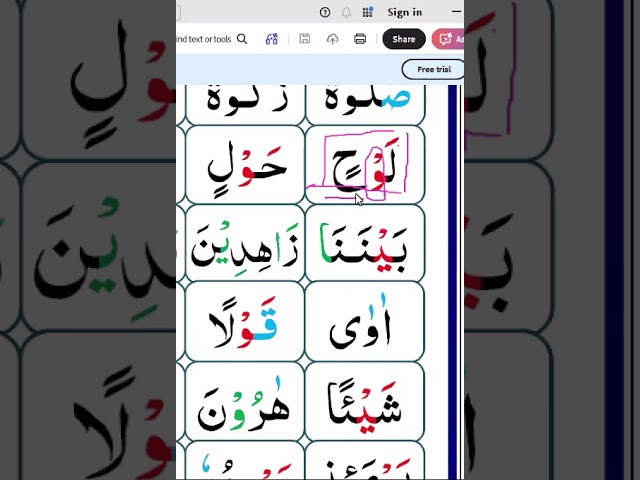
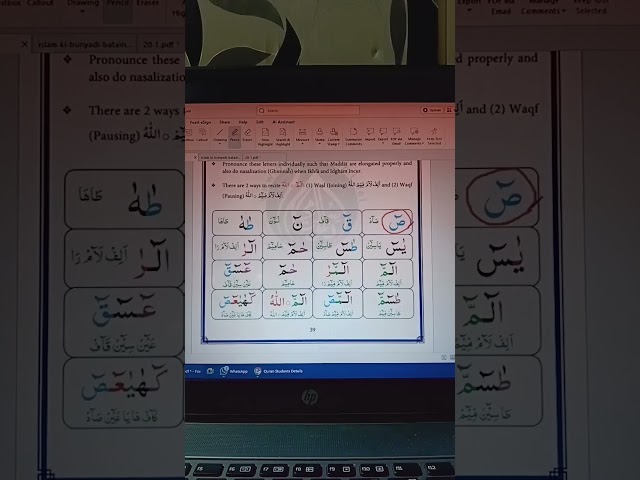
The Qaida teaches the Arabic letters, first alone and then joined, so the student learns how a letter shifts shape at the start, middle and end of a word. Short vowels follow, then sukoon, then the doubled letters. At five lessons a week most students finish in four to six months.
Adults often want to skip it. We advise against that, because the reading faults it prevents are hard to hear once they set. More on the Qaida course.
Quran reading with Tajweed
The stage after the Qaida, where the student opens the Quran itself.
Tajweed is the set of rules covering how each letter is sounded. Where in the throat or mouth it forms, how long a vowel holds, and what changes when certain letters sit together. Noon sakinah, meem sakinah and the madd rules are introduced gradually rather than in one block.
The whole method is listen, correct, repeat. It needs a teacher who can hear one student clearly, which is why it suits private lessons. Quran reading course.
Hifz
Memorisation, whether of the full Quran or a portion of it.
Each session splits between new material and revision of what came before. The revision is the part that decides whether it holds. Your teacher sets the daily portion, hears it returned, and runs a revision cycle so earlier surahs stay firm.
Many families here begin with the short surahs of Juz 30 and stop there, which is a complete goal in itself. Others continue over several years. Hifz course.
Tarjuma
Translation. Learning what the words themselves mean.
The teacher works through the text giving the sense of each word in order. Because Quranic vocabulary repeats, a student starts recognising words unaided after a few months, which is a different experience from reading an English rendering.
This suits anyone who recites well without knowing what they are saying. It answers meaning only, and goes no further. Tarjuma course.
Tafseer
A separate subject from Tarjuma, though the two get confused constantly.
Tarjuma tells you what a verse says. Tafseer explains why it was revealed, how it sits against other verses on the same subject, what the classical scholars understood by it, and what follows from it in practice.
It assumes you have the translation already, so we normally suggest working through a stretch of Tarjuma first. Tafseer course.
Learn Urdu
Reading, writing and speaking Urdu.
It exists for South Asian families raising children abroad. For a Kazakh household in Mongolia it will be of no use, and we list it here only because it is one of our six. Urdu course.
All six are set out on the courses page.
Fees
Thirty US dollars a month.
That buys twenty lessons, five a week from Monday to Friday, half an hour each, one student with one teacher.
The amount does not change with the subject, and it does not change with the teacher’s gender. There is no joining fee, no charge for books or materials, and no cost to switch teachers if the first match is wrong. Billing is in dollars, so the tögrög rate on the day does not affect what you owe.
If you are enrolling more than one child, ask about the rate when you sign up. The fee page has the full plan.
Three free lessons before anything is paid
You get three lessons at no cost, and we do not take card details to arrange them.
Book the hour you would genuinely use in term time, not a quiet afternoon. Check whether your child can follow the teacher’s English before you commit to anything. If you want a female teacher, ask now rather than later, so you are testing the setup you would actually keep.
After the third lesson you decide. There is nothing to cancel if you walk away. Message us through the contact page to arrange them.
From the Altai sums to the ger districts of Ulaanbaatar, a qualified Quran teacher Mongolia families can reach is now two hours away by video call rather than a day’s drive across the mountains. Book your three free lessons through our contact page.
Contact us on WhatsApp for trial classes in Mongolia
F.A.Q. GUIDE RELATED TO OUR ONLINE COURSES & CLASSES
Hanafi, the same as Kazakh Muslims in Mongolia.
Hafs.
No. Lessons are in English, with recitation in Arabic.
No. Distance makes no difference to an online lesson, and neither does winter.
Two hours if you are in Bayan-Ölgii, Khovd or Uvs. Three hours elsewhere in Mongolia.
Yes, at the same fee. Ask when you book
No. Start at Noorani Qaida. Lessons are private, so nobody sees where you began.
Tarjuma gives the meaning of the words. Tafseer explains the context, the reason for revelation, and what scholars drew from the verse.
If You Have Any Questions, Trial Classes & Registration


FEEL FREE TO ASK
Where We Provide Online Quran Classes
Across the vast steppes of Mongolia, Muslim families, many from the Kazakh community in the west, are keeping Quran learning close to home, through flexible one-to-one online classes built around their week.