Quran Teacher Chad
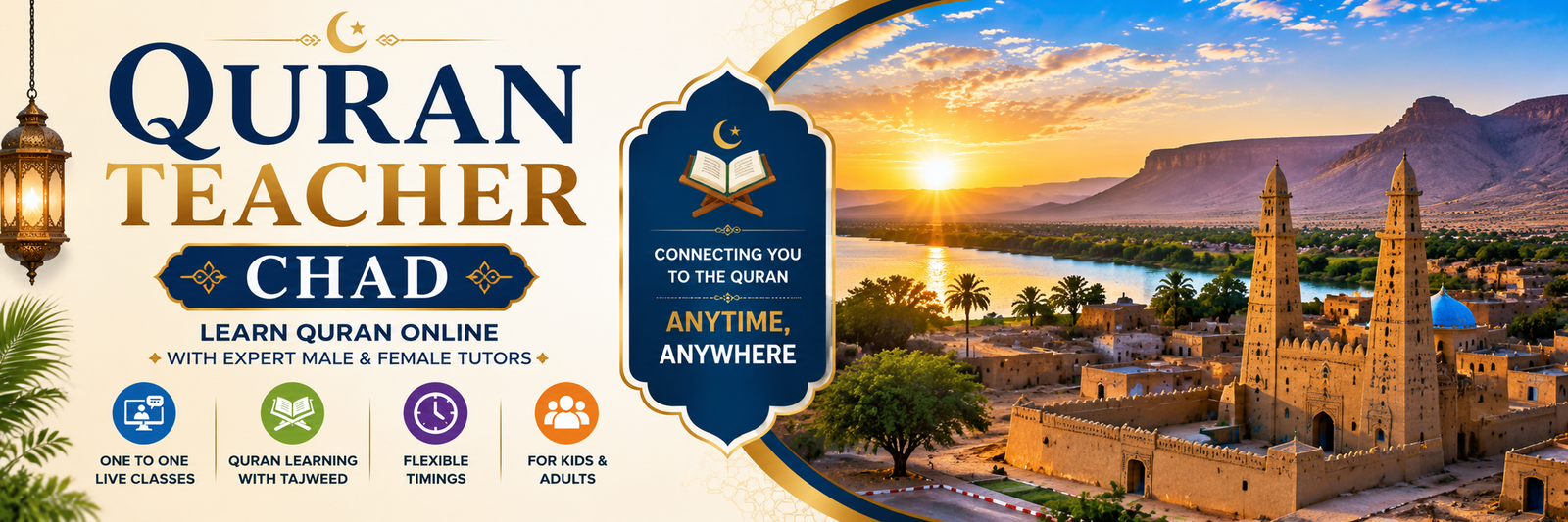
Islamic Quran Academy teaches live one to one Quran lessons to families in Chad over Zoom, Skype or Google Meet. Every student keeps the same male or female Hafiz tutor. Lessons run thirty minutes a day, Monday to Friday, twenty lessons a month, for 30 euros. The first lesson is free and asks for no card details.
Where Quran Study in Chad Usually Stops
Quranic schools are spread across the Sahel and the north, and they teach children to read Arabic and recite. Much of that learning happens by repetition. A child often leaves able to recite without being taught the rules behind the sounds or the meaning of the words.
The next stage is harder to reach. Higher Islamic study inside Chad is limited, and students wanting to go further have long travelled abroad, to Cairo, Yemen, Sudan, northern Cameroon or Nigeria. The country has one university, in N’Djamena, created in 1971 and renamed in 1994.
Our lessons sit in that gap. A student who already recites can move into Tajweed applied properly, then Hifz, translation or Tafseer, without leaving home.
Which Recitation We Teach
A riwaya is a transmitted way of reciting the Quran. All are authentic, and they differ in vowel length, a few pronunciations and a small number of spellings.
Our tutors teach Hafs an Asim. That is the reading printed in most Mushafs worldwide and used across South Asia, the Gulf and Egypt.
Families in Chad also recite Al-Duri an Abi Amr, common in Sudan and Central Africa, and Warsh an Nafi, used across North and West Africa. Tell us at the trial lesson which one your family follows, and we will confirm the fit before you enrol.
What Language Are the Lessons In
Recitation is in Arabic. The tutor reads with the student from the same Mushaf, corrects the sounds out loud, and repeats until the sound is right. For Noorani Qaida and Quran reading, most of the lesson is Arabic and demonstration.
Explanation is in English. French and Arabic are Chad’s official languages and Chadian Arabic is spoken widely, so we are clear about who this suits: students who study English at school, Chadian families settled in Europe, and expatriate households in N’Djamena. For Tarjuma and Tafseer, where the lesson depends on discussion, we confirm the fit at the trial before you commit.
What Every Lesson Includes
Your child is assigned one tutor and keeps that tutor. There is no rotation, so nobody repeats a page because a new teacher has taken the class.
Lessons last thirty minutes and run Monday to Friday. Weekend slots are available. Every month covers twenty lessons.
Short homework follows each lesson. Parents receive progress messages on WhatsApp. Any parent may sit in on any lesson without asking first.
Lesson Times in Chad
Chad keeps West Africa Time all year, with no seasonal change. N’Djamena sits four hours behind Lahore, so your evening class is the tutor’s late evening. Your slot stays the same every month.
Most families book between 16:00 and 18:30, after school and before Maghrib. Morning slots from 06:00 suit students in Abéché and Moundou who prefer to study before the day starts. During Ramadan, timings move to fit Suhoor and Taraweeh locally.
Who Teaches Your Child
Hafiz Ali Ahmad has taught Quran for ten years. He teaches Noorani Qaida, Quran reading with Tajweed and Hifz.
Hafiz Umair Akram has taught Quran for fifteen years. He teaches Noorani Qaida, Quran reading with Tajweed and Hifz.
Both are Huffaz, meaning they have memorised the full Quran. In lessons they work on the Makharij, the points in the mouth and throat where each letter is formed, and on rules a student may have been repeating incorrectly for years without knowing, such as shortening a Madd or dropping a Ghunnah.
Every tutor is checked for qualifications and background before being assigned to a student.
Female Quran Teacher for Sisters and Daughters
Women and girls are taught by a female tutor, one to one, with nobody else in the room. This is agreed when you book and it does not change later, so you are not assigned a male tutor at short notice if someone is unavailable.
Mothers and daughters can study with the same tutor in the same week. Adult women who read silently but hesitate to recite aloud in Salah or in front of family study privately, with no group listening.
What We Teach
Noorani Qaida
Covers the Arabic letters, their sounds and how they join. Any complete beginner starts here. See Noorani Qaida online.
Quran reading with Tajweed
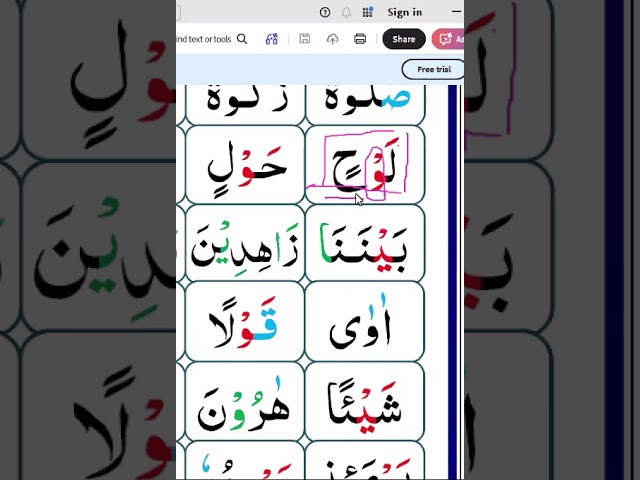
The tutor corrects the Makharij and the rules out loud while the student reads. This is the part a crowded école coranique rarely has time for, because one teacher is working with many children at once. See Quran reading.
Hifz
A small daily portion and a fixed revision cycle, so what is memorised stays memorised. Students usually begin with Juz Amma and the short Surahs, then Surah Mulk. See Hifz.
Tarjuma
Word by word translation. See Tarjuma.
Tafseer
Covering meaning, context and background. See Tafseer.
For Students Who Recite Well but Do Not Understand
This is common in Chad, and it is nobody’s fault. A child taught by repetition can finish the Quran without ever being told what the words mean.
Tarjuma starts with the Surahs the student already knows by heart, so the meaning attaches to something familiar. Tafseer follows for those who want the context. Adults take this route as often as children do.
What Your First Month Looks Like
The trial lesson is used to find the starting point. A student who already recites does not go back to the first page of the Qaida, and a complete beginner is not pushed ahead.
The tutor then sets a daily portion and a weekly target. Homework runs five to ten minutes, because a little every day works better than an hour once a week.
At the end of the month you know what has been covered and what comes next. If the pace is wrong in either direction, say so and it is changed.
Quran Learning in Chad
Islam reached Chad through trade and contact from the fourteenth century rather than through conquest. Muslims make up around 55 percent of the population, mostly Sunni following the Maliki school, according to published country research.
Formal Islamic secondary education has existed here for over a century. The École Mohamed Illech was founded in 1918 and modelled on Egyptian institutions. The Lycée Franco-Arabe opened in Abéché in 1952 and combined Arabic, Quranic and French study in one school.
Abéché was the capital of the old Ouaddaï Sultanate and sits 749 kilometres northeast of N’Djamena. Its Grand Mosque stands on the Place de l’Indépendance.
Where Our Students Live
N’Djamena, Abéché, Moundou, Sarh, Mao, Kélo, Am Timan and Faya-Largeau. Also Chadian families settled in France and Cameroon.
Fees
Twenty lessons cost 30 euros a month, which is 1.50 euros per lesson. Chad uses the CFA franc, which is pegged to the euro, so the price does not move with exchange rates.
There is no registration fee, no material fee and no charge for the trial lesson. Families with more than one child should ask about the rate before booking. Full details are on our fee plan page.
What Families Say
- “I am very happy with Quran Pak Teacher. The teaching method and the resources available on the website are exceptional. My children look forward to every lesson with their teacher and are progressing well Alhamdulillah.”
Sara, London, England - “Not having any knowledge of the Arabic language, I was hesitant to try to learn and recite the Quran. I can’t believe the progress I have been making in a few short weeks. The teachers are very encouraging and helped me accomplish so much.”
Alhesam, North Carolina, USA - “We are really impressed with their constant professionalism and efficiency. The Arabic teachers are extremely helpful, supportive and knowledgeable. The courses have very good course books suitable for all levels.”
Marshall, Australia
More at students feedback.
How to Start
Message +92 313 858 1672 on WhatsApp with the student’s age, the course you want, the recitation your family follows, and two times that suit you. We reply with a tutor and a slot. The trial lesson runs at that time. You decide afterwards.
If the Lessons Are Not Working
Ask for a different tutor and we assign one. Nobody is asked to explain why. Missed lessons are rescheduled at no cost. Lessons can be paused for exams or travel. Refunds follow our refund policy.
Contact us on WhatsApp for trial classes in Chad
F.A.Q. GUIDE RELATED TO OUR ONLINE COURSES & CLASSES
Yes We have both.
1 to 1 Classes duration is 30 minutes for each student. At some cases it can be increased up to 40 minutes.
Classes start from $30 per month for 20 classes (Mon-Fri), 30 minutes each, one-on-one.
Depending on the intensity of the studies (how many classes you take), it will take for adults 6/8 months. For children, it depends on their competency level and the support given by parents.
It is rescheduled on request at no extra cost.
Recitation in Arabic, explanation in English.
A laptop, PC, Tablet or Smart Phone, Internet Connection. We use Google Meet, Teams and Zoom for audio/video chat call.
Yes, students can try a free class before enrolling in a paid plan.
If You Have Any Questions, Trial Classes & Registration



FEEL FREE TO ASK
Where We Provide Online Quran Classes
From the edge of the Sahara to the shores of Lake Chad, Chadian Muslim families are keeping Quran learning close to home, through flexible one-to-one online classes built around their week.