Quran Teacher Hungary
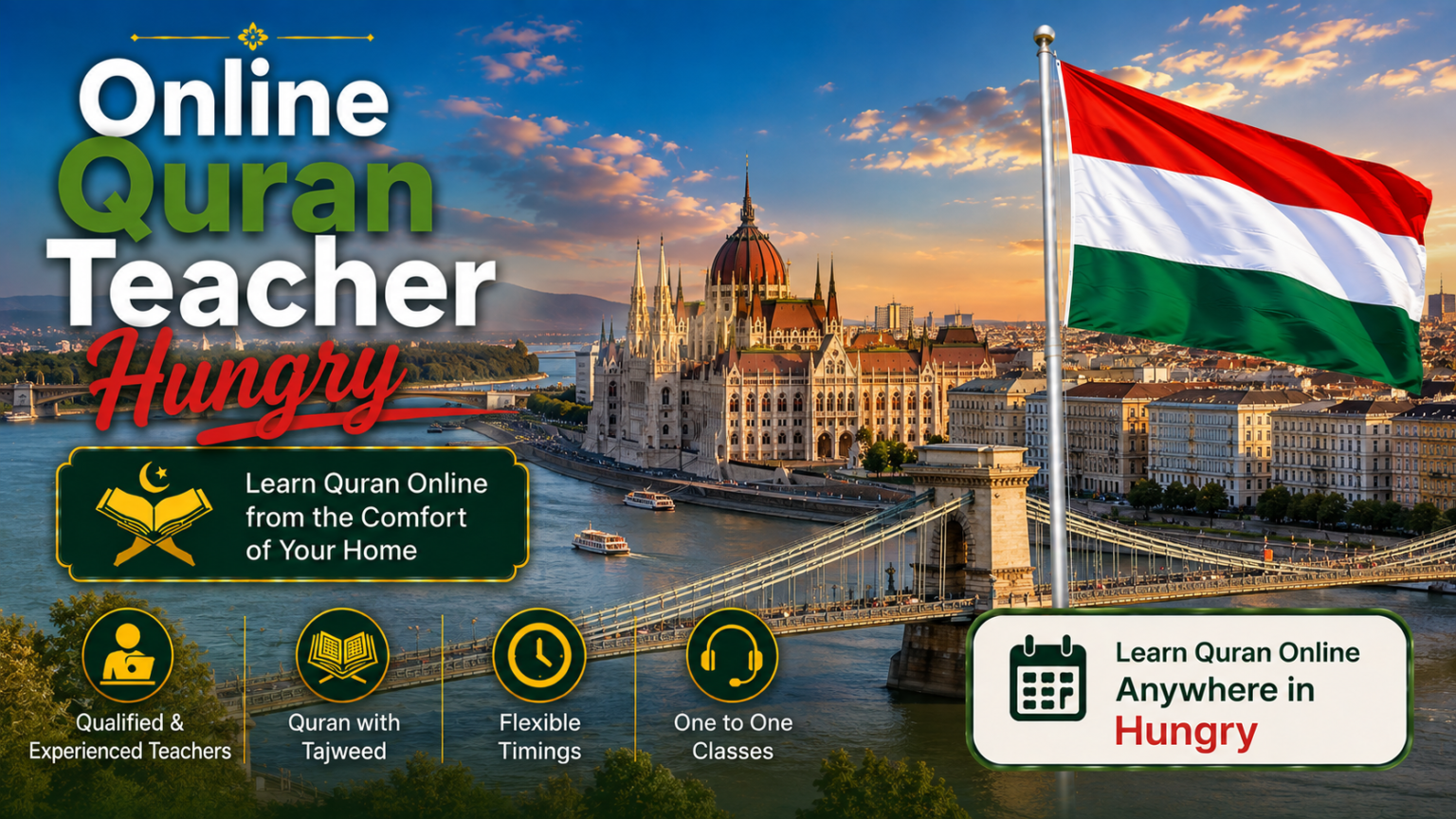
Islamic Quran Academy teaches Quran online to students living anywhere in Hungary. Lessons are private, one student with one teacher, held over Zoom. Classes run Monday to Friday for thirty minutes each. The fee is 30 euros a month for twenty lessons. Both male and female teachers are available, and the first lesson is free.
Why families here study at home
Hungary’s Muslim community is small. Recent estimates place it near 0.3 percent of the population, and most families live in Budapest, with smaller groups in Debrecen, Pécs and Szeged.
Budapest itself has several places to pray. Dar us Salam in the eleventh district is the oldest working mosque in modern Hungary. The Hungarian Islamic Community keeps a mosque on Róbert Károly körút, and a newer centre has been established in Zugló. There are also smaller masjids near Keleti station and Blaha Lujza tér.
Outside the capital the picture changes quickly. In Pécs, Friday prayer has long been held inside the Yakovali Hassan Pasha Djami, an Ottoman monument that still stands. In Debrecen, students gather for Maghrib and Isha in the Theoretical Building of the university, and Jumuah is held over at the Auguszta campus. Academic research on Islam in Hungary recorded that in Szeged, Miskolc and Debrecen, Muslims often prayed in private flats because no mosque existed at all.
A prayer room is not a school. In most Hungarian towns there is simply nowhere for a child to sit with a qualified teacher and read Qaida aloud, page by page, several times a week. That is the gap these lessons fill.
Class times built around the Hungarian school day
Hungary follows Central European Time. Most children finish school in the afternoon and are home well before evening. Our teachers work from Lahore, three or four hours ahead depending on the season, so a class at half past four or six in the evening in Budapest works comfortably for both sides. Saturday and Sunday slots are open for families who would rather keep weekdays clear.
For students at the universities
Hungary hosts a large number of Muslim students through Stipendium Hungaricum, the government scholarship programme managed by Tempus Public Foundation, which holds agreements with more than a hundred partner countries including Pakistan, Indonesia and Egypt.
The University of Debrecen at Egyetem tér 1 teaches around thirty thousand students. The University of Pécs hosts roughly four thousand international students drawn from over a hundred countries. The University of Szeged, on the bank of the Tisza, reports that about a fifth of its students come from abroad.
Many of these students can recite but were never taught the rules properly. Others have not opened a mushaf since childhood and feel awkward about starting again. A private class means nobody else hears you find your place. Teachers explain in clear English or in Urdu, whichever suits you.
Learn More About Each Course
Noorani Qaida
This course is the starting point for anyone who has never learned to read the Arabic script. We begin with the individual letters and their correct sounds, then move gradually to joining letters together, and finally to harakat (vowel marks) and tanween. Every page builds on the one before it, so students of any age can progress at their own pace with a solid foundation before moving on to Qur’anic reading.
Reading with Tajweed
Once a student can read the script, this course focuses on reading it correctly. We start with makhraj (the precise point of articulation for each letter) and sifat (the qualities of each letter’s pronunciation), then introduce the rules of tajweed noon sakinah, madd, and waqf one at a time. Rather than memorising rules in the abstract, students apply each one directly while reading real text, so the learning sticks.
Our hifz programme guides students through memorisation of the Qur’an, typically beginning with Juz Amma and progressing from there. Each session includes both new memorisation and structured revision of previously learned portions, ensuring that what is memorised is retained rather than forgotten. Progress is tracked consistently so both student and family can see steady growth over time.
Tarjuma
This course builds a word-by-word understanding of the Qur’an, starting with the ayat students already recite in salah. Rather than reciting words whose meaning is unclear, students learn to connect each word to its meaning directly, so their recitation becomes something they understand rather than simply repeat.
Tafseer
Building on Tarjuma, this course goes beyond word meaning into the fuller explanation of each ayah why it was revealed, its historical and textual context, and what it means for daily life. The aim is to help students grasp the depth behind the verses they recite, not just their surface translation.
Urdu
Designed for families who want their children to maintain fluency in Urdu, this course covers reading, writing, and conversation skills, helping the next generation stay connected to their language and heritage alongside their Islamic studies.
Female teachers for sisters and girls
Every one of our women teachers is a Hafiza. If you ask for a female teacher, she is assigned before your first paid class and stays with the student for the whole course. You never have to ask again. This suits adult sisters learning at home and parents of teenage daughters equally.
What happens in the first class
The teacher spends the first few minutes talking to the student, not teaching. She asks the child to read a few lines, or asks an adult to recite something short. She listens for where the sounds are being formed and which letters are being mixed up. By the end of the half hour you know the real starting point and which course fits. Nothing is charged until you decide to continue.
A child of six who attends five days a week usually finishes Qaida in four to six months. An adult starting from zero often reads short surahs within three months, because adults grasp the rules faster once the letters settle.
Fees
30 euros a month covers twenty classes, five days a week, thirty minutes each, always one student with one teacher. There are no registration charges and no cost for materials. Families enrolling more than one child can ask about a reduced rate.
Contact us on WhatsApp for trial classes in Hungary
F.A.Q. GUIDE RELATED TO OUR ONLINE COURSES & CLASSES
Yes, via live Zoom classes with teachers based abroad.
Yes, most academies offer evening/weekend slots that overlap with CET.
Mainly English (or Arabic-English). Hungarian-speaking tutors are rare.
Yes, classes usually start with the Arabic alphabet (Noorani Qaida).
Yes, most academies offer this on request.
Yes, most academies offer 1–3 free trial classes.
Tajweed, Hifz (memorization), Tafsir, Arabic, and Islamic studies.
Both separate tracks are usually offered.
If You Have Any Questions, Trial Classes & Registration


FEEL FREE TO ASK
Where We Provide Online Quran Classes in Hungary
Students in Hungary can join our online Quran lessons from home, with flexible schedules and personalized one-to-one teaching design.