Quran Teacher Estonia
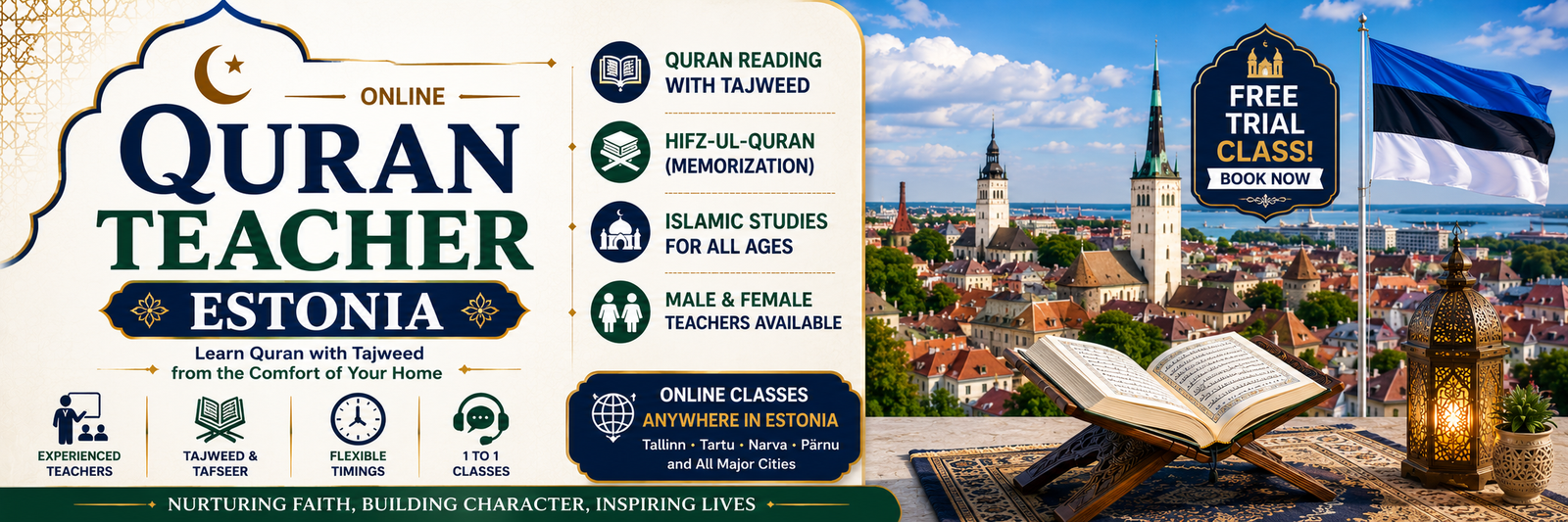
Quran Pak Teacher teaches the Quran one to one to students living in Estonia. Lessons run on Zoom, Google Meet. Every teacher has memorised the whole Quran. Male and female teachers are both available. Fees are 30 euros a month for twenty lessons, and your first lesson is free.
Why Muslim families in Estonia study online
Estonia’s 2021 census recorded around 6,500 people who named Islam as their faith, close to 0.5 percent of the country. Community estimates put the real figure nearer 10,000. Either way, this is one of the smallest Muslim populations in Europe, and it shapes how families here learn.
Estonia has one main place of worship
The Estonian Islamic Centre opened at Keevise 9 in Lasnamäe in 2008 and stands a short walk from Ülemiste. It holds Friday prayer, Eid prayer and community gatherings. It is not a full time madrasa running daily classes for every age group, and it cannot serve a family living two hundred kilometres away.
The older congregations were never replaced
Tatar traders from the Nizhny Novgorod region settled in Tallinn and Narva during the nineteenth century, and by the early 1900s both towns had prayer halls. The Narva Muhamedi Kogudus was registered on 18 May 1928 as the first legal Muslim congregation in the Republic of Estonia. A Tallinn congregation followed in 1939. Soviet authorities banned both in 1940, and the buildings were destroyed in the fighting of 1944. Tatar burial sections still exist at cemeteries in Tallinn, Narva and Rakvere.
Outside Tallinn there is no weekly class
A family in Narva, Kohtla-Järve, Jõhvi, Sillamäe, Tartu or Pärnu has no Quran class within reach today. Studying online is not a lesser option here. For most households outside the capital it is the only steady one.
Your connection is not the problem
Estonia is among the best connected countries in Europe. About 95 percent of households are online and roughly 79 percent can receive gigabit fibre. A 30 minute video lesson runs cleanly from a flat in Lasnamäe or a farmhouse in Viljandi County.
Female Quran teachers for sisters and daughters
Many parents want a woman teaching their daughter. Many women prefer a woman when they study themselves. Our female teachers are Hafizas, meaning each has memorised the entire Quran.
Ask for a female teacher when you book your free lesson and we arrange it before the first class, not after. A mother and daughter can study with the same teacher in the same week, one after the other. Nothing from a lesson is recorded or shared.
This matters more in Estonia than in larger communities. Where a congregation is small, families often have no say in who teaches their child. Online, you choose.
Courses we teach
Noorani Qaida
The starting book for anyone who cannot yet read Arabic script. It covers the letters, how their shape changes in different positions, and the short vowel marks. Most children finish it in four to seven months at five lessons a week. See our Noorani Qaida course.
Nazra, reading from the Mushaf
Reading straight from the printed Quran. Students move here after Qaida, normally starting with the shorter surahs at the back. See Quran reading with Tajweed.
Tajweed
The rules of correct recitation, including Makharij, the exact points in the mouth and throat where each Arabic letter is formed. Estonian and Russian speakers commonly struggle to separate ح from ه, and ض from ظ, because neither language contains those sounds. Teachers train the ear on the difference before naming any rule.
Hifz, memorisation
Memorisation with daily revision. Most students begin with Juz Amma, the thirtieth part, because it holds the short surahs used in daily prayer. See our Quran memorisation course.
Tarjuma and Tafseer
Word meaning first, then explanation. A full Estonian translation of the Quran does exist. Haljand Udam translated it and Avita published it in December 2007, and the first thousand copies sold within hours. Students who read Estonian can follow the meaning in their own language while learning the Arabic. See Quran translation classes and our Quran Tafseer course.
Islamic studies
Kalima, Namaz, daily duas and Hadith, taught alongside Quran reading for children and adults.
Quran classes for children in Estonia
Estonian school days finish early and most children are home well before the evening meal. That leaves a clear window for a short lesson.
Lessons run 30 minutes because that matches how long a young child holds focus. Five short lessons a week works better than one long weekend class. A parent may sit in on any lesson, at any time, without asking first.
We work around the Estonian school calendar. The summer break runs from around 10 June to 31 August, and many families pause or reduce lessons across it. The autumn, Christmas and spring breaks are shorter, and most students carry on through them. Weekend classes are available for families whose weekdays are full.
Quran classes for adults and complete beginners
Many adults in Estonia grew up in Tatar, Azeri or Russian speaking families where religion was not taught at home during the Soviet years. Others accepted Islam later in life. Both groups often arrive knowing no Arabic letters at all.
That is normal here and nobody treats it otherwise. Lessons are private, so no one else hears you practise the same letter ten times. Adults usually move through Qaida faster than children because they already understand how reading works, then slow down at Tajweed, which needs the ear rather than the mind.
Meet your teachers
Islamic Quran Academy has taught the Quran online since 2020 from Bhogiwal Road in Lahore. Every teacher on our staff has memorised the whole Quran and is checked before being given a single student.
Our tutors come from Egypt, Jordan and Saudi Arabia, alongside teachers trained in Pakistan. The Arab teachers bring native pronunciation, which matters most when a student is working on Makharij. This is the part Estonian and Russian speakers find hardest, and a teacher who has spoken Arabic since childhood hears the error the moment it happens.
We keep male and female teachers on staff at all times. Our female tutors teach girls and adult women, and many families here ask for one. Tell us your preference when you book and we assign the teacher before your first lesson.
Every class is one to one. A teacher sees one student on the screen, so a mistake is corrected as it is made rather than missed in a group. Teachers work to your clock. Pakistan runs two hours ahead of Estonia in summer and three in winter, so an evening lesson in Tallinn falls inside a normal working evening in Lahore. You can read more about our academy.
Fees and what is included
Thirty euros a month. That covers twenty lessons of 30 minutes each, one to one, Monday to Friday. It works out near 1.50 euros a lesson.
The price is low because lessons are short and frequent, not because the teaching is thin. Five short sessions a week is how Qaida and Hifz have always been taught. A child repeats a small amount daily instead of cramming once a week. For comparison, private tutoring in Tallinn normally costs 12 to 20 euros for a single session.
Your first lesson is free. No card details and no deposit. Payment is by Western Union once you decide to carry on, and our refund policy is published in full. See the monthly fee plan for every course.
How to start
- Send a message on WhatsApp to +92 313 858 1672.
- Tell us the student’s age, current level, and whether you want a male or female teacher.
- Choose a time. We send the meeting link.
- Take the free lesson, then decide.
We reply to messages from Estonia the same day. You can also reach us through our contact page.
What our students say
We have taught families in the United Kingdom, the United States, Canada and Australia since 2020. These are students in their own words.
Alhesam, North Carolina, United States “Not having any knowledge of the Arabic language, I was hesitant to try to learn and recite the Quran. I can’t believe the progress I have been making in a few short weeks. The teachers are very encouraging and helped me accomplish so much.”
Sara, London, England “I am very happy with Quran Pak Teacher. The teaching method and the resources available on the website are exceptional. My children look forward to every lesson with their teacher and are progressing well Alhamdulillah.”
Marshall, Australia “We are really impressed with their constant professionalism and efficiency. The Arabic teachers are extremely helpful, supportive and knowledgeable. The courses have very good course books suitable for all levels.”
We do not yet have a review from a student in Estonia. When our first family in Tallinn, Narva or Tartu finishes a term, their words will appear here. Every review we hold is on our students feedback page.
Where our Estonian students live
Tallinn, including Lasnamäe, Mustamäe, Õismäe, Kesklinn, Pirita and Maardu. Tartu, Narva, Pärnu, Kohtla-Järve, Jõhvi, Sillamäe, Viljandi, Rakvere, Haapsalu, Kuressaare and Valga.
Ida-Viru County is worth a separate note. It holds about 130,000 people, roughly two thirds of them Russian speaking, and it has no Quran class of any kind. Families in Narva and Sillamäe make up a large share of the students we expect to serve.
Lessons are taught in English. We also teach families across the United Kingdom, Germany and Italy.
Book your free Quran class
Message +92 313 858 1672 on WhatsApp with the student’s age and a time that suits you. We will confirm a slot and send the link.
Contact us on WhatsApp for trial classes in Estonia
F.A.Q. GUIDE RELATED TO OUR ONLINE COURSES & CLASSES
By Western Union, after the free lesson. Nothing is charged before that.
One-to-one classes are 30 minutes per student. In some cases, this can be increased up to 40 minutes.
No full time one. The Estonian Islamic Centre in Lasnamäe runs community activities, and nothing comparable exists outside Tallinn.
Pakistan runs two hours ahead of Estonia in summer and three hours ahead in winter. A 6pm lesson in Tallinn falls in a normal evening for your teacher.
Yes, we offer live one-on-one online Quran classes for students across Estonia, including Tallinn, Tartu, Narva and Pärnu, taught by certified male and female tutors via Zoom and Microsoft Teams.
Classes start from €30 per month, which includes 20 classes (Monday to Friday), each 30 minutes, on a one-on-one basis.
Yes, schedules are flexible and matched to Eastern European Time (EET).
Yes. The courses follow a detailed plan suitable for all ages, from a 4-year-old child to an elderly adult, regardless of prior experience or qualifications whether you’re in or anywhere else.
If You Have Any Questions, Trial Classes & Registration



FEEL FREE TO ASK
Where We Provide Online Quran Classes
Estonia’s winters are long and its Muslim community small, but its families’ commitment to the Quran stays strong, through flexible one-to-one online classes built around their week.