Quran Teacher Iraq
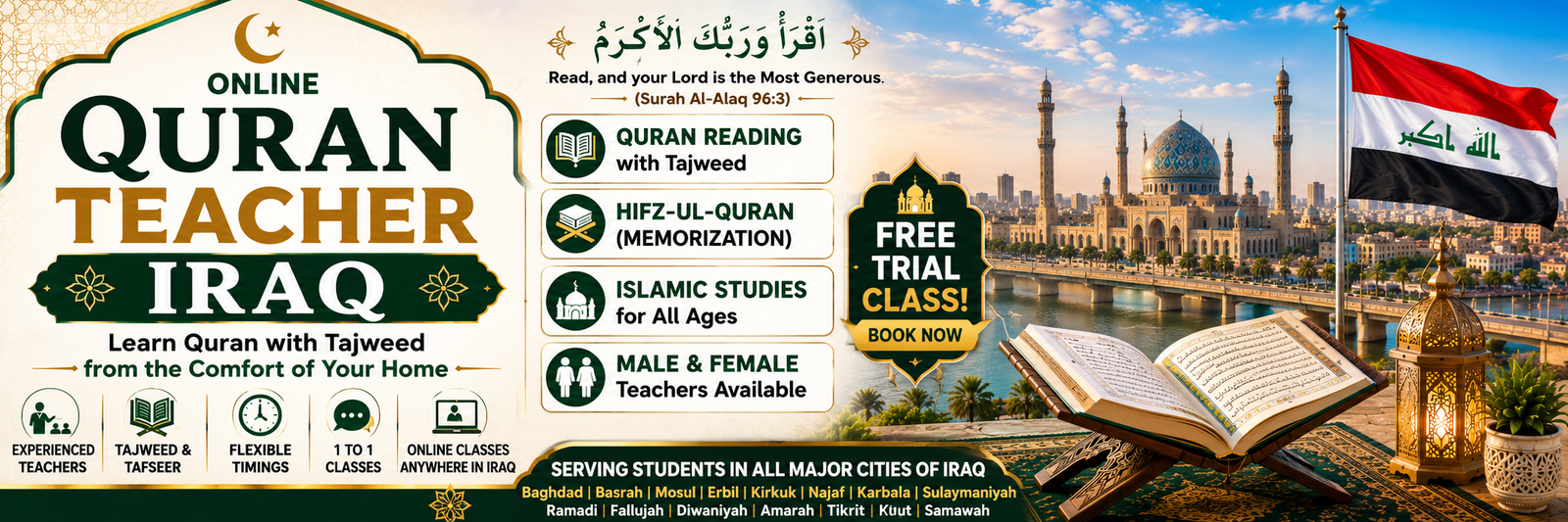
Quran Pak Teacher gives private one to one Quran lessons to students living in Iraq. Classes run on Zoom, Google Meet or Skype. Every teacher has memorised the whole Quran. Male and female teachers are both available. You pick the five days that suit your household, and your first lesson is free.
Quran learning in Iraq today
Iraq has around 46 million people and one of the oldest Quranic teaching traditions anywhere. This page is not written to replace that. It is written for the households it does not reach.
What group programmes already cover
The holy shrines in Najaf and Karbala run a wide network of Quranic stations. One shrine authority alone directly oversees 95 stations in Basra, Dhi Qar, Wasit, Najaf and Baghdad, and works with the national union of Quran reciters on roughly 260 stations across twelve provinces, staffed by more than a thousand instructors, with separate sections for men and women. Iraqi universities run their own Quran centres, including ones opened in Najaf in 2014 and in Fallujah in 2017. In the Kurdistan Region, one charity alone built 552 mosques across Duhok, Erbil, Sulaymaniyah, Kirkuk, Garmian and Mosul between 1992 and 2015.
What they do not cover
All of these are group programmes tied to a place and a fixed hour. A child who is slow on one letter waits for the class. A father on shift work cannot reach a station by six in the evening. A woman may not want to study in a hall at all. A family in a village outside Nasiriyah may have no station within a reasonable drive.
Private lessons answer one narrow need. One student, one teacher, at the hour your home is quiet.
Power cuts and weak signal
Iraqi families ask about this first, and no online academy answers it. Connection is not the shortage. Iraq had 39.6 million internet users at the end of 2025, close to 84 percent of the population, and 50.8 million mobile connections, more than one per person. Electricity is the shortage. The Kurdistan Regional Government has supplied as little as twelve hours a day in summer, and the national grid failed outright in August 2025.
So we built the lessons around it. Classes are 30 minutes and run on a phone using mobile data. If the power drops mid lesson, message the teacher. We finish the same day or add the time to the end of the month. You never pay for a lesson you did not receive.
Who these classes suit
Households whose hours do not match the timetable
Shift work, long commutes into Baghdad or Basra, a child in the afternoon school session. Any home where the family is free at a time no station is open.
Iraqi families living outside Iraq
Around 648,000 Iraq born people live in Western Europe. Germany is home to more than 500,000 people of Iraqi origin, in Berlin, Cologne, Hamburg, Munich, Frankfurt, Stuttgart and Hanover. Sweden has close to 146,000 Iraq born residents and a further 91,000 with an Iraqi born parent, concentrated in Stockholm, Södertälje and Malmö. Others live in the United Kingdom, the Netherlands, Jordan, Turkey, the United States, Canada and Australia.
For those families the worry is the same one every time. The children speak the local language at school and are losing their Arabic at home. A weekly mosque class is not enough to hold it.
Women and girls studying privately
Where privacy matters more than anything else, and where a female teacher is the condition rather than the preference.
Female Quran teachers for sisters and daughters
Our female teachers are Hafizas, meaning each has memorised the entire Quran. Ask for one when you book and we arrange it before the first class, not after.
A mother and daughter can take the same teacher in the same week, one after the other. Nothing from a lesson is recorded, kept or shared with anyone.
Our courses
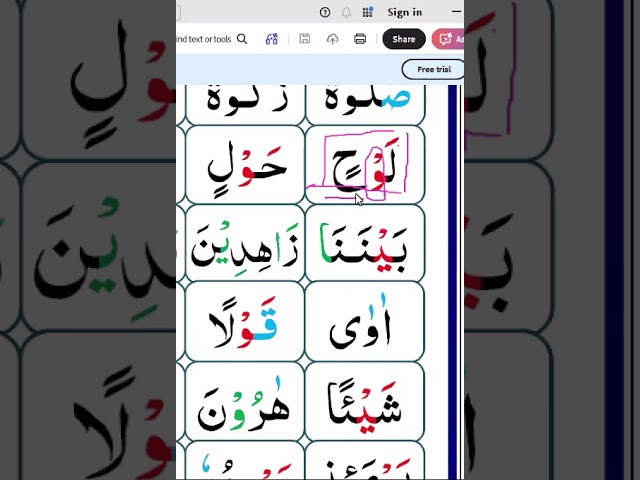
Noorani Qaida
Arabic letters, their shapes in each position, and the vowel marks. Written for young children and for learners who have never read Arabic script. See the Noorani Qaida course.
Nazra, reading from the Mushaf
Reading directly from the printed Quran, usually starting with the shorter surahs. See Quran reading with Tajweed.
Tajweed
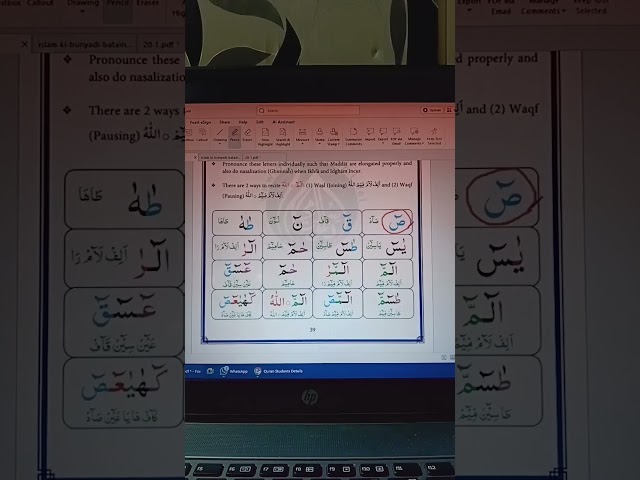
Most students in Iraq already speak Arabic and read fluently, so the problem is rarely the letters. It is habits picked up by ear. Madd lengths cut short, Ghunnah dropped, Qalqalah flattened, because nobody corrected them in the first year of reading. A teacher listening to one student hears these inside the first lesson. In a hall of thirty, nobody hears them at all.
Hifz, memorisation
Daily memorisation with revision, normally beginning with Juz Amma because it holds the surahs used in every prayer. See the memorisation course.
Tarjuma and Tafseer
Word meaning first, then explanation, verse by verse. See translation classes and the Tafseer course.
Islamic studies
Kalima, Namaz, daily duas and Hadith, taught alongside reading.
Quran classes for children in Iraq
Schools in Iraq run Sunday to Thursday, and the weekend is Friday and Saturday. The school year opens around the third week of September. Many schools run in shifts, so one child is home by early afternoon while another finishes late.
Tell us your five days and your hour, and we build the timetable around your household rather than the other way round. Most parents pick the gap after school and before Maghrib. Weekend classes are available.
Lessons are 30 minutes because that is how long a young child holds attention. A parent may watch any lesson, at any time, without asking first.
Quran classes for adults
Two kinds of adult book with us. The first reads well already but knows the recitation was never corrected. The second stopped years ago and wants to start again.
Neither is unusual, and neither is late. At a Quran competition in Karbala, the memorisers honoured on stage included a woman of 72 who had begun memorising at 66.
Lessons are private, so nobody else hears you repeat a verse until it is right.
Meet your teachers
Quran Pak Teacher is run by Islamic Quran Academy in Lahore and has taught online since 2020. Every teacher on staff has memorised the whole Quran and is checked before being given a student.
Teachers come from Egypt, Jordan and Saudi Arabia alongside teachers trained in Pakistan. For a student who already speaks Arabic, that matters in a specific way. A teacher who learned recitation formally can separate what is a dialect habit from what is a Tajweed error, which is the exact distinction most Iraqi students need.
Every class is one to one, so a mistake is corrected the moment it is made, not missed in a group of thirty. Parents may watch any lesson, at any time, without asking first.
You meet your teacher in the free lesson before you pay anything. If the fit is wrong, tell us and we change the teacher. Ask about a teacher’s qualifications when you book and we will tell you what they hold. Read more about the academy.
Fees and what is included
Thirty dollars a month. That covers twenty lessons of 30 minutes each, one to one, on the five days you choose. It works out near one dollar fifty a lesson.
The price is low because lessons are short and daily, not because the teaching is thin. Five short sessions a week is how Qaida and Hifz have always been taught. A student repeats a small amount every day instead of covering a lot once a week.
The first lesson is free. No card details and no deposit. You pay only after you have met the teacher and decided to carry on.
Payment is by Western Union, which has agent locations across Iraq and allows transfers out of the country. You can send from a counter in Baghdad, Basra, Erbil or any other city, or from the Western Union app. Send us the tracking number and we confirm the same day.
See the monthly fee plan for every course and our refund policy in full.
How to start
- Message +92 313 858 1672 on WhatsApp.
- Tell us the student’s age, current level, and whether you want a male or female teacher.
- Choose your five days and your hour. We send the link.
- Take the free lesson, then decide.
We reply the same day. You can also use our contact page.
What our students say
We have taught families in the United Kingdom, the United States, Canada and Australia since 2020.
Alhesam, North Carolina, United States “Not having any knowledge of the Arabic language, I was hesitant to try to learn and recite the Quran. I can’t believe the progress I have been making in a few short weeks. The teachers are very encouraging and helped me accomplish so much.”
Sara, London, England “I am very happy with Quran Pak Teacher. The teaching method and the resources available on the website are exceptional. My children look forward to every lesson with their teacher and are progressing well Alhamdulillah.”
We do not yet have a review from a student in Iraq. When our first family in Baghdad, Basra or Erbil finishes a term, their words go here. Every review we hold is on our students feedback page.
Where our students in Iraq live
Baghdad, Basra, Mosul, Erbil, Najaf, Karbala, Kirkuk, Sulaymaniyah, Duhok, Fallujah, Ramadi, Nasiriyah, Hillah, Samarra and Zakho.
Lessons are taught in Arabic and English. Recitation itself is taught in Arabic, so a child in Erbil, Sulaymaniyah or Duhok who speaks Kurdish at home can still study with us. Tell us which language the student is most comfortable in when you book and we match the teacher accordingly.
Book your free Quran class
Message +92 313 858 1672 with the student’s age and the days that suit you. We will confirm a time and send the link.
Contact us on WhatsApp for trial classes in Iraq
F.A.Q. GUIDE RELATED TO OUR ONLINE COURSES & CLASSES
By Western Union. There are agent locations across Iraq, and you can also send from the app. Nothing is paid until after the free lesson.
One-to-one classes are 30 minutes per student. In some cases, this can be increased up to 40 minutes.
Yes, certified female teachers are available for students who prefer one, ideal for children and female adult learners.
Noorani Qaida, Quran Reading with Tajweed, Quran Memorization (Hifz), Quran Tarjuma, and Quran Tafseer — suitable for kids, adults, and beginners.
Just a laptop, tablet, or smartphone with internet — classes run through Zoom and Microsoft Teams.
Yes, all tutors are experienced and trained to teach different age groups, from young kids to elderly beginners.
QuranPakTeacher.com is a trusted choice, offering certified tutors, flexible scheduling, and affordable plans starting from $30/month.
Yes. The courses follow a detailed plan suitable for all ages, from a 4-year-old child to an elderly adult, regardless of prior experience or qualifications whether you’re in or anywhere else.
If You Have Any Questions, Trial Classes & Registration


FEEL FREE TO ASK
Where We Provide Online Quran Classes
A tradition passed down for generations, now made easier, Iraqi families are learning Quran online with personal one-to-one classes built around their schedule.