Quran Teacher Monaco

Quran Teacher in Monaco: Online Lessons for Monaco and the Riviera
We teach the Quran online to students in Monaco and the French communes around it.
Lessons are one to one over Zoom or Google Meet. You get 20 lessons a month, Monday to Friday, 30 minutes each. Male and female teachers are available, and lessons are set to Central European Time.
You get three free trial classes before you decide anything.
We have taught online since 2020.
There Is No Mosque in Monaco
This is the fact that shapes everything else, and it is worth stating plainly.
Monaco has no mosque. Muslim residents cross into Beausoleil, on the French side of the border, to pray. The United States Department of State noted in its religious freedom reporting that high property prices make it difficult to build new places of worship in the principality.
What that means for a family here
No mosque also means no weekend madrasa, no children’s Quran circle, and no local teacher to ask for help.
A family in Nice or Marseille can enrol a child at a class down the road. In Monaco you cannot. There are only a few hundred Muslims in the whole principality, spread across four small districts, so there is no critical mass for a local class.
That is why online lessons exist for this area. It is not a matter of convenience. For most families here it is the only option.
Lessons Across Monaco and the Riviera
Monaco is less than one square mile. The border is a street, not a journey.
Lessons are available anywhere in the principality, including Monaco-Ville, Monte Carlo, La Condamine and Fontvieille. They are also available in Beausoleil, Cap d’Ail, Roquebrune-Cap-Martin, Menton and Nice.
Many people here live on one side of the border and work on the other. It makes no difference to the lesson. Both sides keep the same clock, so the same time slot works either way.
Lesson Times in Central European Time
Our teachers are in Lahore, Pakistan. The gap is small, so almost any hour of your day works.
The gap changes twice a year
Monaco is 4 hours behind us in winter and 3 hours behind in summer. That is because Monaco moves its clocks with the rest of Europe and Pakistan does not.
In winter, a 5:00 pm lesson in Monaco is 9:00 pm for your teacher. An 8:00 am lesson is midday here.
In summer the gap narrows by an hour, so the same 5:00 pm slot becomes 8:00 pm for the teacher.
The change happens twice a year
Europe moves its clocks on the last Sunday in March and the last Sunday in October.
If a slot you booked in winter no longer suits you in summer, tell us and we will move it. You do not need to work the difference out yourself.
Sounds That Are Hard for French Speakers
French helps you with some Arabic letters and works against you with others. Knowing which is which saves a lot of time.
Where French gives you an advantage
The French r in Paris and in rouge is made at the back of the throat. That is very close to where the Arabic ghayn (غ) is made.
Most learners find ghayn hard. If you speak French, you already produce a sound in the right place. The same position without voice gets you most of the way to kha (خ).
The biggest obstacle
French has no h sound at all. The letter is silent in homme and in heure.
That makes two Arabic letters difficult at once. Ha (ح) comes from deep in the throat, and the softer ha (ه) is closer to a breath. A French speaker has to build both from nothing, and telling them apart takes longer still.
This is the main difference between teaching a French speaker and teaching an English speaker, who at least has an h to start from.
Where the French advantage reverses
The Arabic ra (ر) is tapped with the tip of the tongue, near the front of the mouth. It is not the throat sound French uses.
A French speaker will reach for the uvular r without noticing. It is the mistake that most often goes uncorrected, because it sounds close enough to pass. A teacher who knows to listen for it will catch it in the first week.
Other letters to expect
Ayn (ع) has no French equivalent at all. It usually takes the longest.
Sad (ص), ta (ط), dad (ض) and dha (ظ) are heavier versions of sounds you know. Say the light letter, then say it again with the back of the tongue raised.
Qaf (ق) tends to come out as a plain k, as in carte. The real sound sits further back.
Vowel length
French puts the stress on the last syllable of a word. Arabic does not work that way.
Arabic stretches some vowels and not others. This is called madd, and it is a matter of length rather than stress. Getting it wrong changes the meaning of the word, so it is worth learning correctly at the start.
Starting From Zero
Some students here came to Islam as adults and have never read a word of Arabic.
You do not need any Arabic to begin. You do not need to have grown up around the language. You do not need to know a single letter.
Your first lesson is a conversation. Your teacher finds out what you can already do, what you want to reach, and how much time you have in a week. There is no test, and you will not be asked to read out loud before you are ready.
Lessons are private. Only you and your teacher are in the room. In a community this small, that matters more than it might elsewhere.
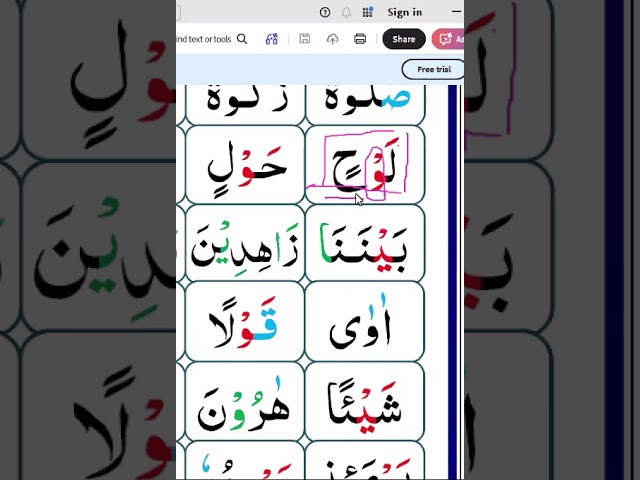
Noorani Qaida for Beginners
Beginners start with Noorani Qaida. Some people write it as Qaida Noorania. It is the same book.
The Qaida teaches the Arabic letters, then how letters join together, then the vowel marks, then simple words.
Skipping it causes problems later. Students who go straight to the mushaf often build reading habits that take longer to correct than they would have taken to learn properly.
After the Qaida you move to reading from the Quran itself. Most students begin at Juz 30, where the surahs are short.
Quran Reading and Tajweed
Tajweed is the set of rules for reciting the Quran correctly. Our full Quran reading course covers it step by step.
What it covers
The main area is makharij, which means where each letter is made in the mouth and throat.The rules that follow from it include ghunnah, qalqalah, idghaam, madd and the stopping signs.
How lessons work
Tajweed is taught out loud, not from a book alone.
Your teacher listens, stops you at the error, says the correct sound, and has you repeat it before moving on. A written explanation cannot fix a sound. Only a teacher listening in real time can.
How long it takes
On average it takes 6 to 12 months to read the Quran fluently with correct tajweed. For adults it is usually 6 to 8 months.
How fast you get there depends on how many lessons you take each week and how much you practise in between.
Memorising the Quran
Hifz is a long commitment, and we would rather say so than promise a quick result. Our Quran memorisation course is built around a steady daily target rather than a rush.
Most students begin with Juz 30 or a set of short surahs.
Revision is the part people underestimate. New pages do not hold unless older ones are repeated regularly. A student who memorises daily but revises rarely will lose most of it.
Hifz suits students who can practise on the days when there is no lesson. If that is not realistic right now, reading and tajweed are a better place to start.
Understanding the Meaning
Some students want to move past reading and into meaning.
We teach Tarjuma, which is translation, and Tafseer, which is explanation of the verses.
Tarjuma gives you the words. Tafseer
gives you the context and the meaning behind them.
These lessons suit new Muslims who can read the words but do not yet know what they mean. They also help parents who want to answer their children’s questions properly.
You can see all six programmes on our courses page.
Lessons for Adults
Many adults can recognise the Arabic letters from childhood but read slowly and know it.
That is one of the most common places we start, and there is nothing unusual about it. Lessons are one to one, so nobody else hears the mistakes.
Adults who want a female teacher should say so when they get in touch. You can read what our students have said about starting later in life.
Fees and Your Free Trial
The fee is €30 a month for 20 lessons.
That is Monday to Friday, 30 minutes a day, one to one with the same teacher throughout. Full details are on our monthly fee page.
You get three free trial classes first, and no payment is needed to book them.
We also publish a refund policy so you know where you stand before you pay anything.
How to Begin
Message us on WhatsApp at +92 313 858 1672, or use the contact form.
Tell us three things: which commune you are in, whether the lessons are for you or your child, and whether you would prefer a male or female teacher.
We will suggest a time in your local hours. You take the three trial classes and decide afterwards.
Contact us on WhatsApp for trial classes in Monaco
F.A.Q. GUIDE RELATED TO OUR ONLINE COURSES & CLASSES
Yes, absolutely. QuranPakTeacher.com provides live one-on-one online Quran classes for students in Monaco, Monte Carlo, La Condamine and Fontvieille, taught by certified male and female tutors via Zoom and Microsoft Teams.
One-to-one classes are 30 minutes per student. In some cases, this can be increased up to 40 minutes.
Our classes start from $30 per month, which includes 20 classes (Monday to Friday), each 30 minutes long, on a one-on-one basis with a dedicated tutor.
Yes, we have certified female teachers available for students who prefer a female tutor, ensuring comfort and ease for both children and adult learners.
We offer Noorani Qaida, Quran Reading with Tajweed, Quran Memorization (Hifz), Quran Tarjuma, and Quran Tafseer — suitable for kids, adults, and elderly learners.
Yes, class timings are fully flexible, and we do our best to match you with a tutor available in your preferred time slot, accounting for Monaco’s time zone.
Just a laptop, tablet, or smartphone with a stable internet connection. We conduct classes through Zoom and Microsoft Teams.
Yes, we offer free trial classes so students in Monaco can experience our teaching style and decide if it’s the right fit before enrolling.
If You Have Any Questions, Trial Classes & Registration



FEEL FREE TO ASK
Where We Provide Online Quran Classes
Life in Monaco moves fast, between business, travel, and busy schedules, but Quran learning doesn’t have to wait, join our flexible one-to-one online classes, thoughtfully designed around your routine and learning pace, no matter how packed your day is.