
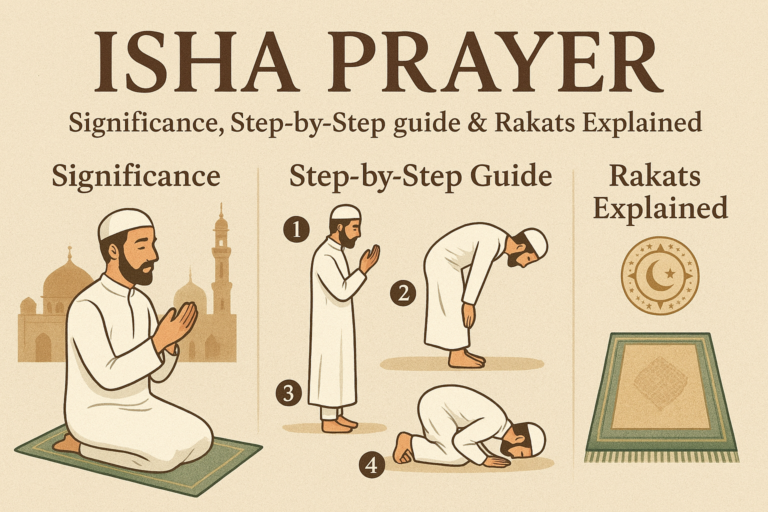
Significance of Isha Prayer
The Isha prayer, also known as Isha Namaz, is the night prayer and the fifth obligatory daily prayer in Islam. It is the final daily prayer among the five daily prayers, performed in the darkness of evening, after Maghrib prayer, until midnight, and before Fajr at dawn. This prayer marks the end of the day, offering spiritual closure, a peaceful ending, and peace before sleep. It brings calm, tranquility, reflection, gratitude, and remembrance of Allah, allowing believers to seek forgiveness, mercy, blessings, and immense reward.
Praying Isha builds strong faith, strengthens discipline, improves time management, and protects the heart from laziness and worldly distractions. When performed in congregation, it creates unity, brotherhood, and compassion, with rewards equal to half the night, and when paired with Fajr prayer, the reward of the whole night, as emphasized by Prophet Muhammad (peace be upon him) in authentic hadiths.
Preparation for Isha Prayer
Before starting Isha, perform wudu (ablution) as ritual cleansing. This includes washing hands, rinsing mouth, sniffing water into the nostrils, washing face and arms, wiping head, and washing feet. This fundamental ritual purifies both body and soul. Make niyyah (intention) with a sincere intention in the heart, for the sake of Allah, preparing mentally with sincerity and devotion.
Facing the Qibla and Beginning the Prayer
Stand upright on the prayer mat, facing the Qibla, the direction of the Kaaba in Mecca. Raise your hands to the ears and say Takbir (Allahu Akbar), meaning God is the Greatest, which marks the official start of the prayer.
Rakats Explained (Complete Structure)
The correct structure of Isha Namaz includes several types of rakats, each with its own importance:
4 Rakats Sunnah Ghair Mu’akkadah – non-obligatory, recommended, an optional warm-up bringing extra blessings.
4 Rakats Fard – obligatory and compulsory; missing them without a valid reason is sinful.
2 Rakats Sunnah Mu’akkadah – highly recommended and always prayed by the Prophet, performed after Fard.
2 Rakats Nafl – optional, offering extra reward; Allah loves voluntary prayers.
3 Rakats Witr (Wajib) – essential, including Dua-e-Qunoot, a specific supplication recited before Ruku in the final rakat.
Step-by-Step Method of Performing Isha Namaz
In each rakat, recite Surah Al-Fatihah and another Surah from the Quran. In the first two rakats, recitation may be audible, while the last two rakats are silent. Common choices include Surah Al-Ikhlas and Surah Al-Kawthar. Perform Ruku (bowing) with hands on knees, saying Subhana Rabbiyal Azeem three times, rise to Qiyam, then go into Sujood (prostration) saying Subhana Rabbiyal A’la, with a brief Jalsa in between.
After completing the rakats, recite the Tashahhud, including Durood, and end the prayer with Tasleem, turning the head right and left and saying Assalamu alaikum wa rahmatullah.
Rewards and Final Reflection
The Isha prayer purifies the soul, removes sins, brings barakah, and grants emotional comfort and peaceful sleep. Angels provide protection through the night, and the believer rests with a heart connected to Allah. Learning Isha properly through Our Courses, with an affordable Monthly fee and a Free trail, can help build consistency and confidence in daily worship.