
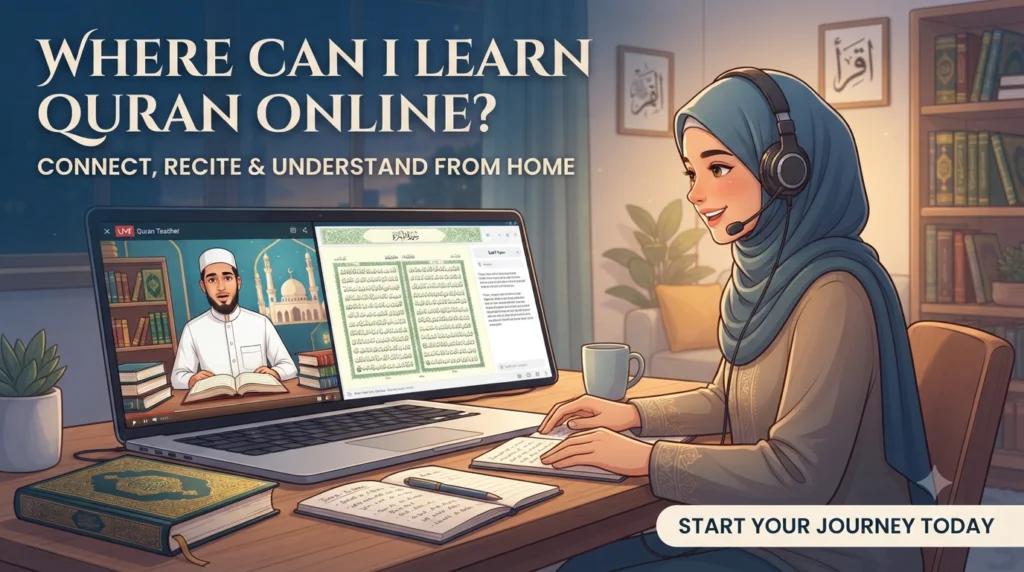
Where Can I Learn Quran Online?
A Simple Guide to Finding the Right Quran Teacher
If you’ve been searching for a way to learn Quran online, you’re not alone. Thousands of people ask this same question every month. Maybe you want to read Arabic properly for the first time. Maybe you want your kids to learn Tajweed. Or maybe you just never had the chance to study with a Quran teacher growing up, and now you do.
Whatever your reason, the good news is this: learning Quran online today is easier, safer, and more affordable than it’s ever been. But with so many websites, apps, and academies out there, picking the right option can feel confusing.
This guide walks you through exactly where to learn, what to look for in a Quran teacher, and how to avoid wasting time and money on the wrong program.
Why Online Quran Learning Has Become So Popular
A few years ago, learning Quran usually meant finding a local mosque, a community teacher, or a madrasah nearby. That worked fine if you lived near one. But not everyone does.
Online Quran classes solve that problem. You can now learn from a qualified teacher in Cairo, Medina, or Karachi while sitting in your living room in London, Toronto, or Sydney.
Here’s what makes online learning appealing for most students:
- You choose the time that fits your schedule.
You learn one-on-one instead of in a crowded classroom. - You can pick a teacher based on their teaching style, not just location.
Classes are often cheaper than in-person tuition. - Kids, working adults, and even seniors can all learn at their own pace.
Where Can You Actually Learn Quran Online?
There are three main routes people take. Each one has its pros and cons.
1. Dedicated Online Quran Academies
These are platforms built specifically for Quran education. They usually offer:
- One-on-one live classes with a qualified Quran teacher
- Structured courses for Quran reading, Tajweed, Hifz (memorization), and Tafsir
- Separate programs for kids and adults
- Female teachers available for sisters and children, if preferred
This is usually the best option if you want steady progress and real accountability. A good academy will also track your progress and assign homework between sessions.
2. Freelance Online Quran Teachers
Some qualified teachers offer private lessons through video call apps like Zoom or Skype, without being tied to a big academy. This can be more flexible and sometimes cheaper.
The downside is that it’s harder to check their credentials. You’re relying more on personal referrals or trial classes to know if they’re a good fit.
3. Quran Learning Apps
Apps are useful for quick daily practice, especially for reading Arabic letters or reviewing memorization. But most apps can’t replace a real teacher. Tajweed (correct pronunciation) is something you learn best by listening and being corrected live, not from a recording.
Our take: apps work well as a supplement, not a replacement. A structured academy with live classes is still the most reliable way to actually learn.
What Makes a Good Online Quran Teacher?
Not every online Quran teacher is the same. Before you sign up anywhere, check for these things.
1. Proper Ijazah or Certification
An Ijazah is a certificate that shows a teacher has studied Quran recitation directly under a qualified scholar and has permission to teach it themselves. Ask any potential teacher if they hold one, and in which style of recitation (commonly Hafs ‘an Asim).
2. Native Arabic Pronunciation
Tajweed depends on hearing correct pronunciation. A teacher who is a native Arabic speaker, or trained extensively in Tajweed, will catch mistakes a non-specialist might miss.
3. Experience Teaching Beginners
Teaching an adult who has never read Arabic before is very different from teaching someone who already reads fluently. Ask if the teacher has experience with your specific level.
4. Teaching Style That Matches You (or Your Child)
Some teachers are strict and structured. Others are more relaxed and encouraging. If you’re enrolling a child, a patient teaching style usually works better than a rigid one.
5. A Trial Class
Any serious Quran teacher or academy should offer a free trial class. This lets you test the connection quality, the teacher’s communication, and whether the pace suits you, before you commit money.
How Online Quran Classes Usually Work
Most online quran classes follow a similar structure, whether you’re a total beginner or already know how to read:
- Assessment – The teacher checks your current level in a short first session.
- Personalized plan – Based on your level, they set a learning path, starting with the Noorani Qaida online course, then moving into online Quran reading with Tajweed.
- Live one-on-one sessions – Usually 30 to 60 minutes, a few times a week.
- Practice between classes – You review what you learned before the next session.
- Progress tracking – Good teachers keep notes on what you’ve covered and what needs more work.
This structure is what separates real learning from just watching videos. You get feedback in real time, which is exactly what you need when learning correct pronunciation.
Quran Classes for Kids vs. Adults
For Kids
Children usually need shorter sessions, more repetition, and a teacher who keeps them engaged. Look for academies that offer:
- Female teachers for young girls, if that’s a preference
- Interactive tools like on-screen writing boards
- Regular parent updates on progress
For Adults
Adults often want faster progress and more flexible timing. Many working professionals prefer early morning or late evening classes. Adult learners also benefit from an online Quran Tafseer course or an online Quran Tarjuma course, since understanding the meaning and translation of the verses adds a deeper layer to their learning that young children usually aren’t ready for yet.
How Much Do Online Quran Classes Cost?
Prices vary a lot depending on the platform, the teacher’s experience, and how many classes per week you choose. As a general range:
- Group classes: usually the most affordable option
- One-on-one classes: cost more, but progress faster
- Package deals: monthly plans are often cheaper per class than paying session by session
Always ask exactly what’s included in the price. Some platforms charge extra for materials, certificates, or replacement classes if you miss a session. You can check a sample Quran classes fee plan to see how monthly packages are usually structured.
Common Mistakes to Avoid
- Skipping the trial class: Never pay for a full package before testing one session. Reading real student feedback and testimonials first can also help you know what to expect.
- Ignoring the teacher’s credentials: A friendly teacher isn’t always a qualified one.
- Choosing based on price alone: The cheapest option isn’t always the best value if the teaching quality is poor.
- Expecting instant results: Reading Quran correctly and memorizing it both take consistent time and practice.
- Not checking internet and platform reliability: A great teacher can’t help much if your video calls keep dropping.
Final Thoughts
Learning Quran online isn’t just a trend. It’s now one of the most practical ways for people around the world to study with qualified teachers, no matter where they live. The key is choosing carefully: check credentials, try a free class first, and make sure the teaching style fits you or your child.
A good Quran teacher does more than teach reading. They guide you patiently, correct your mistakes, and help you build a habit that lasts. Take your time comparing a few options, and start with the platform that feels right for your goals and your schedule.
If you’re ready to start, you can explore all our Quran learning courses or contact us to book a free trial class with a qualified Quran teacher today.