
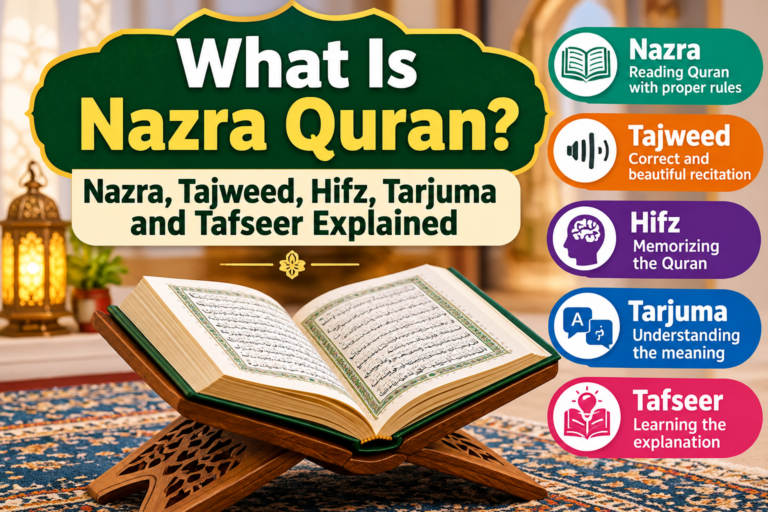
Nazra Quran means reading the Quran by looking at the text, in Arabic, from start to finish. It is the first full course most students take after Noorani Qaida.
The other four terms describe what comes with it or after it:
- Nazra: reading the Quran from the page, fluently and correctly.
- Tajweed: the rules for saying each letter and word the right way while you read.
- Hifz: memorizing the Quran, in part or in full, so you can recite it without looking.
- Tarjuma: translating the Quran word by word into a language you understand, such as Urdu or English.
- Tafseer: explaining what the verses mean, why they were revealed, and how they apply to life.
In short, Nazra and Tajweed teach you to read, Hifz teaches you to remember, and Tarjuma and Tafseer teach you to understand.
What Is Nazra Quran?
Nazra is reading the Quran while looking at the Mushaf. The word comes from the Arabic nazar, which means to look. In Pakistan and India, “Nazra” or “Nazra Quran” is the common name for the Quran reading course.
What students learn in Nazra:
- Joining letters into words and words into full verses
- Reading with the right vowel sounds (Fatha, Kasra, Damma)
- Stopping and pausing at the correct signs
- Reading at a steady pace without spelling words out
- Reading the whole Quran once, from Surah Al-Fatiha to Surah An-Nas
Who it is for: children who have finished Noorani Qaida, and adults who know the letters but cannot yet read the Quran smoothly.
Finishing your first full reading is often called completing the Quran, or khatam. Many families mark the day with a small gathering.
One point people often miss: Nazra does not include the meaning. A student can read every page correctly and still not know what it says. Understanding comes later, with Tarjuma and Tafseer.
What Is Tajweed?
Tajweed is the set of rules for pronouncing the Quran correctly. The word comes from the Arabic root j-w-d, which means to make something good or excellent.
What Tajweed covers:
- Makharij: where in the mouth and throat each letter is made
- Sifaat: the qualities of each letter, such as heavy or light
- Noon Sakin and Tanween rules: Izhar, Idgham, Iqlab and Ikhfa
- Madd: how long to stretch certain vowels
- Qalqalah and Ghunnah: the bouncing letters and the nasal sound
- Waqf: where to stop and where to keep reading
Why it matters: in Arabic, one wrong sound can change a word’s meaning. Many scholars hold that reciting without clear mistakes is required of every Muslim, while knowing the names of all the rules is not required of everyone.
How it fits with Nazra: Tajweed is not a separate step you take after reading. A good teacher teaches Nazra with Tajweed from the first lesson, so the student never builds bad habits. Some students who already read fluently take a separate Tajweed course later to fix old mistakes.
To see the signs printed in the Mushaf, read our guide to the 18 Tajweed symbols in the Quran.
What Is Hifz?
Hifz is memorizing the Quran so you can recite it without looking. A man who memorizes the whole Quran is called a Hafiz, and a woman is called a Hafiza.
How Hifz works day to day:
- Sabaq: the new lines memorized that day
- Sabqi: revision of the last few days’ lessons
- Manzil: revision of everything memorized so far
Revision is the hard part. Memorizing new pages is easier than keeping the old ones fresh, which is why a good Hifz plan spends more time on revision than on new lessons.
Who it suits: students who can already read with Tajweed. Starting Hifz before reading correctly means memorizing mistakes, and those are hard to undo.
Hifz does not have to mean the whole Quran. Many students memorize Juz Amma, the 30th part, or a set of Surahs for daily prayers.
Not sure when to start a child? See our post on the right age to start online Hifz.
What Is Tarjuma?
Tarjuma is translating the Quran into a language you understand. The word comes from the Arabic tarjamah, meaning translation, and it is the everyday term in Urdu.
There are two common ways to learn it:
- Word-by-word Tarjuma (lafzi): you learn the meaning of each Arabic word in order. This is slower, but you start to recognize words when you hear them in Salah.
- Sentence Tarjuma (bamuhavara): you learn the meaning of each verse as a whole, in natural Urdu or English. This is quicker and easier to follow.
What students gain: you finally know what you are reading. Many students say their Salah feels different once they understand the Surahs they recite every day.
What Tarjuma does not do: it gives the meaning of the words, not the full explanation behind them. That is the job of Tafseer.
What Is Tafseer?
Tafseer is the explanation of the Quran. The word comes from the Arabic fassara, which means to explain or make clear.
What Tafseer covers that Tarjuma does not:
- The reason a verse was revealed (asbab al-nuzul)
- What the Prophet ﷺ and his Companions said about it
- How one verse links to other verses on the same topic
- Rulings and lessons taken from the verse
- Context about the people, places and events the verse mentions
An example shows the difference. The Tarjuma of a verse tells you what it says. The Tafseer tells you who it was about, what was happening at the time, and what Muslims should take from it today.
Who it suits: adults and older teenagers who already read the Quran and want to understand it deeply. It works best after Tarjuma, or alongside it.
New to Tafseer? Start with our Quran Tafsir for beginners guide.
In What Order Should You Learn Them?
Most students follow the same path. Reading comes first, and then the path splits into memorizing, understanding, or both.
- Noorani Qaida: learn the Arabic letters, their sounds and how they join.
- Nazra with Tajweed: read the full Quran fluently, with correct pronunciation.
- Then choose one route, or take both side by side:
- Hifz: memorize the Quran, part or whole.
- Tarjuma, then Tafseer: learn what the words mean, then learn the full explanation.
A few points about this order:
- Reading comes before memorizing: Hifz without correct reading locks mistakes in.
- You do not have to finish Hifz before learning meaning: Many adults skip Hifz and go straight to Tarjuma after Nazra.
- Tarjuma and Tafseer can run together: Some students study the translation and explanation of each Surah at the same time.
Which One Should You Start With?
It depends on what you can already do. Find yourself below.
My child is 4 to 7 and has not started: Start with Noorani Qaida. Move to Nazra once your child can read joined letters with vowel marks.
My child finished Qaida: Start Nazra with Tajweed. Do not skip to Hifz yet.
I am an adult and cannot read Arabic at all: Start with Noorani Qaida too. Adults often move faster than children, so it will not take as long as you fear.
I read the Quran, but I was never taught Tajweed: Take a Tajweed course to correct your reading. Your teacher will listen first and fix your most common mistakes.
I read well and want to memorize: Start Hifz. Begin with Juz Amma or the Surahs you recite in Salah.
I read well and want to understand: Start Tarjuma. Add Tafseer once you are comfortable with the word meanings.
I am not sure where I stand: Book a trial class. A teacher can place you at the right level after hearing you read for a few minutes.
How Long Does Each One Take?
Time depends on age, how many classes a week you take, and how much you practice between them. These ranges assume a 30-minute class, five days a week.
- Noorani Qaida: usually a few months. Young children take longer than adults.
- Nazra with Tajweed: about 8 to 12 months for an adult to read the full Quran. Children often need longer.
- Hifz of the full Quran: several years. Juz Amma alone can take a few months.
- Tarjuma and Tafseer: these depend most on depth. A short course on selected Surahs may take months, while the full Quran takes much longer.
Ten minutes of reading at home each day speeds up every one of these. Students who only read in class move slowest.
Learn All Five at Islamic Quran Academy
Islamic Quran Academy teaches every stage of this path in one-on-one online classes:
- Noorani Qaida for beginners of any age
- Quran reading with Tajweed, our Nazra course
- Hifz, for part or all of the Quran
- Tarjuma, the meaning of the Quran in Urdu
- Tafseer, for a deeper understanding
Every teacher is a Hafiz or Hafiza. You can choose a male or female teacher, and lessons are explained in English or Urdu. Students start from age 4, and adults are welcome at every level.
Not sure which course fits? Book three free trial classes. Your teacher will hear you read and suggest where to start. Contact us on WhatsApp or see our fee plans.